Nov 6, 2025
Benefits of Emotional Data: The Essential Guide
Discover the benefits of emotional data in AI coaching. Learn core concepts, real-world applications, privacy, and integration with WhatsApp AI assistants.

Benefits of Emotional Data: The Essential Guide
Researchers estimate that over 90 percent of human communication relies on emotional cues, not just words. In our data-driven world, decoding these subtle signals has never been more important. Understanding emotional data opens new doors to personal growth, better relationships, and smarter technology. Whether you’re curious about how machines read emotions or how these insights shape real-life connections, uncovering the layers of emotional data reveals how feelings become measurable—and meaningful.
Table of Contents
Defining Emotional Data And Core Concepts
Types Of Emotional Data And Detection Methods
How Emotional Data Powers AI Coaching
Practical Applications In Relationships And Growth
Privacy, Security, And Responsible Use Considerations
Key Takeaways
Point | Details |
|---|---|
Understanding Emotional Data | Emotional data captures complex human feelings through various measurable signals, including physiological, facial, vocal, behavioral, and neurological indicators. |
AI and Emotional Intelligence | Emotional data enhances AI coaching by enabling real-time emotion recognition and personalized interaction strategies that cater to user-specific psychological needs. |
Applications in Personal Development | Leveraging emotional intelligence transforms relationship dynamics, improving communication, conflict resolution, and empathy among individuals. |
Privacy Considerations | Ethical management of emotional data is crucial, requiring user consent, data anonymization, and robust privacy protections to safeguard personal information. |
Defining Emotional Data and Core Concepts
Emotional data represents the quantifiable and interpretable information about human feelings, psychological states, and behavioral responses. According to research from arXiv, emotional data encompasses complex metrics that capture the nuanced landscape of human emotional experiences through technological and psychological lenses.
At its core, emotional data involves collecting and analyzing signals that reveal underlying psychological patterns. Wikipedia explains that emotions are not fixed states but dynamically constructed experiences influenced by social contexts, personal memories, and neurological processes. This means emotional data isn’t just about measuring a single feeling, but understanding the intricate web of factors generating that emotional response.
Key components of emotional data typically include:
Physiological measurements (heart rate, skin conductance)
Facial expression analysis
Vocal tone and speech pattern recognition
Contextual behavioral indicators
Neurological brain activity mapping
Understanding emotional data requires recognizing its multidimensional nature. Humans don’t experience emotions as simple, linear experiences but as complex, interconnected psychological events. By breaking down these events into measurable components, researchers and technologists can gain unprecedented insights into human behavior and psychological functioning.

For a deeper exploration of related concepts, read our comprehensive guide on emotional intelligence.
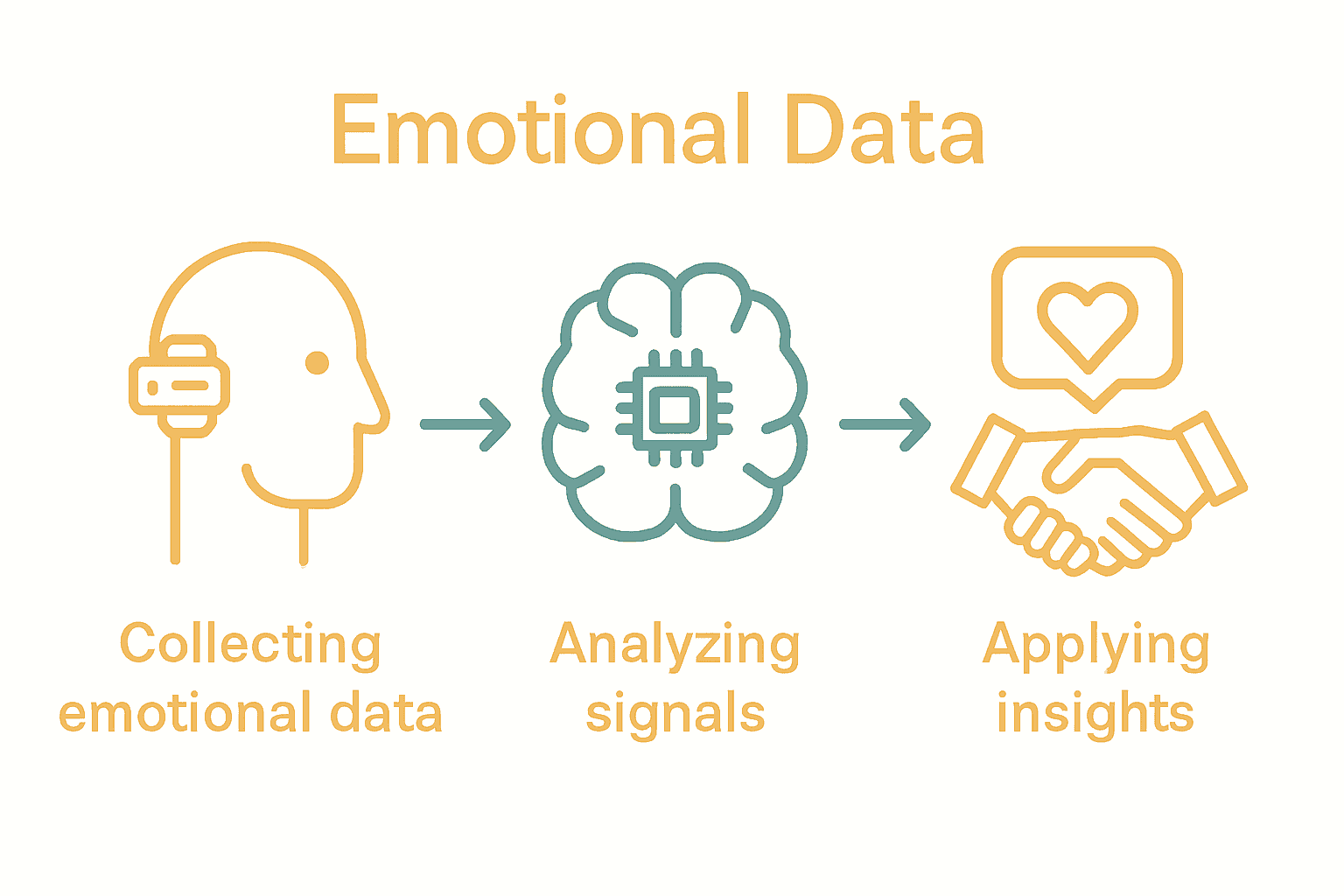
The emerging field of affective computing continues to refine our ability to capture, interpret, and leverage emotional data. This technological approach transforms abstract emotional experiences into structured, analyzable information sets that can inform everything from mental health interventions to user experience design.
Types of Emotional Data and Detection Methods
Emotional data collection involves sophisticated techniques that capture human psychological states through multiple modalities. arXiv research highlights the complexity of emotion recognition, particularly through context-based image annotation methods that reveal nuanced emotional landscapes.
Detection methods range from physiological tracking to advanced computational approaches. According to research from Journals Karary, electroencephalography (EEG) has emerged as a powerful tool for measuring emotional states by analyzing brain wave patterns and neurological responses.
Key types of emotional data detection include:
Here’s a summary of main emotional data types and their detection methods:
Emotional Data Type | Example Signals | Common Detection Methods |
|---|---|---|
Physiological | Heart rate | Wearable sensors |
Facial Expression | Smiling | Computer vision |
Vocal Tone | Pitch | Speech analysis |
Behavioral | Social interactions | Context tracking |
Neurological | Brain waves | Neuroimaging |
Visual recognition (facial expressions)
Vocal tone analysis
Physiological signal monitoring
Contextual behavioral tracking
Neurological brain wave assessment
Modern emotional data detection leverages artificial intelligence and machine learning algorithms to transform raw emotional signals into meaningful insights. These technologies can decode complex emotional patterns by analyzing multiple data streams simultaneously. For deeper insights into this fascinating field, explore our guide on emotional superintelligence.
Emerging technologies are continuously expanding our ability to capture emotional data with unprecedented precision. From wearable devices tracking micro-expressions to advanced neural network models interpreting subtle emotional cues, the future of emotional data detection promises increasingly sophisticated and nuanced understanding of human psychological experiences.
How Emotional Data Powers AI Coaching
Emotional data serves as the fundamental infrastructure enabling AI coaching systems to deliver nuanced, personalized guidance. arXiv research introduces Emo2Vec, a groundbreaking method for encoding emotional semantics into vector representations, dramatically enhancing AI’s capacity to understand and interpret human emotional complexity.
At the core of AI coaching, emotional intelligence algorithms transform raw emotional signals into actionable insights. Wikipedia highlights how advanced emotion AI technologies analyze facial expressions and vocal intonations, allowing systems to detect subtle emotional states with unprecedented precision.
Key mechanisms of emotional data powering AI coaching include:
Real-time emotion recognition
Contextual emotional pattern analysis
Personalized response generation
Adaptive communication strategies
Predictive emotional trajectory mapping
AI coaching leverages emotional data to create deeply personalized interaction models that adapt dynamically to individual psychological landscapes. These systems can detect emotional nuances, predict potential emotional challenges, and provide targeted guidance tailored to each user’s unique emotional profile. To explore the broader implications of this technology, check out our guide on AI emotional intelligence.
The future of AI coaching lies in its ability to transform emotional data into meaningful, supportive interactions. By integrating advanced machine learning algorithms with sophisticated emotional recognition technologies, these systems are evolving from simple response generators to intelligent, empathetic digital companions capable of providing nuanced emotional support and guidance.
Practical Applications in Relationships and Growth
Emotional intelligence transforms how we navigate relationships and personal development. Wikipedia reveals the affect-as-information hypothesis, which demonstrates how our emotional experiences provide critical insights into decision-making and interpersonal dynamics.
Understanding emotional data enables individuals to decode complex relationship patterns with unprecedented depth. Wikipedia explores how emotions fundamentally shape social interactions, highlighting the intricate connections between feelings, communication, and personal growth.
Practical applications of emotional data in relationships include:
Enhanced communication strategies
Conflict resolution techniques
Empathy skill development
Emotional trigger identification
Relationship pattern recognition
Stress management approaches
By leveraging emotional intelligence, individuals can transform potential relationship challenges into opportunities for deeper connection and mutual understanding. Emotional data provides a roadmap for navigating complex interpersonal landscapes, offering insights that traditional communication methods often miss. For those seeking to deepen their emotional awareness, our guide on transforming relationships offers comprehensive strategies.
The ultimate power of emotional data lies in its ability to bridge understanding between individuals. It transcends verbal communication, revealing underlying psychological dynamics that shape our most intimate connections. As we continue to develop more sophisticated emotional intelligence tools, we unlock new possibilities for personal growth, empathy, and meaningful human connections.
Privacy, Security, and Responsible Use Considerations
Emotional data privacy represents a critical frontier in technological ethics and personal protection. Wikipedia highlights the emerging challenges of emotion AI technologies, which analyze deeply personal emotional signals through facial and vocal expressions, raising significant questions about consent and data protection.
Responsible data collection demands rigorous ethical frameworks to protect individual autonomy and psychological boundaries. arXiv research on the EMOTHAW database underscores the complexity of collecting emotional data while maintaining strict privacy standards and protecting personal information.
Key privacy considerations in emotional data management include:
Explicit user consent mechanisms
Data anonymization techniques
Transparent data usage policies
Secure encryption protocols
User control over personal emotional information
Limited data retention periods
Navigating the delicate balance between technological innovation and personal privacy requires continuous dialogue and robust protective measures. Emotional data technologies must prioritize user trust, implementing stringent safeguards that respect individual psychological boundaries. For insights into maintaining privacy in digital communication platforms, explore our guide on privacy in family chat apps.
The future of emotional data technologies hinges on establishing trust through responsible use. By developing transparent, user-centric approaches that prioritize individual agency and psychological safety, we can unlock the transformative potential of emotional intelligence while maintaining the highest ethical standards.
Unlock the Power of Emotional Data with Wisdom App
The article highlights how emotional data reveals the intricate landscape of human feelings and psychological states helping us better understand relationships and personal growth. If you are seeking to transform raw emotional signals into actionable insights for your love life, work, family, or friendships, Wisdom App is designed specifically for you. This AI-powered emotional and relationship coach understands your unique emotional patterns in real time and adapts its guidance to fit your conversations seamlessly inside WhatsApp.

Start harnessing the benefits of emotional data by experiencing a superintelligent AI agent built to detect emotions, predict outcomes, and provide context-aware advice. Improve your emotional awareness and relationship skills now by signing in to Wisdom App. For a deeper dive into emotional intelligence and personal growth, explore our guide on emotional intelligence and discover strategies in our emotional superintelligence guide. Take the next step toward smarter, more compassionate conversations today.
Frequently Asked Questions
What is emotional data?
Emotional data refers to quantifiable information about human feelings and psychological states, encompassing various metrics that capture the complexity of emotional experiences.
How is emotional data collected and detected?
Emotional data is collected through various methods, including physiological measurements (like heart rate), facial expression analysis, vocal tone recognition, and context-based behavioral indicators.
What are the practical applications of emotional data in relationships?
Emotional data can enhance communication, improve conflict resolution, develop empathy skills, and identify emotional triggers, which all contribute to deeper connections and personal growth.
What are the privacy considerations regarding emotional data?
Key privacy considerations include obtaining explicit user consent, implementing data anonymization techniques, maintaining transparent data usage policies, and allowing users control over their personal emotional information.
Recommended