Jan 7, 2026
AI in Personal Growth 2025: Transforming Emotional Intelligence
AI emotional coach apps like Wisdom reshape personal growth in 2025, offering real-time emotional insights, strategic advice, and privacy-first support.

AI in Personal Growth 2025: Transforming Emotional Intelligence
Over 60 percent of american Millennials and Gen Z actively use messaging platforms for advice and self-improvement. The rise of AI-powered personal growth tools is changing how global users learn about their emotions and relationships, making guidance more immediate and personalized. Discover how artificial intelligence can become your trusted partner for developing emotional intelligence and deeper connections, all through a secure WhatsApp experience designed for those who value privacy and meaningful progress.
Table of Contents
AI In Personal Growth: Core Concepts
Types Of AI Coaching For Self-Improvement
How Relationship Superintelligence Works
Ethical And Privacy Considerations In AI Coaching
Practical Benefits And Real-World Results
Key Takeaways
Point | Details |
|---|---|
AI Empowers Personal Growth | AI technologies personalize emotional intelligence development, offering tailored insights and growth pathways. |
Types of AI Coaching | Different AI coaching frameworks focus on psychological behavior modification, productivity enhancement, and emotional intelligence. |
Ethical AI Considerations | Ethical implementation is crucial, ensuring user data privacy and informed consent in AI coaching tools. |
Practical Benefits of AI Coaching | AI coaching delivers measurable improvements in learning retention, skill development, and self-awareness through data-driven strategies. |
AI in Personal Growth: Core Concepts
AI is fundamentally transforming how individuals understand and develop their emotional intelligence and personal capabilities. At its core, artificial intelligence provides unprecedented opportunities for self-awareness and strategic personal development through adaptive learning technologies. Modern AI systems can now analyze complex emotional patterns, provide personalized insights, and create customized growth pathways that were previously impossible.
The emerging field of AI-powered personal growth leverages sophisticated machine learning algorithms to understand individual learning needs and support self-directed development. These advanced systems go beyond traditional coaching by integrating generative AI techniques that can dynamically adapt recommendations based on real-time emotional and behavioral data. By processing nuanced human interactions, AI can identify subtle patterns in communication, emotional response, and interpersonal dynamics that humans might easily miss.
Technological innovations are enabling AI to become a sophisticated emotional intelligence partner. Key capabilities include live emotion detection, predictive communication analysis, and context-aware guidance across different relationship domains. AI systems can now statistically predict potential interaction outcomes, provide strategic communication recommendations, and help individuals develop more effective emotional skills. These tools are not replacing human connection but augmenting our natural ability to understand ourselves and others more deeply.
While AI presents remarkable potential, successful implementation requires understanding its core learning methodologies. Researchers are developing frameworks that emphasize learner agency and personalized growth strategies, ensuring that technological support remains human-centered and ethically designed. The goal is not to replace human judgment but to provide intelligent, supportive guidance that empowers personal transformation.
Pro tip: Start by selecting an AI-powered personal growth tool that offers emotion tracking and provides actionable insights tailored to your specific communication and relationship patterns.
Types of AI Coaching for Self-Improvement
Artificial intelligence has revolutionized personal development by creating diverse coaching approaches that address different dimensions of human growth and potential. Modern AI coaching systems offer sophisticated methodologies for tracking behavioral patterns and providing targeted self-improvement strategies, enabling individuals to unlock unprecedented levels of personal transformation.
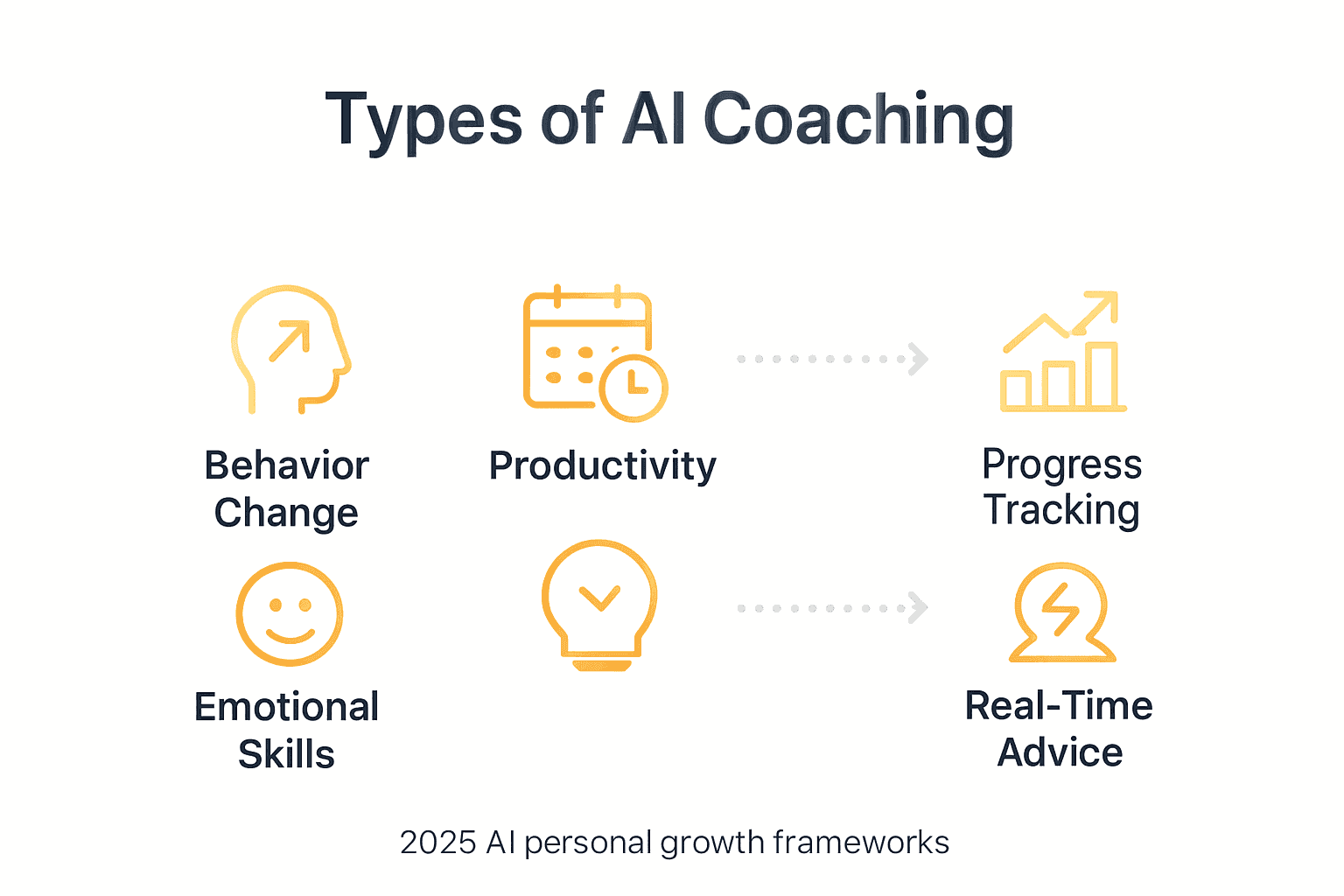
The primary types of AI coaching can be categorized into several innovative frameworks. Psychological Behavior Modification coaching uses advanced algorithms to analyze individual emotional responses and communication patterns, creating personalized intervention strategies. Productivity Enhancement coaching focuses on optimizing time management, goal setting, and performance tracking through intelligent data analysis. Emotional Intelligence Coaching represents a groundbreaking approach that helps individuals develop nuanced interpersonal skills by providing real-time feedback and strategic communication recommendations.
Here’s a comparison of major types of AI coaching and their core focus areas:
Coaching Type | Primary Focus | Typical AI Capabilities |
|---|---|---|
Psychological Behavior Mod. | Emotional response analysis | Personalized behavior plans |
Productivity Enhancement | Task management, goal setting | Automated performance tracking |
Emotional Intelligence Coaching | Interpersonal skills, feedback | Real-time communication insights |
AI-powered personal development platforms utilize multiple coaching approaches to create comprehensive growth experiences. These systems integrate various techniques such as machine learning algorithms, predictive analytics, and adaptive learning models to generate highly customized development pathways. Key features include:
Continuous performance monitoring
Personalized skill development recommendations
Real-time emotional pattern recognition
Adaptive learning strategies
Predictive behavior modification suggestions
The future of AI coaching lies in its ability to provide deeply personalized, contextually aware guidance that respects individual complexity while offering scientifically grounded improvement strategies. By combining technological sophistication with human-centered design, these AI systems are transforming how we approach personal growth and self-improvement.
Pro tip: Select an AI coaching platform that offers multiple coaching types and provides transparent insights into its recommendation algorithms to maximize your personal development journey.
How Relationship Superintelligence Works
Relationship superintelligence represents a groundbreaking approach to understanding and enhancing human connections through advanced artificial intelligence technologies. AI systems can now augment human emotional awareness by interpreting complex social interactions and providing nuanced, context-specific insights, transforming how we understand and navigate interpersonal dynamics.
The core mechanism of relationship superintelligence involves sophisticated data processing and emotional analysis. Advanced AI algorithms can now decode subtle communication patterns, emotional undertones, and relational dynamics with unprecedented precision. These systems utilize multiple layers of intelligence, including:

To understand AI’s impact on personal growth, see how relationship superintelligence differs from traditional coaching:
Aspect | Traditional Coaching | Relationship Superintelligence AI |
|---|---|---|
Communication | Periodic human feedback | Continuous, real-time analysis |
Emotional Insight | Depends on coach’s expertise | Data-driven, context-specific insights |
Personalization | Generalized or manual | Adaptive, algorithmic recommendations |
Emotional sentiment detection
Contextual communication pattern analysis
Predictive interaction modeling
Real-time behavioral insights
Adaptive communication strategy recommendations
Human-centered AI frameworks are carefully designing systems that embed ethical and emotional values into technological interactions, ensuring that relationship superintelligence remains supportive and genuinely helpful. By analyzing thousands of social interactions, these intelligent systems can recognize intricate emotional nuances that typically require years of human psychological training to understand.
The transformative potential of relationship superintelligence extends beyond simple data analysis. These systems act as sophisticated emotional translators, helping individuals understand their own communication patterns, emotional triggers, and relationship dynamics. By providing objective, data-driven insights, AI can help users develop more empathetic, effective, and meaningful connections across personal and professional domains.
Pro tip: Approach AI relationship coaching as a collaborative tool for self-discovery, using its insights to enhance your emotional intelligence rather than replacing genuine human connection.
Ethical and Privacy Considerations in AI Coaching
Ethical AI coaching represents a critical frontier in personal development technology, where the potential for transformative growth must be carefully balanced with fundamental human rights and privacy protections. Emerging research highlights the crucial need for transparent, responsible AI implementation in personal growth contexts, emphasizing the importance of maintaining user autonomy and data security.
The primary ethical considerations in AI coaching center around several key dimensions:
Data privacy and confidentiality
Informed user consent
Algorithmic transparency
Protection against potential bias
Safeguarding personal emotional information
Maintaining user agency and decision-making control
Systematic reviews of human-centered AI frameworks underscore the critical importance of developing robust oversight mechanisms that protect user rights while maximizing technological benefits. These considerations go beyond simple data protection, addressing deeper questions about how AI systems interpret, process, and respond to deeply personal emotional information. Responsible AI coaching must prioritize user well-being, ensuring that technological insights complement rather than replace human emotional intelligence.
Moreover, ethical AI coaching requires ongoing commitment to transparency, consent, and user empowerment. This means developing clear communication about how AI systems collect, analyze, and utilize personal data, providing users with comprehensive control over their information. The goal is not to create invasive technological surveillance but to develop supportive, respectful tools that genuinely enhance personal growth and emotional understanding.
Pro tip: Always review an AI coaching platform’s privacy policy and data usage guidelines thoroughly, ensuring you understand exactly how your personal information will be collected, processed, and protected.
Practical Benefits and Real-World Results
AI coaching technologies are delivering measurable, transformative outcomes across personal and professional development landscapes. Empirical research demonstrates significant improvements in user performance and knowledge application through strategic AI integration, highlighting the profound potential of intelligent coaching systems to enhance individual growth and capability.
The practical benefits of AI coaching can be categorized into several key impact areas:
Enhanced learning retention
Accelerated skill development
Personalized performance optimization
Increased self-awareness
Data-driven personal growth strategies
Reduced learning curve in complex skill domains
By leveraging advanced algorithms and adaptive learning models, AI coaching platforms provide unprecedented levels of personalized guidance. These systems analyze individual communication patterns, emotional responses, and behavioral trends to generate highly targeted recommendations. The result is a dynamic, responsive coaching experience that adapts in real time to the user’s unique developmental needs and psychological profile.
Moreover, AI coaching technologies are proving particularly effective in bridging skill gaps and supporting continuous personal development. Unlike traditional coaching methods, these intelligent systems can provide consistent, unbiased feedback, track progress with remarkable precision, and offer insights that might be difficult for human coaches to detect. This technological approach democratizes high-quality personal growth resources, making sophisticated coaching strategies accessible to a broader range of individuals.
Pro tip: Select an AI coaching platform with robust tracking and personalization features, and commit to consistent, structured engagement to maximize your personal growth potential.
Elevate Your Emotional Intelligence with AI-Powered Coaching Today
The article highlights the challenge of gaining deep self-awareness and strategic emotional development through traditional coaching methods. You may relate to feeling overwhelmed by interpersonal complexities or unsure how to navigate evolving relationship dynamics effectively. Concepts like live emotion detection, predictive communication, and relationship superintelligence emphasize the need for personalized, real-time guidance that adapts uniquely to your emotional and social environment.
That is exactly where Wisdom App shines. As the world’s first AI emotional coach built inside WhatsApp, Wisdom automatically reads your conversations to deliver intelligent, context-aware advice without interrupting your flow. Its superintelligent AI agent uses advanced relationship management AI that continuously monitors emotional patterns and provides actionable insights for growth in love, work, family, and friendships. Designed with privacy as a priority, Wisdom keeps your chats safe while transforming daily interactions into opportunities for personal transformation.
Take control of your personal growth journey with an AI life coach app that combines psychological insights, real-time emotional intelligence, and strategic relationship superintelligence. Start experiencing smarter conversations and meaningful improvements now by signing up at Wisdom App and unlock the power of AI for personal growth in 2025.
Frequently Asked Questions
What are the core concepts of AI in personal growth?
AI in personal growth involves leveraging artificial intelligence to enhance self-awareness and emotional intelligence. Through adaptive learning technologies, AI analyzes emotional patterns and provides personalized insights to create customized growth pathways.
How does AI enhance emotional intelligence coaching?
AI enhances emotional intelligence coaching by offering real-time feedback, predictive communication analysis, and context-aware guidance. These systems use advanced algorithms to recognize subtle communication patterns and emotional responses, helping individuals improve their interpersonal skills.
What types of AI coaching are available for self-improvement?
There are several types of AI coaching, including Psychological Behavior Modification, Productivity Enhancement, and Emotional Intelligence Coaching. Each focuses on different aspects of personal development and uses unique methods for tracking behavior and recommending strategies for self-improvement.
What ethical considerations should be kept in mind while using AI coaching tools?
Key ethical considerations include data privacy, informed user consent, algorithmic transparency, and protecting against bias. Responsible AI coaching emphasizes user autonomy and ensures that personal data is handled securely and ethically.
Recommended