Nov 18, 2025
Digital Companion Apps: Complete Guide to Their Role
Discover the role of digital companion apps as AI emotional coaches, their features, real-world use cases, benefits, and privacy considerations in this comprehensive guide.

Digital Companion Apps: Complete Guide to Their Role
More than 60 percent of people now interact with artificial intelligence each day without even realizing it. As digital companion apps grow more advanced, confusion swirls around what these virtual partners actually offer and where their true limits lie. Understanding the difference between myth and reality can help users make smarter choices, uncovering how these evolving tools really fit into modern relationships and self-improvement journeys.
Table of Contents
Defining Digital Companion Apps And Misconceptions
Types Of Digital Companion Apps And Key Variations
Core Features And Technology Behind Companion Apps
Practical Applications In Emotional And Relationship Growth
Benefits, Limitations, And Privacy Concerns
Key Takeaways
Point | Details |
|---|---|
Role of Digital Companion Apps | These applications are designed to enhance user emotional growth and support, not replace human relationships. |
Technological Foundations | They utilize advanced AI technologies such as natural language processing and machine learning for personalized interactions. |
Benefits and Limitations | While offering 24/7 accessibility and tailored support, users must be aware of potential privacy issues and over-reliance on AI. |
Practical Applications | Digital companions are effective tools for managing emotions, developing communication skills, and providing consistent support in personal growth. |
Defining Digital Companion Apps and Misconceptions
Digital companion apps represent an emerging technological frontier where artificial intelligence transforms traditional human interaction paradigms. According to research from arXiv, these applications are evolving beyond simple task-based interactions into complex social relationship simulators that provide emotional engagement and personalized support.
At their core, digital companion apps are virtual entities designed to simulate meaningful human interactions through advanced AI algorithms. As defined by Wikipedia, these platforms are distinctly different from physical robotic companions, existing primarily within smartphone and web interfaces. They leverage sophisticated natural language processing and emotional intelligence technologies to create responsive, adaptive communication experiences.
Common misconceptions about digital companion apps often stem from unrealistic expectations or sci-fi inspired fantasies. Many people incorrectly assume these applications are designed to replace human relationships, when in reality, they serve complementary roles. These apps are most effective when viewed as supportive tools that:
Provide 24/7 emotional availability
Offer non-judgmental listening
Digital companions excel at helping users process emotions, gain self-awareness, and develop communication strategies. Unlike traditional chatbots, modern AI-powered companion apps can detect nuanced emotional contexts, adapting their responses with remarkable sophistication.
Users should understand that while these apps offer incredible technological capabilities, they remain tools for personal growth and emotional support - not substitutes for professional mental health treatment or genuine human connections. The goal is enhancement, not replacement, of our intricate social networks.
Types of Digital Companion Apps and Key Variations
Digital companion apps have diversified into multiple specialized categories, each addressing unique user needs and interaction contexts. Wikipedia highlights that virtual assistants represent one primary classification, functioning as software agents capable of performing a wide range of tasks from answering questions to managing complex schedules.
Specialized companion app types include emotional support platforms, professional coaching applications, personal development tools, and task management assistants. Unlike traditional software, these applications leverage advanced AI to provide nuanced, context-aware interactions. As noted by Wikipedia, some companion technologies even extend into physical robotic forms designed to support specific demographics like elderly care or child interaction.
The key variations in digital companion apps can be categorized along several critical dimensions:
Emotional Intelligence Level: Apps ranging from basic task completion to advanced empathetic interaction
Interaction Scope: Platforms targeting personal, professional, or therapeutic domains
Communication Modality: Text-based, voice-enabled, or multimodal interfaces
Personalization Depth: Generic responses versus highly adaptive, individualized engagement
Unique segments within digital companion apps include mental health support platforms, language learning companions, career development assistants, and relationship coaching applications. Each variant is engineered with specific algorithmic approaches to simulate meaningful, contextually appropriate interactions that feel both intelligent and supportive.

Users should recognize that while these apps offer remarkable technological capabilities, they represent tools for augmentation rather than complete replacement of human relationships. The most effective digital companions aim to enhance personal growth, emotional understanding, and communication skills by providing consistent, non-judgmental, and strategically designed interactive experiences.
Core Features and Technology Behind Companion Apps
Companion apps leverage sophisticated technological architectures to create intelligent, responsive interactions. Wikipedia reveals that these platforms utilize advanced natural language processing technologies enabling them to interpret and respond to user commands through multiple communication channels, including text, voice, and even image-based interactions.
At the core of these applications are complex machine learning algorithms designed to facilitate adaptive and context-aware communication. arXiv highlights the critical importance of underlying security infrastructures, emphasizing that robust encryption and authentication mechanisms are paramount in ensuring safe and reliable digital interactions. These technological foundations allow companion apps to progressively understand user preferences, emotional states, and communication patterns.
Key technological components that power digital companion apps include:
Natural Language Processing (NLP): Enables understanding of human language nuances
Machine Learning Models: Facilitate continuous learning and personalization
Sentiment Analysis Algorithms: Detect emotional undertones in user interactions
Contextual Intelligence: Adapts responses based on conversation history
Predictive Communication Engines: Anticipate user needs and potential conversation trajectories
The most advanced companion apps integrate multiple technological layers to create seamless, intelligent interaction experiences. These platforms go beyond simple call-and-response mechanisms, employing sophisticated AI techniques that can:
Recognize emotional subtext
Generate contextually appropriate responses
Learn from previous interactions
Maintain consistent personality traits
As digital companion technologies continue evolving, they represent a fascinating intersection of psychology, linguistics, and artificial intelligence. Learn more about digital emotional support strategies in our comprehensive guide on emotional support apps.
Practical Applications in Emotional and Relationship Growth
Digital companion apps have emerged as powerful tools for emotional development and relationship enhancement, offering unprecedented support across various personal growth domains. Formative research demonstrates how these applications can provide targeted emotional support, particularly in high-stress environments like professional settings, helping individuals manage complex emotional landscapes with greater precision and self-awareness.
Emotional intelligence and relationship management represent core areas where digital companions make significant impacts. arXiv reveals fascinating insights into how users form meaningful connections with AI companions, utilizing them as safe spaces for emotional exploration and personal reflection. These platforms offer unique advantages by providing:
Judgment-free emotional processing
Consistent, always-available support
Personalized feedback mechanisms
Skill-building for communication
Emotional pattern recognition
Practical applications of digital companion apps span multiple personal growth dimensions. They assist users in:
Developing communication strategies
Understanding emotional triggers
Practicing conflict resolution skills
Building self-reflection habits
Managing stress and anxiety
These technological solutions go beyond traditional support models by offering adaptive, intelligent guidance tailored to individual emotional landscapes. Learn more about mastering emotional self-improvement with AI guidance, which can provide deeper insights into leveraging these transformative digital tools for personal growth.
Benefits, Limitations, and Privacy Concerns
Digital companion apps offer transformative potential alongside complex challenges that users must carefully navigate. arXiv underscores the critical importance of robust security infrastructure, emphasizing that proper encryption and authentication mechanisms are fundamental in protecting user privacy and maintaining the integrity of digital interactions.
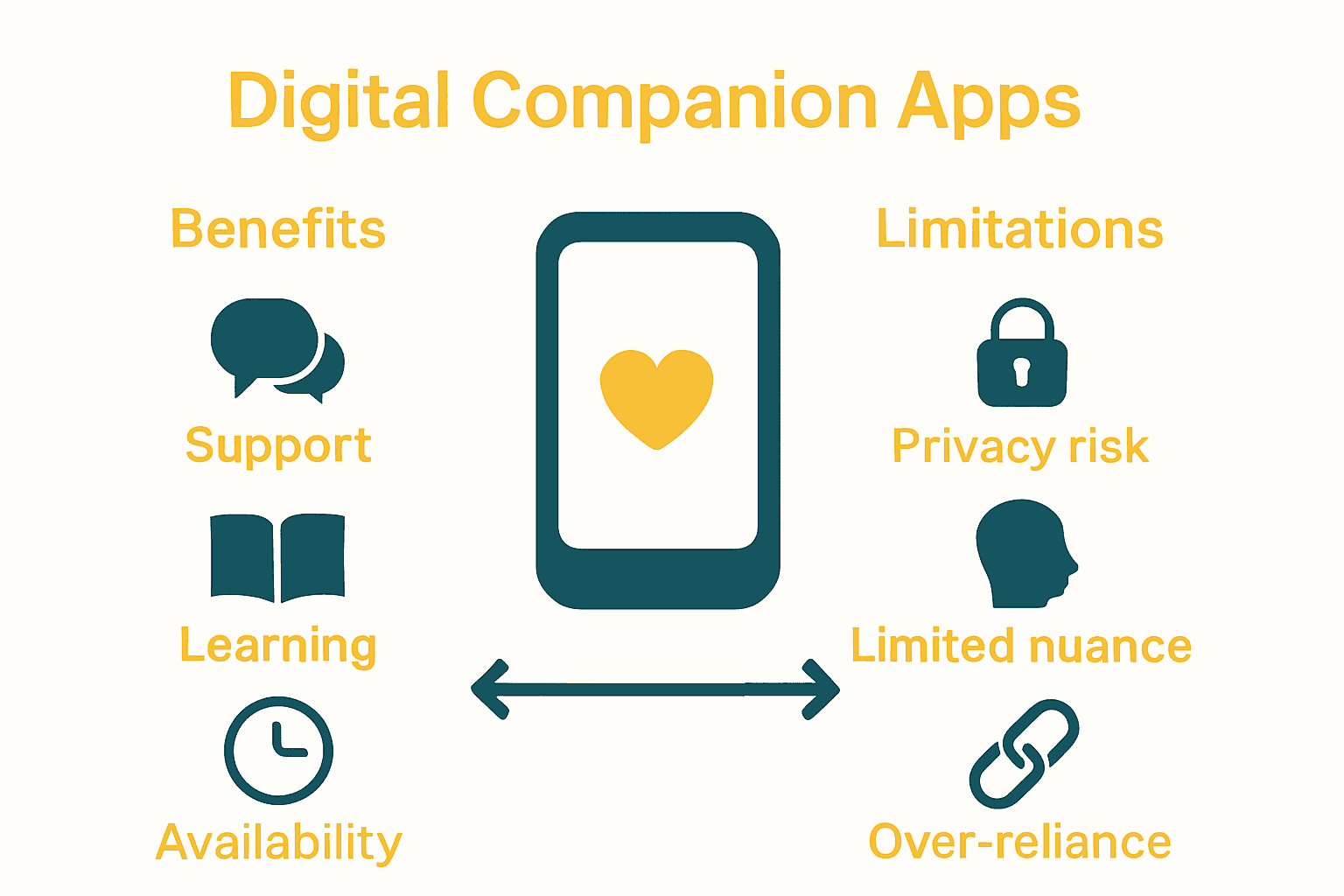
Key benefits of digital companion apps include personalized emotional support, 24/7 accessibility, and non-judgmental guidance. However, Wikipedia highlights that these technological solutions simultaneously raise significant privacy concerns related to data collection and potential misuse of personal information. Users must remain vigilant about understanding the data practices of their chosen digital companion platforms.
Comprehensive analysis reveals multiple dimensions of benefits and limitations:
Benefits:
Immediate emotional support
Consistent learning and development
Personalized interaction strategies
Accessible mental health resources
Skill-building opportunities
Limitations:
Potential over-reliance on AI support
Lack of genuine human emotional nuance
Risk of data privacy breaches
Limited contextual understanding
Potential algorithmic bias
Privacy considerations represent a critical aspect of digital companion app usage.
Users should prioritize platforms that demonstrate:
Transparent data handling policies
Strong encryption protocols
Clear user consent mechanisms
Limited data retention practices
Regular security audits
Ultimately, digital companions are powerful tools when approached with informed awareness, balancing their remarkable capabilities with thoughtful personal boundaries. Explore our guide on emotional awareness for deeper insights into navigating digital relationship technologies.
Empower Your Emotional and Relationship Growth with AI-Powered Support
The article highlights the challenges users face in finding effective emotional support and authentic interaction through digital companion apps. You want a tool that does more than simple task execution, one that understands emotional nuances and offers personalized advice to help develop communication strategies and manage relationships wisely. Pain points include the need for a 24/7 judgment-free space, emotional awareness, and guidance that adapts uniquely to different relationship types.
At Wisdom App, we recognize these needs and deliver a revolutionary solution that bridges technology and emotional intelligence. As the world’s first AI-powered emotional and relationship coach for WhatsApp, Wisdom acts as your invisible life coach right inside your chats. It interprets emotional dynamics in real-time and provides actionable insights designed to enhance self-awareness and relationship success. With features like live emotion detection, strategic communication advice, and privacy-first design, Wisdom transforms ordinary conversations into powerful opportunities for growth.
Ready to experience a superintelligent AI agent committed to helping you grow smarter in love, work, family, and friendships?
Take the next step to unlock personalized emotional coaching now by signing up at Wisdom App. Discover how an AI emotional coach can deepen your self-improvement journey and bring meaningful transformation to your digital companion experience. Don’t wait to improve your emotional intelligence and relationship management with the leading AI relationship coach designed for real life.
Frequently Asked Questions
What are digital companion apps?
Digital companion apps are virtual entities designed to simulate meaningful human interactions through advanced AI algorithms, offering emotional support and personalized engagement.
How do digital companion apps enhance emotional growth?
These apps provide judgment-free emotional processing, consistent support, personalized feedback, and skill-building for communication, helping users develop self-awareness and manage emotions effectively.
What technologies power digital companion apps?
Digital companion apps utilize technologies like natural language processing, machine learning algorithms, sentiment analysis, and contextual intelligence to create adaptive and context-aware communication experiences.
What are the limitations of using digital companion apps?
Limitations include potential over-reliance on AI, lack of genuine human emotional nuance, risks of data privacy breaches, limited contextual understanding, and possible algorithmic bias.
Recommended