Dec 26, 2025
Digital Mental Health Support: Transforming Emotional Wellbeing
AI emotional coach solutions for digital mental health support, live emotion detection, data-driven insights, and private relationship coaching inside WhatsApp.

Digital Mental Health Support: Transforming Emotional Wellbeing
Over 90 million American adults experience mental health challenges every year, yet many hesitate to seek support until symptoms worsen. As access to care remains a serious concern, digital solutions are emerging as game changers by making help more accessible, private, and immediate. This guide shines a light on how advanced technologies—especially those powered by artificial intelligence—are changing the way American individuals find, receive, and shape their mental wellness journey.
Table of Contents
Defining Digital Mental Health Support Solutions
Types of Digital Mental Health Assistance Tools
How AI Emotional Coaches Work on WhatsApp
Key Characteristics of Relationship Superintelligence
Privacy, Security, and Ethical Considerations
Comparing Digital AI Support With Traditional Therapy
Key Takeaways
Point | Details |
|---|---|
Digital Mental Health Solutions Transform Care | Leveraging technology, these solutions enhance accessibility and personalization in psychological support. |
AI Enhances User Experience | AI-powered tools provide real-time emotional analysis and adaptive support, improving user engagement. |
Privacy and Security are Essential | Strong privacy protocols must be in place to protect user confidentiality in digital mental health platforms. |
Hybrid Approach is Recommended | Combining digital AI support with traditional therapy can maximize mental health outcomes for users. |
Defining Digital Mental Health Support Solutions
Digital mental health support solutions represent a transformative approach to emotional wellness, leveraging technology to provide accessible, personalized psychological assistance. Digital mental health technologies are sophisticated platforms designed to address psychological well-being through innovative digital interventions, ranging from AI-powered coaching to interactive therapeutic applications.
These technological solutions encompass a comprehensive framework with multiple domains of support. Researchers have identified key characteristics including population targeting, technological platforms, therapeutic purposes, interaction models, and functional capabilities. Artificial intelligence plays a crucial role, enabling these systems to provide context-aware guidance, real-time emotional analysis, and adaptive support strategies that can dynamically respond to individual user needs.
Modern digital mental health solutions offer unprecedented advantages over traditional therapeutic models. Digital interventions dramatically improve accessibility, allowing individuals to receive support from anywhere with internet connectivity. They collect high-resolution psychological data, enabling more precise tracking of emotional patterns and providing insights that might be missed in conventional counseling sessions. These technologies are not intended to replace human therapists but to complement existing mental health services, creating a more holistic and responsive support ecosystem.

Pro Tip: Start Small: When exploring digital mental health tools, begin with free or low-cost platforms that offer introductory support, allowing you to become comfortable with digital therapeutic technologies without significant initial investment.
Types of Digital Mental Health Assistance Tools
Digital mental health tools have evolved into a sophisticated ecosystem of support mechanisms designed to address psychological wellness across multiple intervention stages. Digital mental health interventions can be strategically categorized into four critical phases: prevention, detection, support and treatment, and management and recovery. These comprehensive tools range from wellness applications and digital biomarker tracking to teletherapy platforms and online peer support communities.
The technological landscape of digital mental health support encompasses diverse assistance tools tailored to different user needs. Wellness applications focus on proactive mental health maintenance, offering meditation guides, mood tracking, and stress reduction techniques. Self-help websites provide educational resources and interactive modules for personal growth. Teletherapy platforms connect users with professional counselors through secure video consultations, breaking down geographical barriers to mental health support. Online support communities enable individuals to share experiences, receive peer validation, and build supportive social networks.
Artificial intelligence systems are increasingly transforming digital mental health assistance by providing personalized, adaptive support mechanisms. These intelligent platforms can analyze communication patterns, detect emotional nuances, and offer context-specific guidance. Advanced AI tools can predict potential mental health challenges, recommend personalized coping strategies, and provide continuous, real-time emotional support. By integrating machine learning algorithms with psychological research, these tools create dynamic, responsive support ecosystems that adapt to individual user needs.
Pro Tip: Explore First: When investigating digital mental health tools, start with free versions or trial periods to assess their compatibility with your personal emotional wellness goals and communication preferences.
Here’s a summary of digital mental health tool types and their unique strengths:
Tool Type | Primary Focus | Distinctive Benefit |
|---|---|---|
Wellness Applications | Proactive self-care | Guided meditation and stress tracking |
Teletherapy Platforms | Professional counseling | Secure, remote video consultations |
AI Emotional Coaches | Adaptive, real-time support | Context-aware advice 24/7 |
Online Peer Communities | Social connection | Shared experience and group validation |
How AI Emotional Coaches Work on WhatsApp
AI emotional coaches on WhatsApp represent a groundbreaking approach to digital mental health support, transforming personal communication into a powerful platform for psychological growth. Multi-agent interaction frameworks enable these sophisticated systems to generate personalized, context-aware emotional guidance that adapts dynamically to individual user communication patterns. By leveraging advanced language models and intelligent response generation, these AI coaches create a seamless, intuitive support experience directly within a familiar messaging environment.
The core functionality of AI emotional coaching involves sophisticated psychological analysis and real-time interaction strategies. These intelligent systems can detect emotional nuances, interpret communication subtleties, and provide targeted advice based on sophisticated algorithms. They analyze conversation context, emotional tone, and communication patterns to generate responses that feel natural, empathetic, and precisely tailored to the user’s specific emotional state. Advanced machine learning techniques allow these coaches to continuously improve their understanding and response capabilities through each interaction.
WhatsApp-based AI emotional coaches distinguish themselves through their ability to provide instant, accessible, and discrete mental health support. Unlike traditional therapy models, these digital companions operate 24/7, offering immediate emotional guidance without scheduling constraints. They can help users navigate complex emotional landscapes, provide coping strategies, offer perspective on challenging situations, and even predict potential emotional challenges before they escalate. The combination of artificial intelligence, psychological research, and conversational interfaces creates a powerful tool for personal emotional development and self-understanding.
Pro Tip: Communication Strategy: When using AI emotional coaches, be as honest and detailed as possible in your interactions to help the system generate more accurate and personalized support recommendations.
Key Characteristics of Relationship Superintelligence
Relationship superintelligence represents a revolutionary approach to understanding and managing interpersonal dynamics through advanced artificial intelligence technologies. AI therapist systems are designed to provide nuanced psychological support by incorporating sophisticated therapeutic techniques such as cognitive behavioral analysis, comprehensive mood tracking, and targeted psychoeducational interventions. These intelligent platforms go beyond traditional communication models by analyzing complex emotional patterns, communication styles, and relational dynamics with unprecedented depth and precision.
The core intelligence of relationship superintelligence emerges from its ability to process multiple layers of human interaction simultaneously. Advanced algorithms can detect subtle emotional shifts, interpret nonverbal communication cues, and generate contextually appropriate responses that adapt in real time. Unlike static communication tools, these systems use machine learning to continuously refine their understanding of individual communication preferences, emotional triggers, and relationship patterns. They can predict potential communication challenges, suggest strategic interventions, and provide personalized insights that help users navigate complex interpersonal landscapes more effectively.
Shared decision-making frameworks are integral to relationship superintelligence, focusing on individual perspectives and personal growth. These systems prioritize understanding ‘what matters to you’ rather than imposing generic solutions, creating a more empathetic and personalized approach to emotional support. By integrating psychological research, communication theory, and artificial intelligence, relationship superintelligence transforms how individuals understand themselves and their interactions. The technology enables users to gain deeper self-awareness, develop more effective communication strategies, and build more meaningful connections across various relationship types.
Pro Tip: Reflective Practice: Treat AI relationship insights as collaborative suggestions, not absolute truths. Use the recommendations as a starting point for personal reflection and growth, always maintaining your own critical thinking and emotional agency.
Privacy, Security, and Ethical Considerations
Digital mental health technologies require rigorous privacy and security protocols to protect user confidentiality and emotional vulnerability. Digital health technology regulations emphasize the critical importance of comprehensive legal frameworks that safeguard personal information, ensuring users can engage with mental health support platforms without compromising their sensitive psychological data. These regulatory guidelines are designed to establish robust protection mechanisms that prevent unauthorized data access, maintain user anonymity, and create secure environments for emotional exploration.
The ethical foundations of digital mental health support extend beyond technical security measures. Positive computing principles advocate for technology design that prioritizes user psychological well-being, emphasizing transparent data practices, informed consent, and user autonomy. Ethical digital mental health platforms must balance technological capabilities with human-centric values, ensuring that artificial intelligence serves as a supportive tool rather than an invasive or manipulative system. This approach requires continuous assessment of algorithmic bias, careful data handling, and a commitment to maintaining user trust through clear communication about data usage.
Comprehensive privacy strategies in digital mental health technologies involve multi-layered protection mechanisms. These include end-to-end encryption, anonymized data processing, strict access controls, and transparent user consent protocols. Advanced platforms implement sophisticated security infrastructures that protect user information at multiple levels, including secure cloud storage, restricted data sharing policies, and advanced authentication methods. By integrating technical safeguards with ethical design principles, digital mental health platforms can create safe, trustworthy environments that support users’ emotional growth while maintaining the highest standards of personal privacy and data protection.
Pro Tip: Privacy Check: Regularly review and adjust privacy settings in your digital mental health tools, and always read the terms of service to understand exactly how your personal information will be used and protected.
This table highlights important privacy measures in digital mental health solutions:
Security Strategy | Purpose | User Benefit |
|---|---|---|
End-to-end Encryption | Protects message content from exposure | Maintains full confidentiality |
Anonymized Data Processing | Removes personal identifiers | Reduces re-identification risk |
Strict Access Controls | Limits data to authorized personnel | Prevents data misuse |
Transparent Consent | Clearly informs about data use | Supports user autonomy |
Comparing Digital AI Support With Traditional Therapy
Digital AI support and traditional therapy represent two distinct yet complementary approaches to mental health care. AI therapist interventions have demonstrated promising results in addressing mild to moderate psychological distress, showing significant potential in reducing symptoms of anxiety and depression. However, these digital platforms are not intended to replace traditional therapeutic methods but to serve as an accessible, immediate supplement to conventional mental health services.
The key differentiators between digital AI support and traditional therapy lie in accessibility, immediacy, and scalability. Traditional therapy offers deep, personalized human interaction with licensed professionals who can provide nuanced emotional understanding and complex therapeutic techniques. In contrast, digital AI support provides instant, 24/7 accessibility, enabling users to receive immediate emotional support and guidance without scheduling constraints. These AI platforms use advanced algorithms to analyze communication patterns, detect emotional nuances, and provide context-specific recommendations that can complement traditional therapeutic approaches.
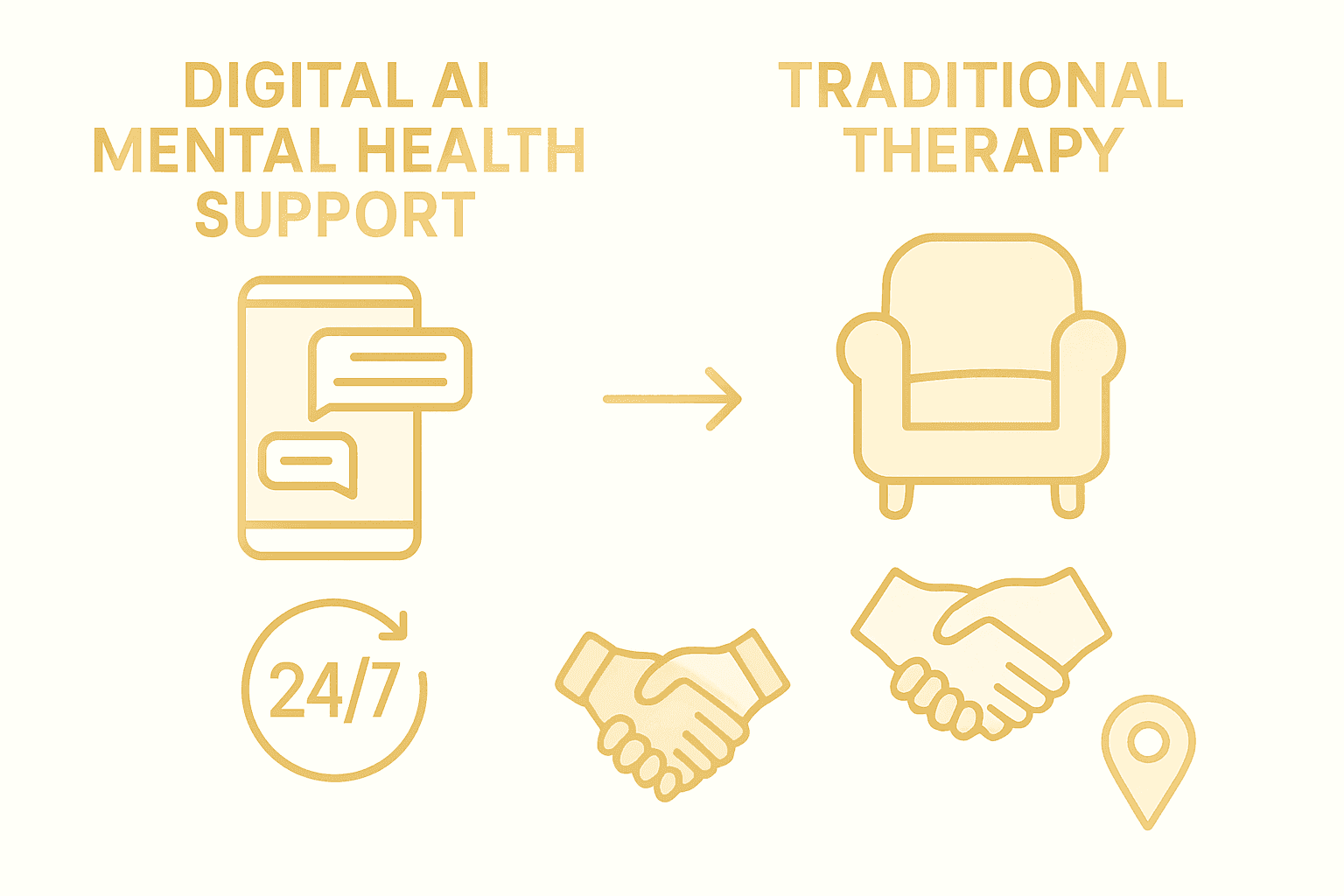
Digital mental health solutions excel in overcoming geographical barriers and enabling early intervention strategies. They can collect and analyze user data to identify potential mental health risks, track emotional patterns, and provide proactive support mechanisms. While digital AI support shows significant promise for individuals with mild psychological challenges, traditional therapy remains essential for complex mental health conditions requiring specialized clinical intervention. The most effective mental health strategies will likely involve an integrated approach that combines the immediate accessibility of digital AI support with the depth and expertise of traditional therapeutic methods.
Pro Tip: Hybrid Approach: Consider using digital AI support as a complementary tool alongside traditional therapy, not as a complete replacement, to maximize your mental health support and personal growth potential.
Empower Your Emotional Wellbeing with AI-Powered Coaching on WhatsApp
The article highlights challenges like limited accessibility to traditional therapy, the need for personalized and adaptive emotional support, and the importance of real-time, context-aware guidance. If you want to overcome these barriers and experience a truly transformative approach to mental health and relationship growth, the Wisdom App offers a solution built precisely for these needs. By integrating relationship superintelligence, live emotion detection, and AI strategies inspired by psychology and philosophy, Wisdom acts as your personal emotional coach inside WhatsApp.
Why wait to improve your communication, self-awareness, and emotional resilience? Start today with Wisdom on WhatsApp and experience how our AI emotional coach delivers actionable insights tailored to your unique relationship dynamics. Explore how a superintelligent AI agent can make emotional growth accessible anytime and anywhere. Don’t miss your chance to turn daily conversations into empowering moments for personal and relational success.
Frequently Asked Questions
What are digital mental health support solutions?
Digital mental health support solutions utilize technology to provide accessible and personalized psychological assistance, including AI-powered coaching and therapeutic applications.
How do AI emotional coaches work on messaging platforms like WhatsApp?
AI emotional coaches on WhatsApp analyze user communication patterns and emotional nuances to provide real-time, context-aware emotional guidance and support within a familiar messaging environment.
What are the advantages of using digital mental health tools over traditional therapy?
Digital mental health tools offer improved accessibility, immediate support, and the ability to collect high-resolution psychological data. They serve as a complement to traditional therapy, rather than a replacement.
How can I ensure my privacy when using digital mental health technologies?
To maintain privacy, regularly review your privacy settings, use platforms with strong security protocols like end-to-end encryption, and read the terms of service to understand how your data will be handled.
Recommended
Emotional Wellbeing in the Digital Age: Complete Guide - Wisdom
Signs of Emotional Wellness: Complete Guide for 2025 - Wisdom
Digital Emotional Support: Everything You Need to Know - Wisdom
Understanding Why Emotional Wellbeing Matters for You - Wisdom
Mood Disorder Definition – Impact on Addiction Recovery | Glendora Recovery Center