Dec 3, 2025
Emotional Awareness Guide for Parents: Practical Steps
Discover this emotional awareness guide for parents with step-by-step strategies to boost family communication, emotional intelligence, and positive parenting results.

Emotional Awareness Guide for Parents: Practical Steps
Most american families want deeper connections but often struggle to understand and express their own emotions. Studies show that emotional intelligence in parents directly shapes children’s ability to handle stress and communicate. Building emotional awareness starts with simple habits you can use every day. You will find practical steps for assessing your current approach, creating a supportive home, and using modern tools that make real growth possible for you and your family.
Table of Contents
Step 1: Assess Your Current Emotional Awareness Practices
Step 2: Set Up An Emotionally Open Home Environment
Step 3: Use AI Coaching Tools For Daily Emotional Check-Ins
Step 4: Model Emotional Awareness During Family Conversations
Step 5: Review And Adjust Your Approach Using Feedback
Quick Summary
Key Insight | Explanation |
|---|---|
1. Reflect on Your Emotions | Maintain an emotional journal to track feelings and identify patterns for better emotional awareness. |
2. Foster an Emotionally Safe Home | Create an environment that encourages open emotional sharing among family members through active listening and validation. |
3. Utilize AI for Emotional Check-ins | Use AI coaching tools for daily emotional check-ins, facilitating structured discussions on feelings within the family. |
4. Model Emotional Communication | Practice transparent emotional sharing during family interactions to teach the importance of expressing and understanding feelings. |
5. Regularly Review and Adapt Strategies | Engage in feedback sessions with family to assess emotional awareness practices and make necessary adjustments for improvement. |
Step 1: Assess your current emotional awareness practices
Evaluating your emotional awareness starts with honest self reflection. Understanding your emotional landscape requires a structured approach that helps you recognize subtle emotional patterns and responses. The Toronto Alexithymia Scale provides an excellent framework for examining how well you identify and articulate your emotions.
To begin your assessment, create a personal emotional journal where you track your feelings throughout the day. Note not just what happened, but how you felt during different interactions and experiences. Pay special attention to moments when you struggle to name or describe your emotions precisely. The Emotional Intelligence Appraisal suggests focusing on four key areas: self awareness, self management, social awareness, and relationship management.
A practical tip is to set aside 10 minutes each evening to review your emotional experiences. Ask yourself questions like: What triggered strong feelings today? Did I respond emotionally in ways that surprised me? Were there moments when I felt disconnected from my emotions? By consistently practicing this reflection, you will gradually develop a more nuanced understanding of your emotional landscape and build stronger emotional intelligence as a parent.
Step 2: Set up an emotionally open home environment
Creating an emotionally safe home requires intentional strategies that help children feel comfortable expressing their feelings. Creating an emotionally supportive climate involves responding calmly to your children’s emotions and establishing consistent communication patterns that foster trust and understanding.
Start by implementing daily practices that encourage emotional sharing. This means actively listening without judgment, validating your children’s feelings, and demonstrating that all emotions are acceptable. Building strong relationship dynamics requires separating behavior from identity, which means critiquing actions without criticizing the child’s character. When children feel safe expressing vulnerability, they develop healthier emotional intelligence and communication skills.
A practical approach is to create a dedicated family time where everyone shares their daily emotional experiences. This could be during dinner or before bedtime, where each family member discusses something that made them happy, frustrated, or confused. By consistently modeling emotional openness and demonstrating how to process feelings constructively, you create a nurturing environment that supports your children’s emotional growth and helps them develop resilient coping mechanisms.

Step 3: Use AI coaching tools for daily emotional check-ins
Integrating AI technology into your emotional awareness practice can transform how you understand and support your family’s emotional growth. Parent-AI collaborative emotion education offers innovative approaches to engaging children in meaningful emotional dialogues, providing structured support for developing emotional intelligence.
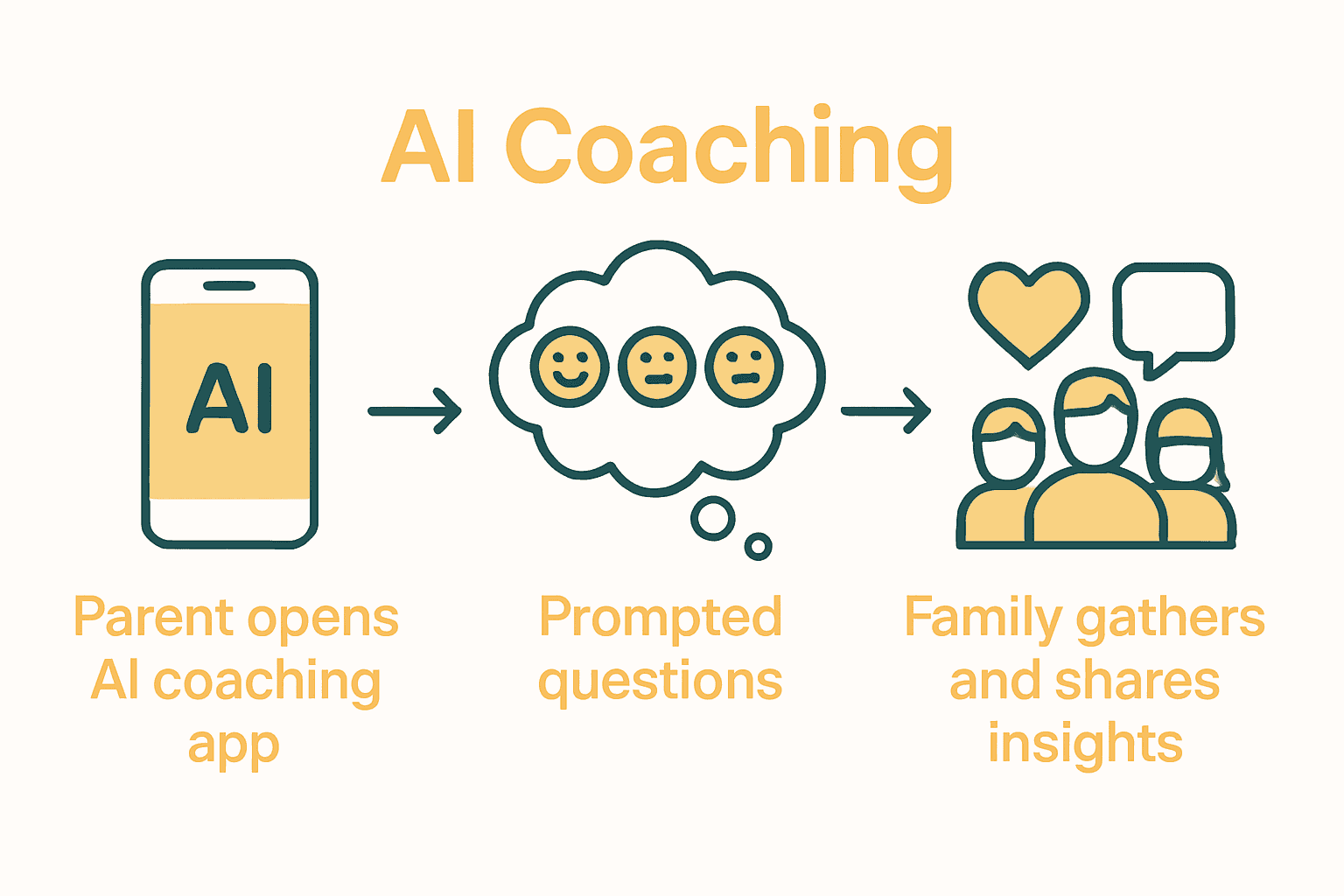
Start by selecting an AI coaching tool that facilitates interactive emotional check-ins. These tools can help you create safe spaces for discussing feelings by generating scenario based conversations and reflection prompts. Social-emotional learning systems demonstrate how AI can guide parents in generating meaningful discussions about emotions, helping children articulate their inner experiences more effectively.
A practical strategy is to schedule daily 10-minute sessions using your chosen AI emotional coaching platform. During these check-ins, focus on creating a judgment-free environment where family members can explore their emotional states. Encourage each person to share their feelings, challenges, and moments of joy, using the AI tool to help structure and deepen the conversation. By consistently practicing these emotional check-ins, you will build a family culture of openness, empathy, and emotional intelligence that supports each member’s personal growth and mutual understanding.
Step 4: Model emotional awareness during family conversations
Modeling emotional awareness requires intentional communication that demonstrates how to recognize, understand, and express emotions constructively. Meta-emotion provides a powerful framework for understanding how our thoughts and feelings about emotions shape family interactions, creating opportunities for deeper emotional connection.
Start by practicing transparent emotional communication during family conversations. This means sharing your own emotional experiences openly and authentically, while also demonstrating emotional competence skills such as recognizing your feelings, naming them accurately, and explaining their origins. When you experience frustration, sadness, or joy, narrate your emotional journey out loud, helping your family members understand the nuanced landscape of human emotions.
A practical strategy is to create a family ritual where each member shares their emotional experience of the day, including both positive and challenging feelings. During these conversations, focus on listening without judgment, validating each person’s emotional experience, and modeling healthy emotional processing. By consistently demonstrating emotional vulnerability and self reflection, you teach your children that emotions are natural, valuable, and important components of human experience that deserve respect and understanding.
Step 5: Review and adjust your approach using feedback
Emotional regulation is an ongoing journey that requires consistent reflection and willingness to adapt your strategies. Developing emotional awareness is not a linear process but a dynamic approach that demands continuous learning and intentional adjustment based on your family’s evolving needs.
Create a structured feedback mechanism where family members can share their perspectives on your emotional awareness practices. This might involve monthly family meetings or periodic one-on-one conversations where everyone has the opportunity to discuss what is working well and what could be improved. Therapeutic approaches to attachment and emotional development emphasize the importance of remaining flexible and responsive to individual family members’ unique emotional landscapes.
A practical strategy is to maintain a family emotional growth journal where you document your observations, challenges, and insights. Track patterns in your communication, note moments of emotional breakthrough, and identify areas where your approach could be more supportive. By treating emotional awareness as a collaborative and iterative process, you demonstrate to your children that personal growth is about continuous learning, vulnerability, and mutual understanding rather than achieving a perfect endpoint.
Enhance Your Family’s Emotional Awareness with AI-Powered Support
The article highlights the challenge parents face in consistently recognizing and nurturing emotional awareness within their family. It emphasizes the need for honest self-reflection, creating emotionally safe spaces, and deliberately modeling emotional intelligence during conversations. These are key steps to help children feel understood and develop resilient emotional skills.
Are you ready to simplify this important journey? Wisdom App offers an AI emotional coach designed to guide your family through daily emotional check-ins and meaningful conversations. By using live emotion detection and relationship superintelligence, Wisdom helps you respond thoughtfully to emotions and build deeper connections effortlessly.

Start transforming your family dialogues with an AI life coach app built for emotional growth. Experience how Wisdom’s insights on emotional patterns and relationship dynamics create a safe environment for everyone to express and reflect. Begin today by signing up at Wisdom App and explore how our AI emotional coach can become your trusted partner in raising emotionally aware children.
Frequently Asked Questions
How can I assess my current emotional awareness as a parent?
To assess your emotional awareness, start by reflecting on your emotional responses and patterns. Maintain a personal emotional journal where you track your feelings daily, noting significant emotional triggers and responses.
What steps can I take to create an emotionally open home environment for my children?
Creating an emotionally open home involves fostering consistent communication where feelings can be shared without judgment. Set aside dedicated family time each day for sharing emotional experiences, enabling everyone to express their emotions comfortably.
How can I integrate AI tools for emotional check-ins in my family?
To integrate AI coaching tools, select a platform that facilitates interactive emotional discussions. Schedule 10-minute daily sessions to explore feelings together, using the AI tool to guide conversations and enhance emotional understanding.
What are effective ways to model emotional awareness in family conversations?
Model emotional awareness by openly sharing your own feelings with family members during conversations. Create a ritual where everyone discusses their emotional experiences of the day, ensuring you listen actively and validate each person’s feelings.
How can I gather feedback to improve my emotional awareness practices?
Establish a feedback mechanism by holding monthly family meetings or one-on-one discussions about emotional awareness practices. Document insights and challenges in a family growth journal to help adjust your approach based on family members’ needs.
What should I do if I struggle to recognize and articulate my emotions?
If you’re struggling to articulate your emotions, dedicate time to reflect on your emotional experiences and practice naming your feelings. Commit to daily exercises for self-recognition and engage in open discussions with family to enhance your emotional vocabulary.
Recommended