Nov 18, 2025
Emotional Awareness in Business: Complete Guide
Emotional awareness in business drives leadership, teamwork, and conflict resolution. Explore its benefits, real-world impact, and implementation tips.

Emotional Awareness in Business: Complete Guide
Over 80 percent of workplace success comes from emotional intelligence rather than raw technical abilities. In fast-paced business environments, how people navigate emotions can decide outcomes, teamwork, and even company culture. Gaining a clear understanding of emotional awareness helps professionals communicate better, resolve conflicts, and foster trust, setting the stage for personal and organizational growth.
Table of Contents
Defining Emotional Awareness in Business
Types of Emotional Awareness at Work
Impact on Leadership and Team Dynamics
Enhancing Communication and Decision-Making
Common Challenges and How to Overcome Them
Key Takeaways
Point | Details |
|---|---|
Emotional Awareness Enhances Leadership | High emotional awareness in leaders fosters empathy and ethical decision-making, positively affecting team dynamics and organizational performance. |
Interpersonal Skills are Critical | Key dimensions such as self-recognition, empathy, and emotional regulation are essential for building strong workplace relationships and navigating challenges effectively. |
Communication is Transformed | Integrating emotional awareness into communication strategies enhances understanding and responsiveness, leading to more effective problem-solving and collaboration. |
Navigating Challenges is Essential | Professionals must address emotional overwhelm and cultural differences while maintaining boundaries and developing emotional skills to thrive in diverse environments. |
Defining Emotional Awareness in Business
Emotional awareness in business represents the sophisticated ability to recognize, understand, and strategically manage emotions within professional environments. According to Open University, emotional intelligence involves comprehending and navigating both personal and collective emotional landscapes, which is crucial for promoting workplace well-being.
At its core, emotional awareness transcends traditional technical skills. It encompasses a complex set of interpersonal capabilities that enable professionals to decode emotional signals, respond empathetically, and create harmonious work dynamics. As research from WSEAS indicates, emotional intelligence includes personal, emotional, and social abilities that directly impact an individual’s capacity to address environmental pressures and challenges.
Key dimensions of emotional awareness in business include:
Self-recognition: Understanding personal emotional triggers and responses
Empathy: Accurately perceiving and responding to colleagues’ emotional states
Emotional regulation: Managing personal emotions during high-stress scenarios
Social navigation: Building strong interpersonal connections through emotional intelligence
Professionals with high emotional awareness can transform potentially challenging interactions into opportunities for collaboration, trust-building, and mutual understanding. They recognize that emotions are not weaknesses but powerful communication tools that, when skillfully managed, can drive organizational success and individual growth.
For those seeking to deepen their understanding, our complete guide to emotional intelligence provides comprehensive insights into developing these critical professional skills.
Types of Emotional Awareness at Work
Workplace emotional awareness is a multifaceted concept with several distinct types that professionals must develop to succeed. According to the Cambridge Journal of Management and Organization, a comprehensive Five-Level Model of Emotion reveals that emotional awareness extends beyond simple recognition, encompassing intricate layers of emotional understanding and management.
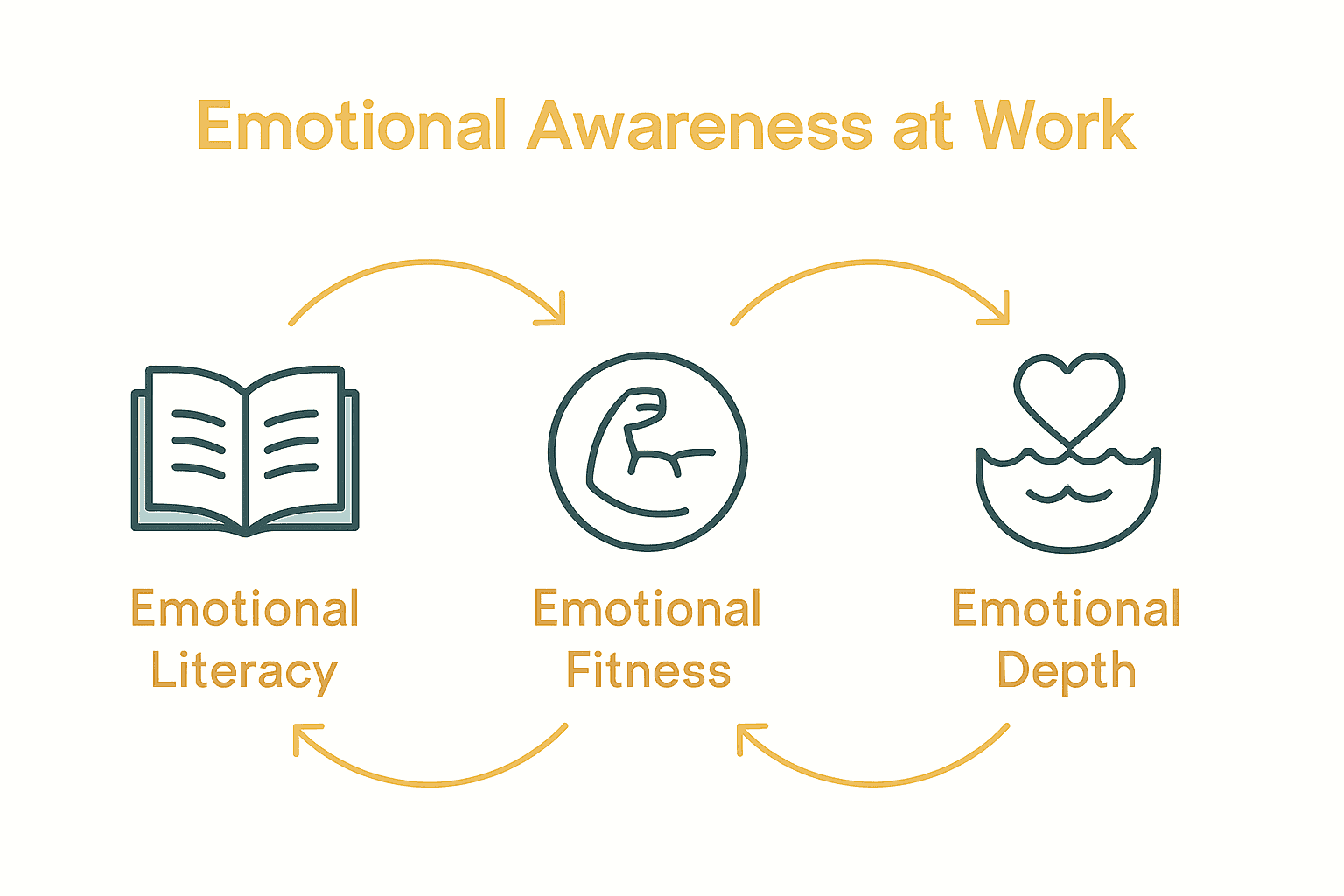
Building on this research, emotional awareness can be categorized into several critical dimensions. Wikipedia’s Four Cornerstone Model of Emotional Intelligence highlights four key components that define emotional awareness in professional settings:
Emotional Literacy: The ability to identify and name emotions accurately
Emotional Fitness: Capacity to regulate and manage emotional responses effectively
Emotional Depth: Understanding the underlying causes and impacts of emotions
Emotional Alchemy: Transforming negative emotional experiences into positive growth opportunities
These types of emotional awareness are not isolated skills but interconnected abilities that work together to create a holistic approach to professional interactions.
Individuals who master these dimensions can navigate complex workplace dynamics with greater ease, build stronger relationships, and respond more strategically to challenging situations.

For professionals looking to dive deeper into understanding these nuanced emotional intelligence skills, our complete guide to emotional awareness in the digital age offers comprehensive insights into developing these critical workplace competencies.
Impact on Leadership and Team Dynamics
Emotional awareness fundamentally transforms leadership approaches and team interactions, creating more resilient and adaptive organizational environments. According to research from arXiv, leaders with advanced emotional intelligence are perceived as significantly more empathetic and ethical, directly influencing team trust and overall organizational performance.
Team dynamics are profoundly shaped by emotional awareness, with leaders who demonstrate high emotional intelligence creating more collaborative and psychologically safe work environments. Open University research highlights that emotional intelligence plays a critical role in promoting workplace well-being and fostering positive emotional climates.
Key impacts of emotional awareness on leadership include:
Enhanced Communication: Breaking down communication barriers through empathetic understanding
Conflict Resolution: Skillfully navigating and mediating interpersonal workplace tensions
Employee Engagement: Creating supportive environments that motivate and inspire team members
Strategic Decision-Making: Integrating emotional insights with logical analysis
Leaders who cultivate emotional awareness can transform potential workplace challenges into opportunities for growth, collaboration, and mutual understanding. By recognizing and responding to the emotional undercurrents within their teams, they create more resilient, adaptive, and high-performing organizational cultures.
To explore deeper strategies for developing emotional intelligence in leadership, explore our complete guide to emotional awareness in the digital age.
Enhancing Communication and Decision-Making
Emotional awareness serves as a critical catalyst for transforming communication and decision-making processes in professional environments. According to research from arXiv, emerging AI-based emotion recognition technologies are revolutionizing how businesses understand and interpret emotional signals, providing unprecedented insights into more nuanced and empathetic communication strategies.
The concept of bounded emotionality plays a pivotal role in this transformation. As Wikipedia highlights, expressing a comprehensive range of emotions in the workplace can significantly strengthen work relationships and dramatically improve communication and decision-making effectiveness. This approach moves beyond traditional rational decision-making models, recognizing emotions as valuable data points rather than distractions.
Key strategies for enhancing communication and decision-making through emotional awareness include:
Active Listening: Developing deeper understanding by recognizing emotional undertones
Emotional Calibration: Balancing emotional insights with logical analysis
Context-Sensitive Communication: Adapting communication styles to different emotional landscapes
Empathetic Problem-Solving: Using emotional intelligence to navigate complex interpersonal dynamics
Professionals who master these skills can create more responsive, adaptive, and collaborative work environments. By integrating emotional awareness into communication and decision-making processes, organizations can unlock more innovative, inclusive, and effective approaches to solving complex challenges.
To dive deeper into developing these critical skills, explore our guide to emotional self-improvement with AI guidance, which offers cutting-edge strategies for enhancing emotional intelligence.
Common Challenges and How to Overcome Them
Emotional awareness in business is not without significant challenges that professionals must strategically navigate. Research from arXiv highlights critical concerns surrounding emerging emotion recognition technologies, particularly the potential risks of privacy invasion and emotional manipulation, which demand careful ethical consideration and robust guidelines.
The implementation of emotional awareness in organizational settings presents complex interpersonal dynamics. As Wikipedia’s exploration of bounded emotionality suggests, maintaining appropriate emotional boundaries while encouraging authentic expression requires nuanced, thoughtful approaches. Professionals must learn to balance vulnerability with professional discretion.
Common challenges in developing emotional awareness include:
Emotional Overwhelm: Managing intense workplace emotions without becoming personally compromised
Cultural Misinterpretation: Navigating diverse emotional expression across different cultural contexts
Professional Vulnerability: Maintaining appropriate emotional boundaries
Skill Development: Overcoming initial discomfort with emotional introspection
Successful navigation of these challenges requires a structured, compassionate approach. Organizations must create safe spaces for emotional learning, provide training in emotional intelligence, and develop clear frameworks that respect individual emotional experiences while maintaining professional standards.
For professionals seeking structured guidance in overcoming these challenges, our guide to emotional self-improvement with AI guidance offers targeted strategies for developing emotional resilience and awareness.
Unlock Emotional Awareness with AI-Powered Guidance for Business Success
Navigating the complex emotional dynamics at work can be challenging. This article highlights key obstacles like managing emotions under pressure, understanding cultural differences, and balancing vulnerability with professionalism. If you want to transform these challenges into opportunities for growth and stronger relationships, integrating emotional intelligence skills like self-recognition, empathy, and emotional regulation is essential.
Experience how Wisdom App, the world’s first AI emotional and relationship coach on WhatsApp, can help you sharpen your emotional awareness with live emotion detection and context-aware advice tailored to every professional interaction. Start improving your communication, decision-making, and leadership today by joining thousands who trust this superintelligent AI agent to provide practical emotional insights. Don’t wait to elevate your business relationships—sign in now at Wisdom App and begin your journey toward smarter emotional management. Learn more about building emotional intelligence with our complete guide to emotional intelligence or dive deeper into workplace skills with the complete guide to emotional awareness in the digital age.
Frequently Asked Questions
What is emotional awareness in a business context?
Emotional awareness in business refers to the ability to recognize, understand, and manage emotions within professional environments, contributing to workplace well-being and effective communication.
How can emotional awareness improve team dynamics?
High emotional awareness among leaders fosters collaboration and creates a psychologically safe work environment, enhancing trust, engagement, and overall team performance.
What are some key dimensions of emotional awareness?
Key dimensions include self-recognition, empathy, emotional regulation, and social navigation, which collectively enable professionals to respond effectively to their own emotions and those of others.
What challenges might one face when developing emotional awareness?
Common challenges include emotional overwhelm, cultural misinterpretation of emotions, maintaining professional boundaries, and initial discomfort with emotional introspection. Addressing these requires structured approaches and training.
Recommended