Nov 4, 2025
Emotional Wellbeing Step by Step for Lasting Personal Growth
Discover emotional wellbeing step by step with this clear, actionable guide. Achieve emotional balance and personal growth through structured, easy steps.

Emotional Wellbeing Step by Step for Lasting Personal Growth
Did you know that over 70 percent of people say they struggle to accurately identify their own emotions? Developing strong emotional awareness is more than just a wellness trend. It shapes your relationships, your resilience, and your day to day decision making. By learning how to assess your emotional baseline, label your feelings, and track your progress, you can unlock a deeper level of self understanding and create lasting personal growth.
Table of Contents
Step 1: Assess Your Emotional Baseline
Step 2: Identify and Label Key Emotions
Step 3: Apply Daily Mindful Check-Ins
Step 4: Integrate Personalized AI Guidance
Step 5: Track Progress and Celebrate Growth
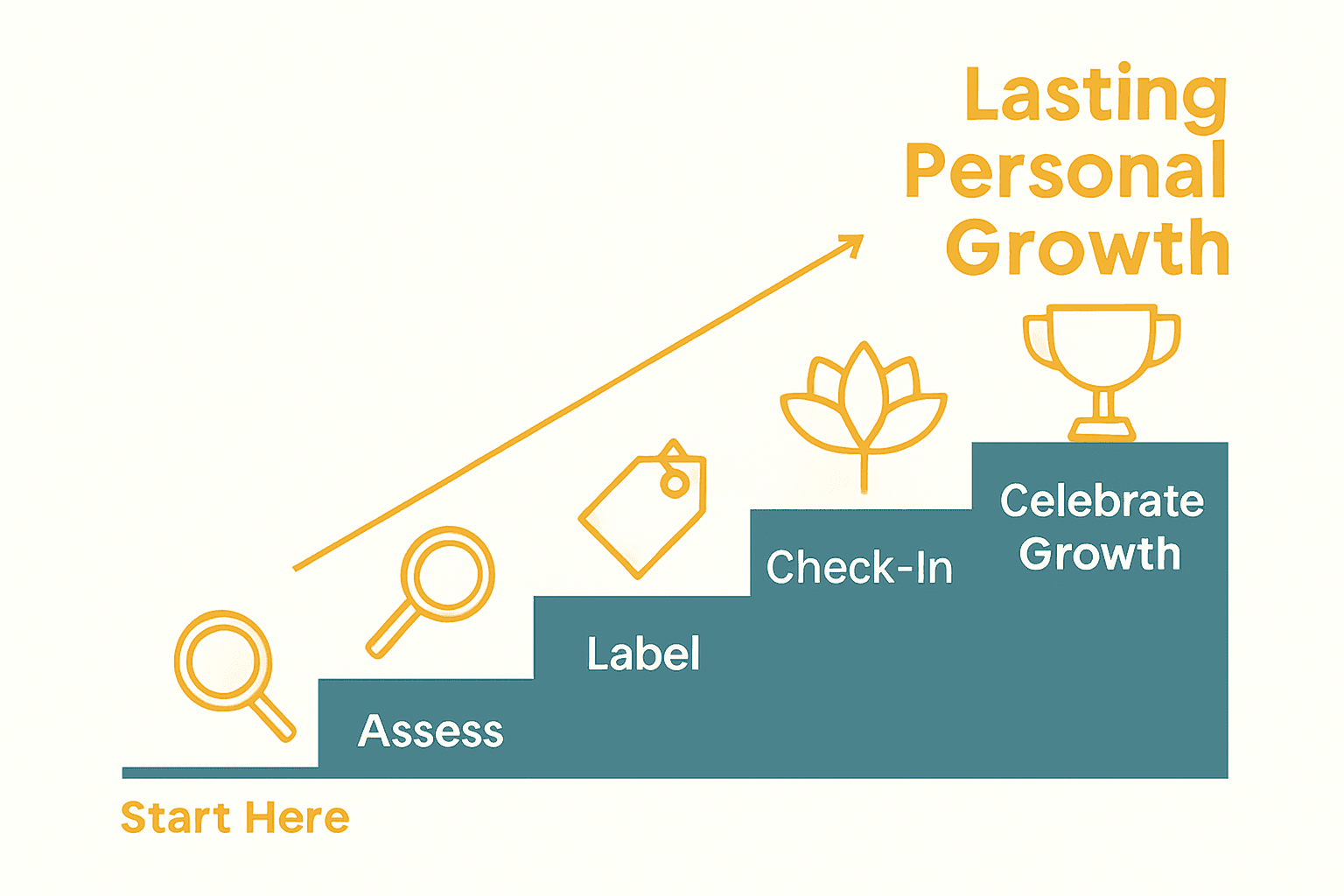
Quick Summary
Key Point | Explanation |
|---|---|
1. Assess Your Emotional Baseline | Evaluate your current emotions using tools like the Toronto Alexithymia Scale to understand your emotional state. |
2. Master Emotional Labeling | Identify and articulate emotions accurately to improve emotional regulation and self-awareness. |
3. Implement Daily Mindful Check-Ins | Dedicate specific times for introspection to connect with your emotions and evaluate your emotional states. |
4. Use AI Guidance for Emotional Growth | Integrate trusted AI tools to gain insights into emotional patterns and develop tailored growth strategies. |
5. Track Progress and Celebrate Growth | Document your emotional developments to recognize transformations and maintain motivation in your personal growth journey. |
Step 1: Assess Your Emotional Baseline
In this essential first step, you will create a comprehensive snapshot of your current emotional landscape by systematically evaluating your emotional awareness and baseline state. Understanding your emotional foundation is crucial for meaningful personal growth and developing targeted strategies for improvement.
To begin assessing your emotional baseline, consider using standardized tools like the Toronto Alexithymia Scale, a respected self-report measure designed to help you identify and describe emotions with greater precision. This assessment will reveal potential challenges in emotional recognition and expression. Another complementary approach is the Differential Emotions Scale, which evaluates the intensity of ten fundamental emotions and provides a multidimensional view of your emotional experiences.
Start by setting aside quiet time in a comfortable environment where you can reflect honestly. Create a journal or use a digital note taking app to document your responses. As you work through the assessment, pay attention not just to what emotions you experience but how deeply you can recognize and articulate them. Are there emotions you struggle to name or understand? Do certain feelings feel more accessible than others? This self exploration is not about judgment but about developing a compassionate understanding of your inner emotional world.
A helpful warning: emotional baseline assessment can sometimes surface complex or unexpected feelings. Be gentle with yourself during this process and consider seeking professional support if you find the experience overwhelming. Your goal is self understanding not self criticism. The insights you gain here will become the foundation for your emotional growth journey.
Step 2: Identify and Label Key Emotions
In this critical step, you will learn to precisely identify and articulate the emotions coursing through your inner landscape. Mastering emotional labeling is a transformative skill that enables deeper self understanding and more effective emotional regulation.
According to Jove, emotional labeling involves identifying and naming specific emotions like anger, fear, happiness, or sadness an essential process for effective communication and emotional management. PubMed research further emphasizes that accurately categorizing emotions has profound implications for personal development particularly in understanding social and emotional dynamics.
Start by creating an emotion inventory. Get a journal and list out every emotion you experience throughout a typical day. Be specific do not just write happy or sad. Instead use nuanced descriptors like frustrated, anxious, excited, overwhelmed, or peaceful. Track the intensity of these emotions on a scale from 1 to 10. Notice patterns connect emotions to specific triggers or situations. Are certain environments or interactions consistently generating similar emotional responses?
A helpful warning: emotional labeling can feel challenging initially. Many people struggle to move beyond basic emotion descriptions. Be patient with yourself. This is a skill that develops with consistent practice. Consider using emotion wheels or reference guides to expand your emotional vocabulary. The Emotional Intelligence Complete Guide can provide additional insights into refining your emotional awareness.
As you become more proficient at identifying and labeling your emotions you will unlock deeper self awareness. This skill transforms how you understand yourself navigate relationships and respond to life challenges.

The next step is learning how to process and regulate these emotions effectively.
Step 3: Apply Daily Mindful Check-Ins
In this transformative step, you will develop a powerful daily practice of emotional awareness and self reflection through intentional mindful check-ins. These structured moments of introspection will help you stay connected to your inner emotional landscape and respond to life with greater intentionality.
According to Emotion Review, interdisciplinary research highlights the significance of emotional regulation and mindfulness practices in understanding our complex inner world. Sara Ahmed’s Cultural Politics of Emotion further emphasizes how emotions are deeply embedded in our daily practices and linguistic experiences.
Set aside three specific times each day for your mindful check-ins morning, midday, and evening. Each session should last 5 to 10 minutes. Find a quiet space where you can sit comfortably without interruptions. Close your eyes and take several deep breaths. Scan your body for physical sensations that might indicate underlying emotional states. Ask yourself reflective questions like What am I feeling right now? Where am I experiencing this emotion in my body? What might have triggered this emotional state?
A helpful warning: mindful check-ins can initially feel awkward or uncomfortable. You might encounter emotions you have been avoiding or suppressing. Remember that this process is about gentle observation not judgment. Some days will feel easier than others. The key is consistent practice. For additional insights into developing emotional awareness, explore our guide on self awareness and growth.
As you continue these daily mindful check-ins, you will develop a more nuanced understanding of your emotional patterns. This practice lays the groundwork for more advanced emotional regulation techniques and deeper self understanding.
The next step involves learning how to process and transform these emotional insights into meaningful personal growth.
Step 4: Integrate Personalized AI Guidance
In this transformative step, you will harness the power of advanced artificial intelligence to accelerate your emotional growth journey. Personalized AI guidance offers an unprecedented opportunity to gain deep insights into your emotional patterns and develop targeted strategies for personal development.
Cutting edge research from ArXiv reveals exciting developments in AI emotion recognition through frameworks like UniMSE which unifies sentiment analysis and emotional understanding. Another groundbreaking study from ArXiv demonstrates AI’s remarkable capability to analyze emotions at both sentence and word levels providing nuanced insights into emotional experiences.
To integrate personalized AI guidance effectively start by selecting a reputable AI emotional coaching platform that prioritizes privacy and offers comprehensive emotional analysis. Look for tools that can detect subtle emotional nuances provide context specific recommendations and adapt to your unique communication style. During interactions be as transparent and honest as possible to enable the AI to generate the most accurate and personalized insights.
A helpful warning: while AI guidance is powerful it should complement not replace human emotional support. Approach AI coaching as a sophisticated tool for self reflection and growth rather than a complete substitute for professional therapy or human connection. Master the Emotional Self-Improvement Process with AI Guidance can provide additional context on effectively leveraging AI for emotional development.
As you integrate AI guidance into your emotional wellness journey you will discover a powerful ally in understanding your inner world. This technology offers unprecedented opportunities for self discovery personalized growth strategies and emotional intelligence development. The next step involves learning how to synthesize these insights into meaningful personal transformation.
Step 5: Track Progress and Celebrate Growth
In this crucial step, you will develop a systematic approach to documenting your emotional growth journey and recognizing the meaningful transformations happening within yourself. Tracking progress allows you to appreciate your development and maintain motivation through tangible evidence of your personal evolution.
Carroll Izard groundbreaking research on emotion theory identifies ten primary discrete emotions that provide a comprehensive framework for understanding emotional development. Similar to how the Geneva Emotional Music Scale tracks emotional responses over time, you will create a personalized emotional growth tracking system that captures your unique journey.
Establish a consistent documentation method through a dedicated journal or digital tracking tool. Create monthly emotional scorecards where you rate your emotional intelligence across different dimensions such as self awareness, emotional regulation, empathy, and interpersonal communication. Use a scale from 1 to 10 and include specific examples of how you have demonstrated growth in each area. Note significant emotional breakthroughs challenges overcome and moments of personal insight.
A helpful warning: avoid becoming overly critical or perfectionistic in your tracking. Progress is not linear and emotional growth happens in complex waves. Some months will show more dramatic improvements than others. The goal is observation and appreciation not harsh self judgment. Master the Personal Growth Process for Lasting Change can provide additional perspectives on maintaining a compassionate growth mindset.
As you continue tracking your progress you will build a powerful narrative of personal transformation. This documentation serves as both a motivational tool and a reflective mechanism helping you understand your emotional patterns and growth trajectory. Your next step involves integrating these insights into a holistic approach to ongoing personal development.
Accelerate Your Emotional Wellbeing Journey with Wisdom App
If step-by-step emotional growth feels overwhelming, you are not alone. The article highlights common challenges like recognizing and labeling emotions, maintaining mindful check-ins, and tracking progress without judgment. Wisdom App offers a superintelligent AI emotional coach that works with you inside WhatsApp to provide personalized, real-time insights. Imagine having a compassionate digital mentor who understands your unique emotional patterns and relationship dynamics to help you master emotional awareness and regulation.

Take control of your emotional journey today. Experience how the AI relationship coach at Wisdom App transforms ordinary chats into powerful growth moments. Start integrating mindful check-ins, get tailored advice on emotional labeling, and track your development with data-driven scorecards. Begin your lasting personal growth now by signing in at https://app.wisdomnow.co/signIn. Your emotional wellbeing deserves this kind of intelligent support.
Frequently Asked Questions
How can I assess my emotional baseline effectively?
Start by using standardized tools like the Toronto Alexithymia Scale or the Differential Emotions Scale. Set aside quiet time to reflect and journal your emotional experiences, focusing on recognizing and articulating your feelings.
What strategies can I use to identify and label my emotions?
Create an emotion inventory by listing out specific emotions you experience daily, using nuanced descriptors for clarity. Track the intensity of these emotions on a scale from 1 to 10, noting patterns and triggers for better self-understanding.
How often should I perform mindful check-ins for emotional awareness?
Aim for three mindful check-ins each day—morning, midday, and evening—lasting 5 to 10 minutes each. Use this time to reflect on your feelings, physical sensations, and triggers to enhance your emotional connection.
What is the role of AI in improving emotional wellbeing?
Personalized AI guidance can help you analyze emotional patterns and develop targeted growth strategies. Engage with a reputable AI emotional coaching platform regularly to receive tailored insights and recommendations for your emotional journey.
How can I track my progress in emotional growth?
Establish a consistent documentation method by creating a dedicated journal or digital tracking system. Rate your emotional intelligence across dimensions like self-awareness and emotional regulation monthly, noting significant breakthroughs and insights to monitor your evolution.
What should I avoid while working on my emotional growth?
Avoid becoming overly critical or perfectionistic during your growth process. Focus on observation and appreciation of your journey, accepting that progress is not linear and emotional growth can vary over time.
Recommended