Nov 18, 2025
Emotional Wellbeing With AI in 2025: Complete Guide
Comprehensive guide to AI emotional coaching in 2025. Learn how AI agents support emotional wellbeing, real-world uses, privacy, and benefits.

Emotional Wellbeing With AI in 2025: Complete Guide
More than 60 percent of people now rely on digital tools for emotional support, but in 2025, artificial intelligence is taking this further with technology that can truly understand and guide our feelings. Emotional wellbeing is no longer limited to traditional therapy or self-help methods. AI’s new abilities offer continuous, real-time support tailored to each person’s emotions. This article reveals how advanced AI frameworks are redefining personal growth, empathy, and mental health for a changing world.
Table of Contents
Defining Emotional Wellbeing With AI in 2025
Types of AI Emotional Support Tools
How AI Coaches Detect and Guide Emotions
Benefits and Success Stories of AI Coaching
Privacy, Security, and Ethical Considerations
Key Takeaways
Point | Details |
|---|---|
AI as a Companion | AI is evolving to become a sophisticated companion for emotional wellbeing, focusing on personalized support and understanding of complex emotional landscapes. |
Types of AI Tools | Various AI emotional support tools have emerged, including conversational companions and personalized coaching platforms, enhancing accessibility and emotional insights. |
Real-Time Adaptability | AI coaching systems provide continuous, judgment-free support that adapts to users’ emotional states, allowing for proactive emotional management. |
Ethical Considerations | The integration of AI in emotional support necessitates strong ethical frameworks to ensure data confidentiality, informed consent, and algorithmic fairness for user protection. |
Defining Emotional Wellbeing With AI in 2025
Emotional wellbeing in 2025 represents a transformative intersection between human psychology and artificial intelligence, where technology becomes a sophisticated companion for personal growth and emotional understanding. According to groundbreaking research from arXiv, AI is evolving beyond simple interaction to become a teleology-driven affective computing framework that comprehensively understands human emotional landscapes.
The emerging AI paradigm focuses on long-term human well-being through adaptive, goal-directed processes that go far beyond traditional emotional support mechanisms. Springer Research highlights AI’s potential to assess, enhance, and support emotional and psychological competencies with unprecedented precision. This means AI can now:
Detect subtle emotional nuances in communication
Provide personalized emotional intelligence insights
Predict potential emotional challenges before they escalate
Offer context-aware guidance tailored to individual psychological profiles
Unlike traditional therapeutic approaches, AI emotional wellbeing tools in 2025 represent a dynamic, real-time intelligence that learns and adapts. These systems don’t just respond - they anticipate, analyze, and guide individuals toward more profound emotional self-awareness and growth. By combining psychological research, machine learning, and adaptive algorithms, AI transforms from a mere technological tool into an empathetic, strategic emotional companion.
The most revolutionary aspect of AI emotional wellbeing is its ability to provide continuous, judgment-free support. Where human interactions might be limited by time, geography, or personal biases, AI offers consistent, data-driven insights that help individuals understand their emotional patterns, triggers, and potential pathways for personal development.
Types of AI Emotional Support Tools
As AI technology advances, emotional support tools have diversified into sophisticated systems designed to address complex psychological needs. arXiv Research introduces the ESC-Judge framework, a groundbreaking method for systematically comparing and evaluating different emotional support conversational agents, revealing the intricate landscape of AI emotional assistance.
These AI emotional support tools can be categorized into several distinct types:
Conversational Companions: AI systems that engage in empathetic dialogue
Sentiment Analysis Tools: Technologies that detect and interpret emotional states
Personalized Coaching Platforms: Adaptive systems offering individualized emotional guidance
Therapeutic Simulation Assistants: Advanced AI mimicking professional counseling techniques
One remarkable example is PsyCounAssist, an AI-powered psychological counseling assistant that integrates multimodal emotion recognition with personalized follow-up support. This technology represents a significant leap in emotional support tools, demonstrating how AI can provide nuanced, context-aware emotional guidance.
The most innovative emotional support tools go beyond simple response generation. They leverage machine learning algorithms to understand emotional complexity, recognize subtle communication patterns, and provide adaptive, context-specific support. These tools are not replacements for human therapy but powerful complementary resources that offer immediate, judgment-free emotional insights and strategies for personal growth.

For those seeking to explore these transformative technologies further, understanding the benefits of AI emotional support can provide deeper insights into how these tools are reshaping mental health and personal development landscapes.
How AI Coaches Detect and Guide Emotions
Emotion detection represents the cutting edge of AI psychological support, transforming how technology understands and responds to human emotional experiences. arXiv Research reveals groundbreaking insights into AI’s ability to collaborate with humans in facilitating empathic conversations, demonstrating sophisticated emotional intelligence beyond traditional computational approaches.
The detection process involves multiple sophisticated techniques:
Multimodal Signal Analysis: Integrating verbal, vocal, and physiological data
Natural Language Processing: Interpreting emotional nuances in communication
Micro-Expression Recognition: Detecting subtle facial and behavioral cues
Contextual Emotional Mapping: Understanding emotional patterns across interactions
PsyCounAssist Research exemplifies this advanced approach by utilizing multimodal emotion recognition that combines speech analysis and photoplethysmography signals for real-time affective understanding. This technology can simultaneously track vocal tone, speech patterns, physiological responses, and contextual language markers to provide a comprehensive emotional assessment.
AI coaching goes beyond mere detection, transforming raw emotional data into actionable guidance. These systems can predict emotional trajectories, suggest personalized coping strategies, and provide immediate, adaptive support tailored to individual psychological profiles.
For individuals seeking deeper insights into this transformative technology, defining emotional superintelligence offers a comprehensive exploration of how AI is revolutionizing emotional understanding and support.
Benefits and Success Stories of AI Coaching
AI coaching represents a transformative approach to emotional support, offering unprecedented personalization and accessibility in mental health and personal development. arXiv Research reveals a remarkable breakthrough with the implementation of Hailey, an AI-in-the-loop agent that demonstrated a 19.60% increase in conversational empathy in peer-to-peer mental health support, highlighting the profound potential of AI-driven emotional guidance.
The key benefits of AI coaching include:
24/7 Emotional Accessibility: Immediate support without waiting lists
Non-Judgmental Interaction: Consistent, unbiased emotional guidance
Personalized Insights: Adaptive strategies tailored to individual psychological profiles
Scalable Mental Health Support: Reaching individuals traditionally underserved by conventional therapy
PsyCounAssist Research further demonstrates the practical applicability of AI coaching, showcasing how advanced technologies can enhance psychological counseling practices. These systems provide nuanced, context-aware support that adapts in real-time to users’ emotional states, creating a dynamic and responsive coaching experience.
Success stories illuminate AI coaching’s transformative potential, with individuals reporting improved emotional intelligence, better communication skills, and more profound self-awareness. For those eager to explore personal growth through technological innovation, mastering the emotional self-improvement process with AI guidance offers a comprehensive roadmap to leveraging these groundbreaking emotional support technologies.
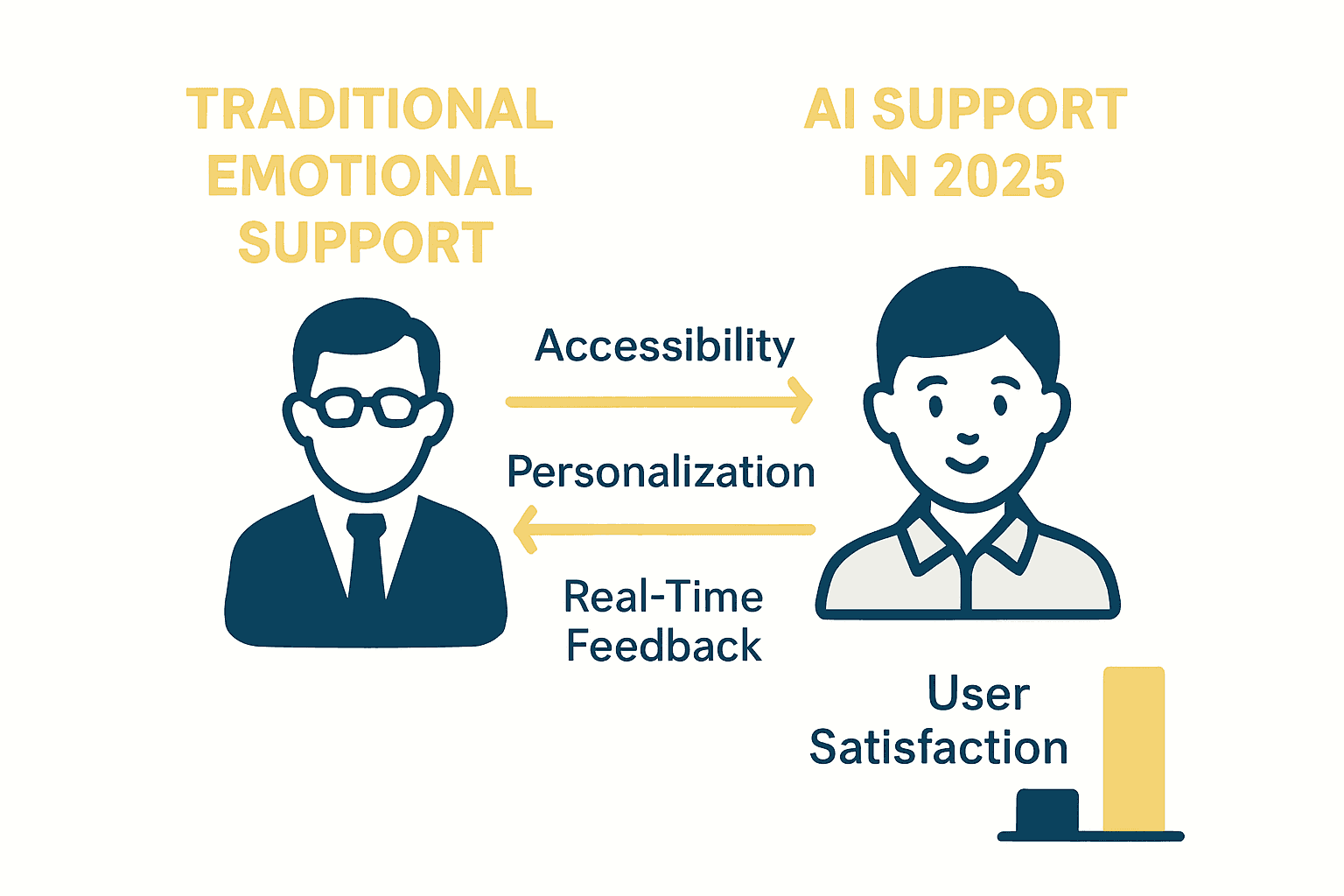
Privacy, Security, and Ethical Considerations
The intersection of AI and emotional support demands rigorous ethical frameworks to protect user vulnerability and personal information. arXiv Research introduces a teleology-driven affective computing framework that emphasizes ethical alignment as fundamental to meaningful human-AI interactions, ensuring technology serves genuine psychological well-being rather than exploitative objectives.
Key ethical considerations for AI emotional support include:
Data Confidentiality: Stringent protection of sensitive personal information
Informed Consent: Transparent communication about data usage and AI interactions
Emotional Boundaries: Clear limitations on AI’s role in psychological support
Algorithmic Fairness: Preventing bias and discrimination in emotional analysis
PsyCounAssist Research demonstrates a novel approach to ethically integrating AI into psychological counseling, highlighting critical security protocols that protect user privacy while maintaining therapeutic effectiveness. These protocols ensure that emotional data remains confidential, processed securely, and used exclusively for supportive purposes.
As AI continues to evolve, maintaining user trust requires ongoing commitment to ethical standards and technological transparency. For those concerned about navigating these complex considerations, understanding the importance of privacy in family chat apps provides additional insights into protecting personal information in digital communication platforms.
Experience Next-Level Emotional Wellbeing with AI Coaching Today
The article highlights the challenges of understanding and managing complex emotions in real time and the breakthroughs in AI-driven emotional intelligence for personal growth. If you want to move beyond traditional emotional support and embrace a superintelligent, context-aware AI coach that actively reads and guides your emotional landscape, Wisdom App offers the breakthrough you need. With features like live emotion detection, relationship superintelligence, and personalized growth plans, Wisdom helps you unlock deeper self-awareness and healthier relationships right inside WhatsApp.
Start transforming your everyday conversations into insightful coaching moments now. Explore how an AI emotional coach can become your invisible life mentor to improve love, work, family, and friendships. Don’t wait to experience 24/7, judgment-free support that adapts uniquely to your emotional needs. Sign up today at Wisdom App and take the first step toward mastering emotional wellbeing with AI’s next frontier.
Frequently Asked Questions
What is emotional wellbeing with AI in 2025?
Emotional wellbeing with AI in 2025 refers to the integration of artificial intelligence into mental health support, where AI serves as a sophisticated tool to understand and enhance emotional states, offering personalized, judgment-free guidance for personal growth and emotional understanding.
How do AI emotional support tools work?
AI emotional support tools use advanced technologies such as natural language processing, sentiment analysis, and multimodal signal analysis to detect emotional nuances and provide context-aware guidance tailored to individual psychological profiles.
What are the benefits of AI coaching for emotional wellbeing?
The benefits of AI coaching include 24/7 emotional accessibility, non-judgmental interaction, personalized insights, and scalable support for individuals who may not have access to traditional therapy.
What ethical considerations are associated with AI in emotional support?
Ethical considerations include ensuring data confidentiality, obtaining informed consent, establishing emotional boundaries for AI interactions, and promoting algorithmic fairness to prevent bias in emotional analysis.
Recommended