Dec 3, 2025
Psychology of AI Communication Tools Explained
Comprehensive guide to the psychology of AI communication tools, covering emotional intelligence, real-time applications, risks, and privacy considerations.

Psychology of AI Communication Tools Explained
Over 60 percent of american adults now interact with artificial intelligence in their everyday digital conversations, often without even realizing it. As these advanced tools blend psychological insight with messaging technology, they transform how people connect, share emotions, and build relationships online. Understanding how AI communication systems decode feelings and mimic empathy unlocks a new view into the future of human connection and personal growth.
Table of Contents
Defining AI Communication Tools And Psychology
Types Of AI Communication And Emotional Coaching
How AI Tools Detect And Respond To Emotions
Real-World Uses In Personal Growth And Relationships
Risks, Limitations, And Privacy Challenges
Key Takeaways
Point | Details |
|---|---|
Integration of Emotional Intelligence | AI communication tools enhance interactions by leveraging emotional intelligence and contextual understanding. |
Diverse Applications | These tools serve various purposes, including mental health support and professional coaching, offering personalized emotional guidance. |
Risks and Ethical Considerations | Users should be aware of potential risks such as emotional manipulation, privacy concerns, and algorithmic bias when using AI tools. |
Limitations of AI Understanding | AI systems may struggle with complex emotional contexts, highlighting the importance of maintaining genuine human connections. |
Defining AI Communication Tools and Psychology
Artificial intelligence communication tools represent a groundbreaking intersection between technology and human interaction, leveraging advanced psychological principles to enhance digital communication experiences. These sophisticated systems go beyond traditional messaging platforms by integrating emotional intelligence and contextual understanding into their core functionality.
At the fundamental level, AI communication tools utilize complex technologies like Natural Language Processing (NLP) and machine learning to decode and generate human-like interactions. According to GeeksforGeeks, these technologies enable AI systems to recognize emotional nuances, interpret contextual cues, and generate responses that mimic human communication patterns. This breakthrough allows AI to understand not just the literal meaning of words, but the underlying emotional subtext.
Public perception of AI communication tools remains complex and multifaceted. PubMed research highlights critical considerations around transparency and ethical usage, revealing that users have distinct preferences regarding AI-mediated communication. Key psychological factors influencing acceptance include:
Transparency about AI involvement
Perceived authenticity of interactions
Emotional safety and privacy
Demonstrated empathy and understanding
Ultimately, AI communication tools represent more than technological innovation - they are emerging platforms for psychological exploration, offering unprecedented opportunities to understand human communication dynamics through intelligent, adaptive systems.
Types of AI Communication and Emotional Coaching
AI communication and emotional coaching tools represent a sophisticated spectrum of technological interventions designed to provide personalized psychological support and guidance. These tools leverage advanced algorithms and machine learning techniques to deliver nuanced, context-aware emotional assistance across various domains of human experience.
AI Competence research highlights the diverse applications of emotional intelligence technologies, showcasing innovative platforms like therapeutic assistants, wellness applications, and customer support avatars. These tools range from mental health chatbots to sophisticated emotional guidance systems that can analyze communication patterns, detect emotional states, and generate supportive, contextually appropriate responses.
According to ANHCO, AI communication tools can be categorized into several key types:
Therapeutic AI Assistants: Specialized chatbots providing mental health support
Wellness Coaching Platforms: Apps focusing on holistic emotional and personal development
Professional Development AI: Tools for executive and life coaching
Interpersonal Communication Enhancers: Systems designed to improve relationship dynamics
These AI-driven emotional coaching tools are not replacement for human interaction, but powerful supplementary resources that offer immediate, personalized psychological insights. By combining advanced natural language processing with deep learning algorithms, they provide users with adaptive, intelligent support tailored to individual emotional landscapes.
How AI Tools Detect and Respond to Emotions
Emotion detection represents a groundbreaking frontier in artificial intelligence, where sophisticated algorithms decode the intricate nuances of human emotional expression. These advanced systems go beyond simple keyword recognition, employing complex emotional intelligence frameworks that analyze multiple layers of communication simultaneously.
AI Competence research reveals how Natural Language Understanding (NLU) techniques enable AI to perform intricate emotional analysis. These tools utilize advanced sentiment analysis algorithms that can:
Detect subtle emotional undertones
Analyze contextual emotional cues
Interpret non-literal language and implied meanings
Recognize emotional intensity and progression
According to Executive, cutting-edge sentiment analysis platforms like Medallia and Lexalytics demonstrate the remarkable precision of modern emotional detection technologies. These systems employ multi-dimensional emotional mapping, combining linguistic analysis, tone recognition, and contextual understanding to generate nuanced, empathetic responses.
The emotional response mechanism in AI tools operates through a sophisticated process of pattern recognition, machine learning, and predictive modeling. By continuously learning from vast datasets of human interactions, these intelligent systems can generate increasingly refined and contextually appropriate emotional responses, bridging the gap between technological processing and genuine human-like empathy.
Real-World Uses in Personal Growth and Relationships
AI communication tools have emerged as transformative technologies that extend far beyond simple conversational interfaces, offering profound opportunities for personal development and relationship enhancement. These intelligent systems act as dynamic companions, providing nuanced insights and strategic guidance across various aspects of human interaction and emotional intelligence.
NECSI research highlights how AI tools are revolutionizing personal growth through emotional intelligence amplification. By analyzing complex behavioral patterns, these technologies help individuals develop critical skills such as:
Emotional self-awareness
Conflict resolution strategies
Communication skill enhancement
Strategic decision-making
Interpersonal relationship management
The real-world applications of AI in personal growth are remarkably multifaceted. These tools can provide personalized feedback on communication styles, detect potential relationship challenges before they escalate, and offer tailored recommendations for emotional development. By combining advanced psychological insights with machine learning algorithms, AI communication platforms create a unique space for continuous personal transformation, acting as an always-available, judgment-free developmental resource.

Ultimately, AI communication tools represent more than technological innovation - they are intelligent mirrors reflecting our emotional landscapes, helping us understand ourselves and our relationships with unprecedented depth and clarity. They transform complex psychological insights into actionable, personalized guidance, bridging the gap between self-awareness and meaningful personal growth.
Risks, Limitations, and Privacy Challenges
Artificial intelligence communication tools, while revolutionary, present a complex landscape of potential risks and ethical challenges that demand careful consideration. These technologies, despite their transformative potential, are not without significant psychological and privacy implications that users must critically evaluate.
PubMed research highlights critical concerns surrounding AI-mediated communication, revealing fundamental challenges that impact user trust and interaction authenticity. The primary risks emerge in several key domains:
Potential for emotional manipulation
Risk of algorithmic bias
Compromised personal data privacy
Reduced human emotional authenticity
Potential psychological dependency
According to CSI, the social implications of AI communication tools extend beyond simple technological interactions. These systems introduce profound questions about human agency, emotional boundaries, and the fundamental nature of interpersonal communication. The inherent limitations become particularly evident when AI tools struggle to comprehend nuanced emotional contexts, cultural subtleties, or complex psychological dynamics.
Navigating these challenges requires a balanced approach that recognizes both the innovative potential and inherent limitations of AI communication technologies.
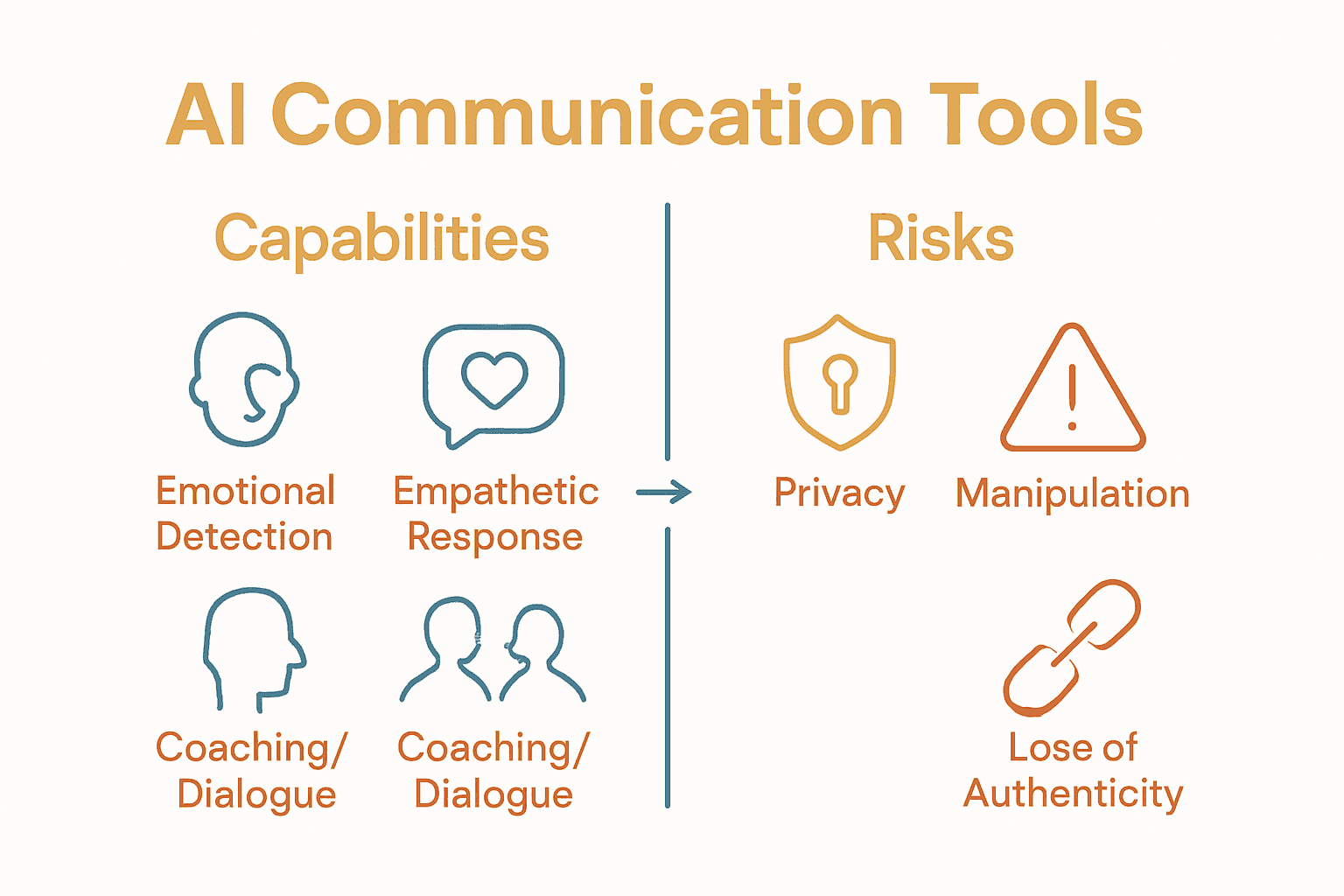
Users must maintain critical awareness, understanding that these tools are sophisticated assistants designed to complement human interaction, not replace the depth and complexity of genuine human emotional connections.
Discover Smarter Emotional Connection with AI That Understands You
The article reveals the complexities and emotional depth behind AI communication tools which are designed to detect feelings and guide conversations intelligently. You understand the challenge of navigating authentic emotions, privacy concerns, and the need for personalized psychological support that truly respects your unique relationships. Wisdom App steps directly into this space, offering a superintelligent AI relationship coach that reads emotional dynamics live and tailors advice specifically for your conversations on WhatsApp. It combines advanced emotional intelligence with a strategic approach to communication—helping you improve self-awareness, resolve conflicts, and grow closer to loved ones without leaving your chat.
Take control of your emotional well-being with an AI life coach that listens like a trusted friend and advises like a seasoned therapist. Experience the power of live emotion detection, relationship superintelligence, and privacy-first design all in one seamless app. Start your journey toward better communication and personal growth today by signing in at Wisdom App. Explore how the world’s first AI emotional coach for WhatsApp transforms ordinary chats into meaningful, actionable insights with powered guidance from a superintelligent AI agent. Empower your relationships with a tool designed to help you grow smarter in love and life right now.
Frequently Asked Questions
What are AI communication tools?
AI communication tools are advanced systems that leverage artificial intelligence, including natural language processing and emotional intelligence, to enhance digital interaction and facilitate human-like conversations.
How do AI communication tools detect and respond to emotions?
AI communication tools use sophisticated algorithms that analyze emotional nuances in human communication. They employ sentiment analysis to interpret emotional cues, recognize tone, and generate empathetic responses tailored to the user’s emotional state.
What are the different types of AI communication tools?
AI communication tools can be categorized into several types, including therapeutic AI assistants, wellness coaching platforms, professional development AIs, and interpersonal communication enhancers, each focusing on various aspects of emotional support and human interaction.
What are the potential risks associated with AI communication tools?
Some potential risks include emotional manipulation, algorithmic bias, compromised privacy, reduced authenticity in human interactions, and possible psychological dependency on these tools.
Recommended