Nov 4, 2025
Role of Data in Emotional Wellbeing: Complete Guide
Comprehensive guide to the role of data in emotional wellbeing. Learn how AI-powered insights, real-time emotion detection, and privacy shape mental health.

Role of Data in Emotional Wellbeing: Complete Guide
Nearly 73 percent of adults report that tracking their emotions helps them better understand their mental health. As data becomes more integrated into everyday life, its power to reveal hidden patterns in our emotional wellbeing is growing. New tools and AI platforms now turn daily feelings into actionable insights, guiding people toward healthier relationships, improved self-awareness, and more resilient mental states.
Table of Contents
Defining Data’s Impact on Emotional Wellbeing
Types of Emotional Data and Their Sources
How AI Analyzes and Utilizes Emotional Data
Benefits of Data-Driven Emotional Support
Privacy, Security, and Ethical Considerations
Avoiding Pitfalls and Maximizing Wellbeing with Data
Key Takeaways
Point | Details |
|---|---|
Emotional Data Insights | Data allows individuals to map emotional patterns, identify triggers, and develop personal growth strategies through systematic collection and analysis. |
AI’s Role in Emotional Analysis | Advanced AI technologies enhance emotional wellbeing by integrating various data sources, providing actionable insights for better emotional understanding. |
Personalized Emotional Support | Data-driven approaches enable tailored emotional assistance and continuous monitoring, promoting proactive mental health management. |
Ethical Considerations | Managing emotional data involves ensuring informed consent, data privacy, and user control to uphold personal autonomy and psychological safety. |
Defining Data’s Impact on Emotional Wellbeing
Data has emerged as a powerful lens through which we can understand, track, and enhance our emotional wellbeing. Emotional data represents more than just numbers - it captures the intricate patterns of human feelings, behaviors, and psychological states. By systematically collecting and analyzing personal emotional information, individuals can gain unprecedented insights into their mental and relational dynamics.
In the realm of emotional intelligence, data serves multiple critical functions. It helps us map emotional patterns, identify triggers, recognize recurring psychological responses, and develop targeted strategies for personal growth. Advanced AI technologies like Signs of Emotional Wellness Guide are revolutionizing how we understand emotional health by transforming subjective experiences into measurable, actionable information.
The primary dimensions of emotional data encompass several key areas:
Mood Tracking: Recording daily emotional states and fluctuations
Behavioral Patterns: Analyzing recurring psychological responses
Relationship Dynamics: Measuring interaction quality and communication effectiveness
Stress Response: Monitoring physiological and psychological stress indicators
By leveraging data-driven insights, individuals can develop more nuanced self-awareness. This approach transforms emotional understanding from a subjective experience into a structured, strategic process of personal development. With technological advancements in AI and machine learning, Understanding AI Emotional Support platforms can now provide unprecedented depth and accuracy in emotional analysis, helping people navigate complex psychological landscapes with greater precision and self-understanding.
Types of Emotional Data and Their Sources
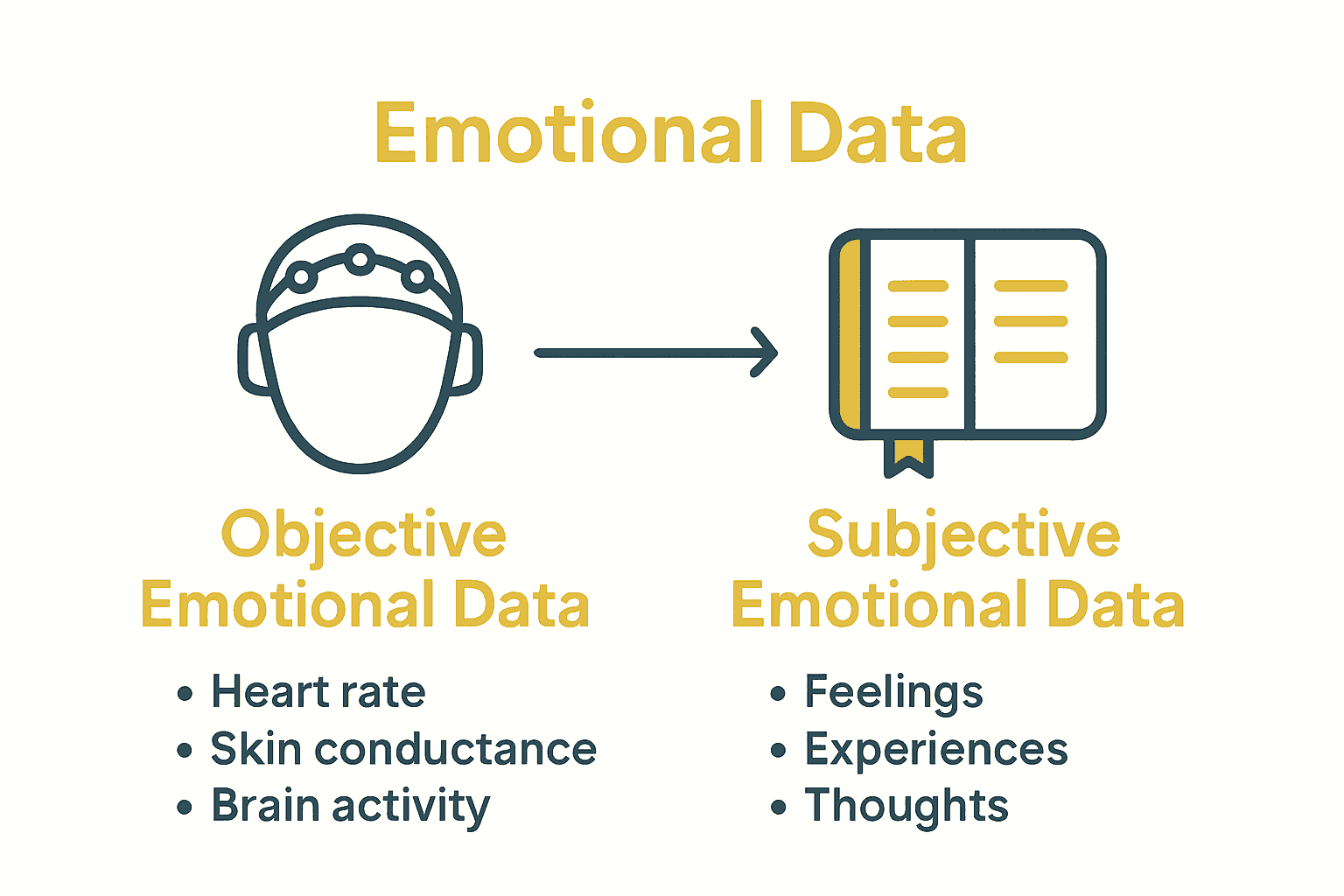
Emotional data encompasses a diverse range of information sources that capture the complex landscape of human feelings and psychological experiences. According to research from doras, these sources can be categorized into objective physiological measurements and subjective self-reported experiences, providing a comprehensive view of emotional states.
The primary types of emotional data collection include:
Physiological Signals: Measuring biological responses through technologies like:
Electroencephalography (EEG)
Electrocardiography (ECG)
Galvanic Skin Response (GSR)
Self-Assessment Tools: Psychological instruments that capture personal emotional experiences
Behavioral Tracking: Analyzing patterns of interaction and response
Diary studies, as documented in research, represent a powerful qualitative method for collecting emotional data. Participants record daily experiences, thoughts, and feelings, providing rich contextual insights into their emotional landscapes. These longitudinal records offer deep understanding of emotional progression and pattern recognition.

With the emergence of Defining Emotional Superintelligence, AI technologies are revolutionizing emotional data collection. Advanced platforms can now integrate multiple data sources - from physiological signals to self-reported experiences - creating a holistic, nuanced understanding of individual emotional dynamics. This multi-dimensional approach transforms emotional data from isolated snapshots into comprehensive, actionable insights about human psychological experiences.
Here’s a summary of the main types of emotional data and their sources:
Emotional Data Type | Data Source Example | Description |
|---|---|---|
Physiological Signals | EEG | Measures biological responses |
Self-Assessment Tools | Surveys | Captures self-reported experiences |
Behavioral Tracking | App usage | Analyzes patterns of interaction |
Diary Studies | Daily journals | Provides qualitative day-to-day insights |
How AI Analyzes and Utilizes Emotional Data
Artificial Intelligence has revolutionized emotional data analysis by transforming complex psychological information into actionable insights. According to research from Wikipedia, AI systems can now analyze extensive datasets including brain imaging and behavioral data to detect intricate biomarkers associated with mental health conditions, enabling more accurate diagnoses and personalized treatment strategies.
The core mechanisms of AI emotional analysis include:
Pattern Recognition: Identifying recurring emotional and behavioral sequences
Contextual Understanding: Interpreting emotions within specific environmental contexts
Predictive Modeling: Forecasting potential emotional trajectories
Multimodal Data Integration: Combining physiological, behavioral, and self-reported data
Research from arXiv highlights how advanced AI models can now interpret human emotions through sophisticated techniques like analyzing facial expressions and scene contexts. These models are trained on extensive datasets, allowing them to recognize nuanced emotional states in natural environments with unprecedented accuracy.
With the emergence of AI Emotional Intelligence Guide, AI technologies are pushing the boundaries of emotional understanding. By leveraging machine learning algorithms and deep neural networks, these systems can now provide insights that go beyond traditional psychological assessments, offering real-time, dynamic understanding of human emotional experiences and potential intervention strategies.
Benefits of Data-Driven Emotional Support
Data-driven emotional support represents a transformative approach to mental health and personal growth, leveraging technology to provide personalized, precise, and proactive psychological assistance. According to research from WJARR, these approaches enable real-time customization of interventions tailored to individual and group needs, significantly improving overall well-being and creating more supportive environments.
The key benefits of data-driven emotional support include:
Personalized Insights: Generating unique, individual-specific emotional understanding
Predictive Support: Anticipating potential emotional challenges before they escalate
Continuous Monitoring: Tracking emotional progression and development
Objective Assessment: Reducing bias through data-driven analysis
Research from Wikipedia highlights how AI technologies are facilitating mental health services, particularly through virtual platforms that increase access to care, especially in underserved areas. These technologies democratize emotional support, breaking down traditional barriers of cost, geography, and availability.
By integrating advanced technologies like Digital Emotional Support, data-driven emotional support transforms psychological assistance from a reactive model to a proactive, predictive framework. This approach empowers individuals with deeper self-understanding, providing actionable insights that enable more effective emotional management and personal growth strategies.
Privacy, Security, and Ethical Considerations
Digital emotional data represents a complex landscape of potential insights and significant ethical challenges. According to research from Wikipedia, the implementation of AI in mental healthcare presents critical considerations around data privacy, security, and the fundamental barriers to responsible technology adoption.
Key ethical considerations in emotional data management include:
Informed Consent: Ensuring users fully understand data collection processes
Data Anonymization: Protecting individual identities and personal information
Transparent Data Usage: Clearly communicating how emotional data will be utilized
User Control: Providing mechanisms for data access, modification, and deletion
Research on digital phenotyping highlights the profound ethical concerns surrounding continuous behavioral monitoring through personal digital devices. The potential for intrusive tracking raises critical questions about individual autonomy and psychological privacy.
By integrating rigorous privacy protocols, like those explored in Understanding Privacy in Family Chat Apps, emotional support platforms can build trust through transparent, user-centric data management. This approach prioritizes individual agency, ensuring that technological innovation never compromises personal boundaries or psychological safety.
Avoiding Pitfalls and Maximizing Wellbeing with Data
Emotional data analysis requires a nuanced and critically aware approach to truly support individual wellbeing. According to research on impact bias, humans tend to overestimate the intensity and duration of future emotional states, which can significantly distort data-driven emotional assessments and lead to potentially misleading interventions.
Key strategies for responsible emotional data utilization include:
Critical Data Interpretation: Recognizing the limitations of quantitative emotional measurements
Contextual Understanding: Considering broader life circumstances beyond raw data points
Emotional Complexity Recognition: Acknowledging that feelings are multidimensional and non-linear
Continuous Learning: Adapting analytical approaches based on emerging psychological insights
Research on digital phenotyping emphasizes the critical importance of addressing ethical concerns while leveraging data for mental health insights. This involves maintaining a delicate balance between technological innovation and preserving individual psychological autonomy.
By integrating principles from Emotional Wellbeing in the Digital Age, individuals can transform data from a potential pitfall into a powerful tool for personal growth. The key lies in approaching emotional data with humility, recognizing that numbers and algorithms are tools to support human experience, not replace the rich, nuanced nature of emotional life.
Unlock the Power of Emotional Data with Wisdom App
The article highlights how emotional data is essential for understanding and improving our emotional wellbeing through careful tracking and insightful analysis. If you often feel overwhelmed by your emotions or struggle to make sense of your relationship dynamics, you are not alone. Gaining clarity on live emotional states and behavioral patterns is key to personal growth and better connections. Wisdom App offers a breakthrough solution by acting as your AI emotional coach inside WhatsApp. It reads your ongoing conversations and emotional cues, then delivers personalized, context-aware advice tailored for love, work, family, and friendships.

Experience the benefits of data-driven emotional support with features like live emotion detection, predictive insights, and relationship scorecards. Wisdom is more than a chatbot—it is a superintelligent AI agent designed to improve emotional awareness and relationship success discreetly and securely. Start transforming your emotional understanding today by joining thousands who use Wisdom App. Explore how AI life coaching can empower your mental health and personal growth by signing up now at https://app.wisdomnow.co/signIn and discover the future of emotional intelligence apps.
Frequently Asked Questions
What is emotional data?
Emotional data refers to information that captures human feelings, behaviors, and psychological states. It includes both subjective experiences and objective physiological measurements, helping individuals understand their emotional wellbeing better.
How can AI enhance emotional wellbeing?
AI enhances emotional wellbeing by analyzing large datasets to identify emotional patterns, predict potential challenges, and provide personalized support. AI can process various emotional data types, providing deeper insights compared to traditional assessments.
What are some common types of emotional data collection methods?
Common types of emotional data collection include physiological signals, self-assessment tools like surveys and diaries, behavioral tracking through apps, and qualitative diary studies that record daily emotional experiences.
What ethical considerations should be taken into account when using emotional data?
Key ethical considerations include ensuring informed consent, protecting data anonymity, maintaining transparency about data usage, and allowing users control over their data. These practices help build trust and protect individual psychological privacy.
Recommended