Nov 21, 2025
AI and Personal Growth: Complete Guide to Transformation
AI emotional coach: comprehensive guide to AI for personal growth, emotional intelligence, relationship management, and digital self-improvement tools.

AI and Personal Growth: Complete Guide to Transformation
Over 80 percent of people now tap into digital tools for personal improvement, but few realize how dramatically AI is changing the game. With the rise of intelligent systems that can recognize emotions, track progress, and adapt guidance in real time, personal growth is becoming more personalized and responsive than ever. Understanding how AI shapes emotional wellbeing and self-awareness opens new doors to deeper connection, insight, and psychological support.
Table of Contents
Defining AI for Personal Growth and Wellbeing
Core Features of AI Emotional Coaching
How AI Transforms Relationships and Self-Awareness
Key Benefits and Real-World Applications
Risks, Limitations, and Privacy Considerations
Key Takeaways
Point | Details |
|---|---|
AI enhances personal development | AI provides personalized emotional support and adaptive guidance, transcending traditional self-help methods. |
Real-time insights and feedback | Advanced AI systems offer continuous monitoring and tailored strategies that facilitate ongoing personal growth. |
Transformative impact on relationships | AI aids in recognizing emotional patterns and offers unbiased reflections to improve interpersonal dynamics. |
Consideration of risks and privacy | Users must be mindful of potential dependencies and ensure data privacy when engaging with AI-driven personal development tools. |
Defining AI for Personal Growth and Wellbeing
Artificial Intelligence (AI) represents a transformative approach to personal development, offering unprecedented capabilities for emotional intelligence, self-improvement, and psychological support. Unlike traditional self-help methods, AI introduces dynamic, responsive systems that can adapt to individual psychological landscapes and provide nuanced guidance.
According to research from Springer, AI’s impact on personal wellbeing is multifaceted, presenting both significant opportunities and potential challenges. The study highlights AI’s potential to enhance personal growth through:
Personalized Support: Creating tailored emotional feedback mechanisms
Automated Learning: Analyzing individual behavior patterns
Adaptive Guidance: Developing context-specific developmental strategies
The emerging field of AI-driven personal development goes beyond traditional coaching by integrating sophisticated emotional intelligence algorithms. Frontiersin research emphasizes the importance of designing intelligent systems that create “feedback loops” for continuous psychological assessment and support. This means AI can now recognize emotional nuances, track personal growth trajectories, and provide insights that human coaches might miss.

Modern AI personal growth tools represent more than technological innovation - they are becoming sophisticated companions in our journey of self-discovery. By combining psychological insights, real-time emotion detection, and adaptive learning algorithms, these systems offer a revolutionary approach to understanding and improving our emotional intelligence. Explore how AI can transform your personal growth journey with our comprehensive guide on emotional wellbeing with AI.
Core Features of AI Emotional Coaching
AI emotional coaching represents a sophisticated technological approach to psychological support, leveraging advanced algorithms and machine learning to provide personalized, responsive guidance. These systems go beyond traditional coaching by integrating complex emotional intelligence frameworks that adapt dynamically to individual psychological needs.
Research from arXiv introduces a groundbreaking evaluation framework for emotional support in language models, highlighting their capacity to stabilize and improve user emotional states through nuanced, context-aware interactions. The key features of AI emotional coaching include:
Real-time Emotion Detection: Analyzing verbal and contextual cues
Dynamic Response Generation: Creating personalized emotional support strategies
Continuous Learning: Adapting guidance based on individual interaction patterns
arXiv further explores this field with the ‘Reflexion’ platform, which demonstrates how AI can facilitate structured emotional self-reflection through innovative techniques like metaphorical storytelling and real-time emotion tracking. This approach transforms emotional coaching from a static, one-size-fits-all model to a highly personalized, responsive support system.
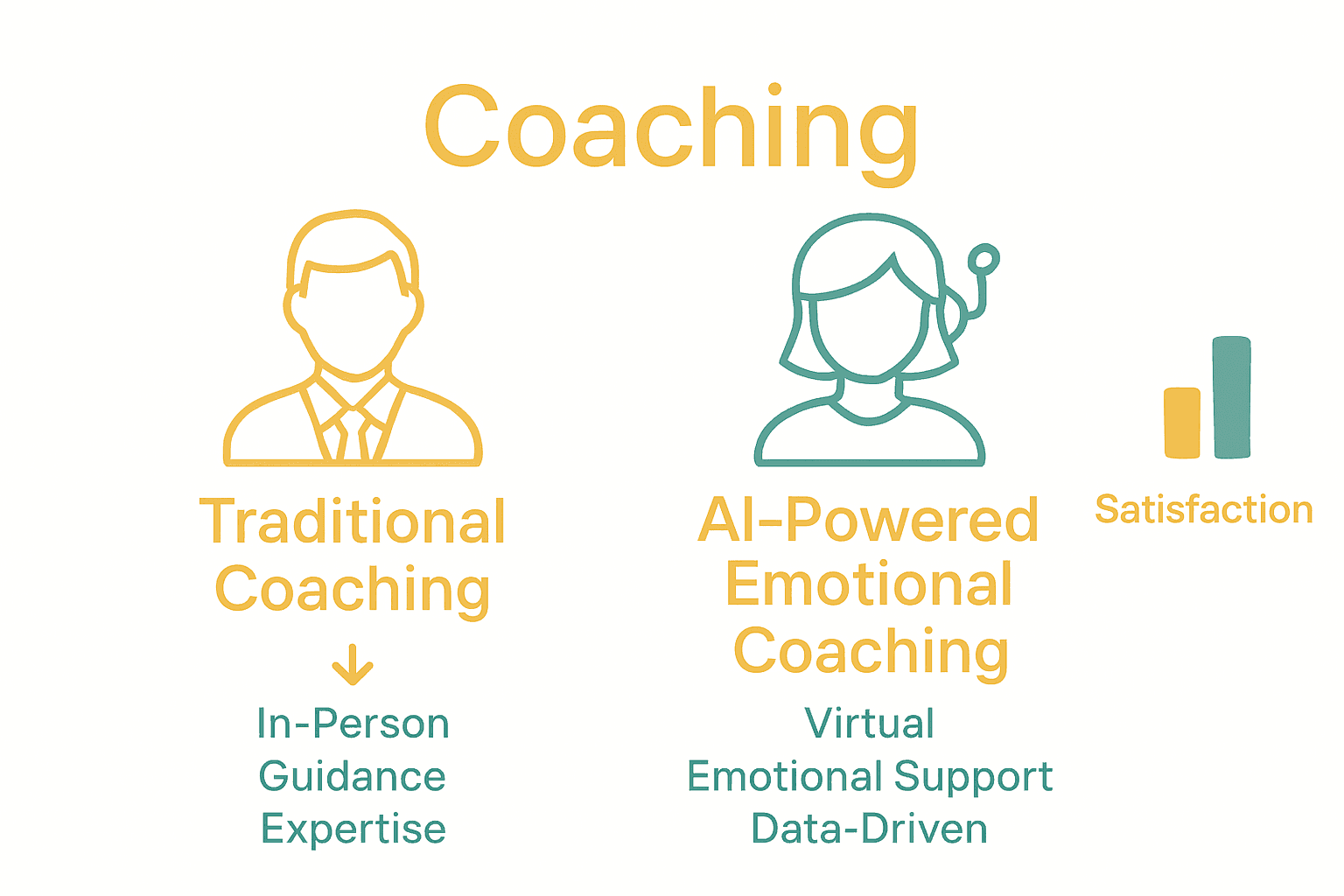
The most advanced AI emotional coaching tools now integrate psychological insights with cutting-edge technology, creating an unprecedented opportunity for personal growth. Learn more about the transformative potential of AI emotional intelligence in our comprehensive guide, which explores how these intelligent systems are revolutionizing personal development and emotional well-being.
How AI Transforms Relationships and Self-Awareness
Artificial Intelligence is revolutionizing our understanding of relationships and self-awareness, offering unprecedented insights into emotional intelligence and interpersonal dynamics. By leveraging advanced algorithms and machine learning, AI provides a mirror that reflects our deepest emotional patterns and potential growth opportunities.
Research from arXiv reveals a groundbreaking understanding of human-AI emotional alignment, demonstrating that AI systems can now share and modulate emotions across different languages and cultural contexts. This breakthrough suggests that AI is not just a technological tool, but an emerging platform for emotional exploration and understanding.
Key transformative aspects of AI in relationships include:
Emotional Pattern Recognition: Identifying recurring behavioral cycles
Unbiased Reflection: Providing objective insights into personal interactions
Adaptive Communication: Tailoring emotional support to individual needs
Wikipedia highlights fascinating research examining human acceptance of AI as potential emotional and romantic partners, revealing complex societal perspectives on technological intimacy. This emerging field challenges traditional boundaries of emotional connection, suggesting that AI might become a sophisticated companion in our journey of self-discovery.
As AI continues to evolve, it promises to be more than a technological innovation - it’s becoming a transformative partner in personal growth. Explore our comprehensive guide on emotional awareness and AI’s role in transforming relationships to understand how these intelligent systems are reshaping our approach to emotional intelligence and interpersonal connections.
Key Benefits and Real-World Applications
AI-powered personal development tools represent a transformative approach to self-improvement, offering sophisticated solutions that adapt and respond to individual psychological needs. These intelligent systems go beyond traditional coaching methods by providing personalized, data-driven insights that can dramatically accelerate personal growth across multiple domains of life.
JISEM Journal research reveals compelling evidence of AI’s potential to enhance emotional intelligence and social skills, demonstrating significant improvements in personality development. The real-world applications of these technologies are both profound and far-reaching:
Professional Development: Customized career coaching and skill enhancement
Mental Health Support: Continuous emotional monitoring and adaptive guidance
Relationship Optimization: Nuanced communication strategy development
Personal Growth: Targeted self-improvement recommendations
The most advanced AI systems now integrate complex psychological frameworks with machine learning algorithms, creating unprecedented opportunities for personal transformation. These tools can analyze behavioral patterns, predict potential challenges, and provide strategic interventions tailored to an individual’s unique emotional landscape.
By bridging technology and human potential, AI is redefining personal development as an intelligent, responsive, and deeply personalized journey. Discover how AI can revolutionize your approach to emotional intelligence and self-improvement, unlocking new dimensions of personal growth and emotional mastery.
Risks, Limitations, and Privacy Considerations
While AI offers transformative potential for personal growth, it is crucial to approach these technologies with a balanced and critical perspective. The integration of artificial intelligence into personal development requires careful navigation of potential risks, ethical considerations, and psychological limitations.
MDPI research reveals a concerning trend, highlighting a negative correlation between extensive ChatGPT usage and critical aspects of personal well-being, including self-control and academic performance. This underscores the importance of maintaining a thoughtful and measured approach to AI engagement:
Potential Dependency: Risk of over-reliance on AI guidance
Emotional Authenticity: Challenges in replicating genuine human empathy
ICA Coach emphasizes the irreplaceable nature of human emotional intelligence, particularly in coaching relationships. The research highlights critical limitations in AI’s ability to build deep, trust-based connections that are fundamental to meaningful personal transformation.
Privacy considerations remain paramount in AI-driven personal development. While these technologies offer unprecedented insights, users must remain vigilant about data protection, emotional boundaries, and the potential for algorithmic bias. Learn more about maintaining privacy in digital coaching environments, ensuring a safe and secure path to personal growth.
Unlock Your Personal Growth with AI Emotional Coaching Today
The article highlights the powerful role AI plays in transforming emotional intelligence and personal development by offering personalized, real-time guidance that adapts to your unique emotional patterns. If you find yourself striving for deeper self-awareness, improved relationships, or smarter emotional management, the challenge is clear: how can you receive consistent, reliable support without overwhelming complexity or losing authenticity? Wisdom App delivers the answer by acting as an AI emotional coach and relationship superintelligence right inside WhatsApp.
Experience the future of personal growth with a tool designed to detect your emotions live, analyze context, and offer strategic advice tailored for your romantic, family, professional, or social connections. Start enhancing your communication, self-control, and emotional wellbeing now. Take the first step toward smarter love and life by signing up for Wisdom App, explore how AI can support your journey with AI emotional coaching, and see why thousands trust this superintelligent AI agent as their digital companion for lasting transformation.
Frequently Asked Questions
How can AI enhance personal growth and emotional wellbeing?
AI enhances personal growth by providing personalized support, automated learning, and adaptive guidance. It analyzes individual behavior patterns and creates tailored emotional feedback mechanisms, which can lead to significant improvements in emotional intelligence and personal development.
What are the core features of AI emotional coaching systems?
Core features of AI emotional coaching include real-time emotion detection, dynamic response generation, and continuous learning. These features enable AI to analyze verbal and contextual cues to provide personalized emotional support strategies.
What are the potential risks and limitations of using AI for personal development?
Potential risks of using AI for personal development include dependency on AI guidance, challenges in replicating genuine human empathy, and privacy concerns regarding data protection. It’s essential to engage thoughtfully with AI tools to prevent negative outcomes.
How do AI tools facilitate relationship optimization and self-awareness?
AI tools facilitate relationship optimization by recognizing emotional patterns, providing unbiased reflections on personal interactions, and tailoring communication strategies to individual needs. This encourages deeper self-awareness and understanding of interpersonal dynamics.
Recommended