Dec 10, 2025
AI and Self-Improvement: Complete Guide to Smart Growth
AI emotional coach for self-improvement: learn key features, real-world applications, privacy, risks, and how AI boosts personal growth.

AI and Self-Improvement: Complete Guide to Smart Growth
Most American adults are now turning to Artificial Intelligence tools for self-improvement, with over 60 percent saying technology has changed the way they approach personal growth. This rise in AI-powered guidance matters because it can personalize feedback and support in ways traditional methods rarely achieve. Whether someone is looking to build confidence, improve emotional intelligence, or find balance in daily life, understanding the real potential of modern AI can open new possibilities for meaningful change.
Table of Contents
Defining AI for Self-Improvement and Growth
Types of AI Coaching and Emotional Support
Core Features of AI-Driven Personal Growth
Real-World Applications for Relationships and Life
Privacy, Security, and Common Misconceptions
Risks, Limitations, and Best Practices
Key Takeaways
Point | Details |
|---|---|
AI Personalization | AI technologies provide tailored recommendations for personal development based on individual behavioral analysis. |
Emotional Support Systems | AI-driven systems offer various forms of emotional coaching that adapt to personal circumstances for improved well-being. |
Privacy and Ethics | Utilizing AI in personal growth necessitates strict adherence to data privacy and ethical guidelines to ensure user safety. |
Critical Awareness | Users must remain critically aware of AI’s limitations and potential biases, balancing technological assistance with human judgment. |
Defining AI for Self-Improvement and Growth
Artificial Intelligence (AI) represents a transformative approach to personal development, enabling individuals to leverage advanced technologies for strategic growth and self-enhancement. Unlike traditional self-improvement methods, AI brings unprecedented personalization, adaptive learning, and data-driven insights into the realm of individual transformation.
At its core, AI for self-improvement functions through sophisticated algorithms that analyze behavioral patterns, emotional responses, and performance metrics to generate tailored recommendations. Researchers exploring AI-driven personal development have demonstrated how these technologies can provide individualized support mechanisms across multiple domains, including mental wellness, skill acquisition, productivity optimization, and emotional intelligence training.
The fundamental mechanism of AI in personal growth involves continuous learning and adaptation. Through advanced generative intelligence frameworks, AI systems can dynamically adjust their guidance based on user interactions, creating a responsive and intuitive growth environment. This approach transforms self-improvement from a static process into an intelligent, interactive journey where technology acts as a personalized coach, helping individuals identify strengths, address limitations, and design strategic pathways for personal evolution.
Key characteristics of AI-powered self-improvement include:
Personalized analysis of individual performance and potential
Real-time feedback and adaptive recommendations
Data-driven insights across emotional, professional, and personal domains
Scalable learning techniques that evolve with user progress
Privacy-protected guidance tailored to unique individual needs
Types of AI Coaching and Emotional Support
Artificial Intelligence (AI) emotional support systems have evolved into sophisticated platforms offering diverse approaches to personal guidance and psychological assistance. These systems range from conversational agents to advanced analytical tools designed to provide nuanced, context-aware emotional coaching across different domains of human experience.
Systematic research in educational settings has identified multiple distinct types of AI emotional support mechanisms. These include systems that generate affective responses tailored to individual circumstances, interactive platforms that create positive psychological environments, and adaptive technologies capable of understanding and responding to complex emotional landscapes.
The landscape of AI emotional coaching can be categorized into several key types. Advanced evaluation frameworks help distinguish these systems based on their interaction models, depth of emotional intelligence, and specific support objectives. Primary categories include:
Conversational AI Coaches: Provide real-time dialogue and immediate emotional feedback
Analytical Emotional Support Systems: Offer data-driven insights into emotional patterns and potential growth strategies
Predictive Emotional Guidance: Use machine learning to anticipate emotional challenges and proactively suggest coping mechanisms
Personalized Therapeutic Interfaces: Create customized emotional support experiences based on individual psychological profiles
Holistic Well-being Platforms: Integrate emotional, mental, and behavioral insights for comprehensive personal development
These AI-powered emotional support systems represent a revolutionary approach to personal growth, combining technological sophistication with deep psychological understanding to provide unprecedented levels of individualized guidance.
Core Features of AI-Driven Personal Growth
AI-driven personal growth represents a revolutionary approach to self-improvement, leveraging advanced technologies to create dynamic, intelligent systems that adapt and respond to individual developmental needs. These sophisticated platforms go beyond traditional coaching methods by integrating complex cognitive mechanisms that enable continuous learning and personalized guidance.

The Active Thinking Model demonstrates how AI can autonomously evaluate performance and generate novel strategies for personal development. This approach introduces dynamic task generation and self-reflective learning capabilities that allow individuals to continuously refine their growth strategies, identifying strengths and addressing potential limitations with unprecedented precision.
Core features of AI-driven personal growth systems typically encompass a comprehensive range of sophisticated capabilities. Emerging AI development frameworks emphasize the importance of ethical and adaptive learning environments that support holistic personal transformation. These advanced systems distinguish themselves through several key attributes:
Adaptive Learning Mechanisms: Continuously adjust recommendations based on individual progress and behavioral patterns
Real-Time Performance Analysis: Provide immediate insights into personal growth trajectories
Predictive Skill Development: Anticipate potential challenges and proactively suggest improvement strategies
Contextual Intelligence: Understand nuanced personal circumstances and tailor guidance accordingly
Ethical Self-Reflection: Integrate moral and emotional development into the growth process
By combining technological sophistication with deep psychological understanding, AI-driven personal growth platforms offer a transformative approach to self-improvement that is personalized, intelligent, and dynamically responsive to individual needs.
Real-World Applications for Relationships and Life
Artificial Intelligence is transforming how individuals navigate complex personal and professional relationships, offering unprecedented insights and support across multiple life domains. By leveraging advanced algorithms and emotional intelligence, AI technologies provide nuanced guidance that adapts to individual communication styles, emotional states, and interpersonal dynamics.
Intelligent tutoring systems demonstrate how computational linguistics can create adaptive conversational experiences that respond to cognitive and emotional contexts. These technologies extend far beyond traditional coaching, enabling individuals to receive personalized support in real-time communication, conflict resolution, and personal growth strategies.
The practical applications of AI in relationships and life management span several critical areas, helping individuals develop more meaningful connections and self-awareness:
Communication Enhancement: Analyzing communication patterns and suggesting more effective interaction strategies
Emotional Intelligence Training: Providing real-time feedback on emotional responses and interpersonal dynamics
Conflict Resolution: Offering strategic guidance for navigating challenging relationship scenarios
Personal Development: Generating customized growth plans based on individual behavioral insights
Relationship Compatibility: Assessing communication styles and potential areas of connection or friction
These AI-driven approaches represent a fundamental shift in how people understand and improve their personal and professional relationships, transforming complex human interactions into opportunities for continuous learning and growth.
Privacy, Security, and Common Misconceptions
Artificial Intelligence in personal development represents a powerful technological frontier that simultaneously inspires excitement and provokes legitimate concerns about privacy, ethical boundaries, and potential risks. Understanding the nuanced landscape of AI safety requires critically examining both the transformative potential and potential limitations of intelligent systems.
Friendly artificial intelligence represents a critical framework for ensuring that AI technologies remain aligned with human interests. This approach focuses on developing intelligent systems that prioritize user safety, maintain stringent privacy protocols, and provide transparent, ethical guidance without compromising personal data or individual autonomy.
Recursive self-improvement models highlight the complex ethical considerations surrounding AI development. Common misconceptions about AI often stem from misunderstandings about technological capabilities and potential risks. Key areas of concern and clarification include:
Data Privacy: Ensuring personal information remains confidential and protected
Algorithmic Transparency: Understanding how AI makes recommendations and decisions
Consent and Control: Maintaining user agency in AI-driven interactions
Ethical Boundaries: Preventing potential manipulation or unintended psychological impacts
Technological Limitations: Recognizing that AI is a supportive tool, not a replacement for human judgment
Effective AI systems must balance technological innovation with robust ethical frameworks, creating a responsible approach that empowers users while protecting their fundamental rights and personal boundaries.
Risks, Limitations, and Best Practices
Artificial Intelligence technologies offer transformative potential for personal growth, but understanding their inherent risks and implementing strategic safeguards is crucial for responsible engagement. Navigating the complex landscape of AI-driven personal development requires a nuanced approach that balances technological innovation with critical human oversight.
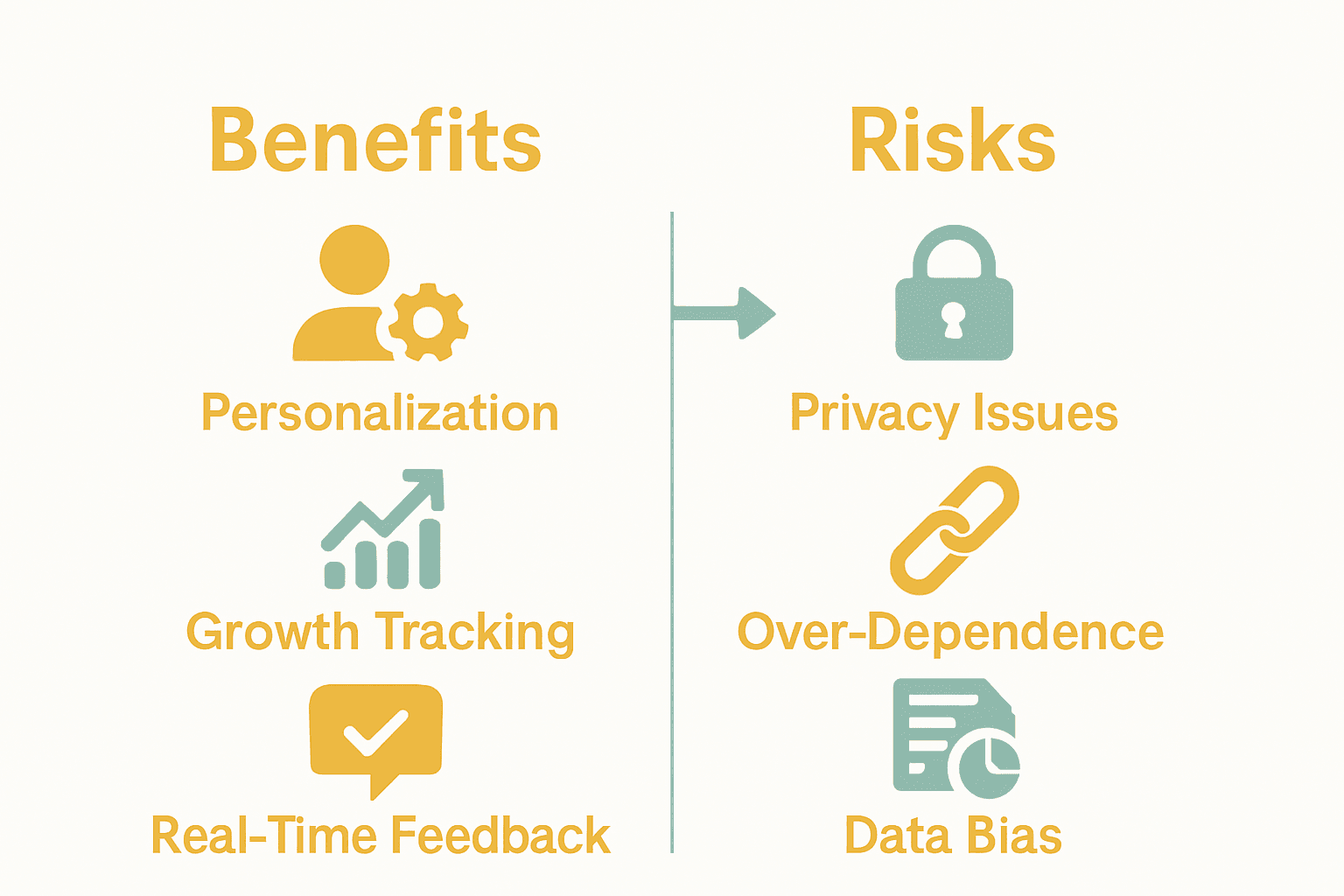
Research investigating AI-powered educational applications reveals critical insights into the complex dynamics of technological intervention. These studies demonstrate that while AI can significantly enhance learning strategies, it simultaneously presents potential limitations that users must carefully consider and manage.
Self-regulated learning supported by AI interventions highlights the multifaceted challenges inherent in technological personal development tools. Key risks and best practices include:
Algorithmic Bias: Recognize and mitigate potential prejudices in AI recommendation systems
Psychological Dependency: Maintain human agency and avoid over-reliance on technological guidance
Data Privacy: Implement robust protection mechanisms for personal information
Emotional Intelligence Limitations: Understand AI’s contextual and empathetic constraints
Continuous Critical Evaluation: Regularly assess the effectiveness and ethical implications of AI tools
Successful integration of AI into personal growth requires a balanced, critically aware approach that leverages technological capabilities while preserving individual autonomy and psychological well-being.
Unlock Smarter Growth with AI-Powered Emotional Coaching
The article highlights the challenge of navigating complex emotional patterns and personal growth using traditional self-improvement methods. If you seek adaptive learning mechanisms, real-time emotional insights, and personalized strategies rooted in psychology and data-driven intelligence, you are not alone. Wisdom App offers a unique solution by blending live emotion detection, relationship superintelligence, and context-aware guidance to turn everyday conversations into powerful opportunities for self-improvement.
Ready to experience transformational growth tailored to your unique relationships? Start using Wisdom App, the world’s first AI emotional coach on WhatsApp. Designed to support your mental wellness, communication skills, and emotional intelligence in real time, Wisdom provides strategic guidance without disrupting your daily interactions. Take control of your personal evolution with a trusted digital companion that respects your privacy and grows smarter with every chat.
Frequently Asked Questions
What is AI for self-improvement?
AI for self-improvement uses advanced algorithms to analyze personal data, providing tailored recommendations for growth and development across various domains, such as mental wellness and productivity.
How can AI enhance emotional intelligence training?
AI enhances emotional intelligence training by offering real-time feedback on emotional responses, suggesting coping mechanisms, and providing insights into interpersonal dynamics, facilitating better communication and understanding.
What types of AI support systems are available for personal growth?
Common types of AI support systems for personal growth include conversational AI coaches, analytical emotional support systems, predictive emotional guidance, personalized therapeutic interfaces, and holistic well-being platforms.
Are there privacy concerns associated with using AI for self-improvement?
Yes, privacy concerns exist, especially regarding data confidentiality and algorithmic transparency. It is essential for users to understand how their data is protected and how AI systems make recommendations.
Recommended