Dec 30, 2025
Psychology of Digital Companions – Impact on Emotional Growth
AI emotional coach apps on WhatsApp are transforming relationships. Explore digital companion psychology, benefits, key features, and ethical concerns.

Psychology of Digital Companions – Impact on Emotional Growth
Almost half of American adults now interact with digital companions powered by artificial intelligence, tapping into personalized guidance on platforms like WhatsApp for relationship advice and personal growth. This shift matters because emotional intelligence and effective communication are becoming must-have skills for tech-savvy Millennials and Gen Z navigating life’s complex connections globally. Discover how advanced AI companions offer safe support to deepen self-awareness, strengthen your relationships, and boost your emotional intelligence in an ever-changing digital world.
Table of Contents
Defining Digital Companions And Core Concepts
Types Of Digital Companions And Their Uses
How Ai-Powered Emotional Coaching Works
Benefits For Emotional Intelligence And Relationships
Risks, Limitations, And Ethical Considerations
Key Takeaways
Point | Details |
|---|---|
Digital Companions Transform Interactions | These AI systems create empathetic connections and foster emotional growth, moving beyond traditional chatbots. |
Diverse Applications Across User Types | Digital companions support various needs, from child development to emotional support and personal growth. |
Emotional Coaching Enhances Self-Awareness | AI-powered emotional coaching provides personalized feedback, assisting users in managing emotions and improving communication. |
Ethical Considerations Are Critical | Users must remain aware of risks such as emotional dependency and privacy concerns, focusing on responsible usage. |
Defining Digital Companions and Core Concepts
The emergence of digital companions represents a transformative intersection of technology and human psychology, where artificial intelligence systems are designed to form meaningful emotional connections with users. These sophisticated technological entities go beyond traditional chatbots or digital assistants, aiming to create sustained, empathetic interactions that support emotional growth and personal development.
Researchers have systematically explored the concept of artificial companions, defining them as adaptive and engaging systems designed to form emotional bonds with individuals. Unlike conventional technological interfaces, digital companions are characterized by their ability to understand context, adapt to user needs, and facilitate genuine emotional engagement. They integrate multiple dimensions of interaction:
Contextual Intelligence: Dynamically understanding user emotional states
Adaptive Personality: Modifying communication style based on individual preferences
Emotional Responsiveness: Providing nuanced, empathetic feedback
Long-term Relationship Building: Creating sustained, meaningful connections
Moreover, these digital companions represent a profound shift in human-technology interactions. Machine companionship is conceptualized as a sustained, positive connection between humans and machines, emphasizing intimacy and social connection beyond transactional exchanges. They serve not just as tools, but as potential emotional support systems that can complement human relationships, offering consistent, non-judgmental guidance.
Pro tip: When exploring digital companion technologies, prioritize platforms that demonstrate genuine adaptability and emotional intelligence rather than focusing solely on technological features.
Types of Digital Companions and Their Uses
Digital companions represent a diverse ecosystem of technological solutions designed to support human emotional and cognitive needs across various contexts. Research examining different categories of digital companions reveals a rich landscape of interaction modalities, ranging from smart toys and adaptive learning applications to sophisticated conversational agents tailored for specific demographic groups.
These digital companions can be strategically categorized based on their primary functional objectives:
Child Development Companions: Designed to support learning, social skills, and emotional intelligence in children
Emotional Support Companions: Focused on providing psychological comfort and mental health assistance
Professional Growth Companions: Aimed at career development, skill enhancement, and workplace communication
Personal Growth Companions: Supporting self-improvement, habit tracking, and personal reflection
Social Interaction Companions: Facilitating connection and communication skills development
Comprehensive research on social companionship in conversational agents highlights five primary research streams, demonstrating the nuanced roles these digital entities can play in human psychological landscapes. Each type of companion is engineered with specific interaction paradigms, leveraging advanced artificial intelligence to create meaningful, context-aware relationships that adapt to individual user needs.
The evolution of digital companions represents a technological frontier where emotional intelligence meets computational design, offering personalized support across multiple life domains. These systems are not mere digital interfaces, but sophisticated tools for personal and interpersonal development.
Here’s a comparison of major types of digital companions and their distinctive impact areas:
Companion Type | Primary User Group | Key Impact Area | Example Application |
|---|---|---|---|
Child Development | Children & Parents | Social skills & learning | Interactive smart toy |
Emotional Support | Individuals seeking help | Mental health & comfort | AI therapy chatbot |
Professional Growth | Working professionals | Career advice & skills | Virtual mentor bot |
Personal Growth | Self-improvement users | Habit tracking & self-reflection | Goal-setting assistant |
Social Interaction | Socially isolated users | Communication skills | Friendship simulation app |
Pro tip: When selecting a digital companion, prioritize platforms that offer transparent customization options and demonstrate a deep understanding of individual emotional contexts.
How AI-Powered Emotional Coaching Works
AI-powered emotional coaching represents a sophisticated technological approach to understanding and supporting human emotional experiences through advanced computational techniques. These intelligent systems leverage complex algorithms and machine learning models to create nuanced, personalized emotional support mechanisms that adapt dynamically to individual user needs and psychological states.
The emotional coaching process involves several critical technological components:
Emotion Recognition: Advanced natural language processing algorithms analyze text and communication patterns
Context Understanding: Machine learning models interpret subtle emotional nuances and contextual cues
Response Generation: Adaptive AI generates empathetic, tailored responses that validate user experiences
Continuous Learning: Neural networks refine interaction strategies based on user feedback and engagement
Psychological Framework Mapping: AI integrates multiple psychological theories to provide comprehensive support
Social companion AI utilizes sophisticated empathy algorithms and personalized interaction frameworks to simulate authentic emotional coaching experiences. These systems go beyond traditional chatbot interactions by creating dynamic, responsive environments that encourage self-reflection, emotional growth, and personal development. The AI essentially acts as an intelligent mirror, helping users understand their emotional landscapes through carefully crafted conversational strategies.

The technological sophistication of these systems lies in their ability to process emotional information with remarkable precision, offering insights that are simultaneously data-driven and deeply empathetic. By combining advanced computational techniques with nuanced psychological understanding, AI-powered emotional coaches create transformative interactions that support mental and emotional well-being.
Pro tip: Select AI emotional coaching platforms that demonstrate transparent learning mechanisms and clearly articulate their approach to maintaining user privacy and emotional safety.
Benefits for Emotional Intelligence and Relationships
AI companions serve as powerful tools for enhancing emotional intelligence and relationship dynamics, providing users with unique opportunities for self-discovery and interpersonal growth. These digital support systems create safe, non-judgmental spaces where individuals can explore their emotional landscapes, develop deeper self-awareness, and practice complex communication skills without fear of immediate social consequences.
The primary benefits of digital companions for emotional intelligence include:
Self-Awareness Enhancement: Providing objective emotional feedback and reflection opportunities
Emotion Regulation Skills: Teaching strategies for managing complex emotional states
Communication Skill Development: Offering practice environments for nuanced interpersonal interactions
Empathy Cultivation: Modeling compassionate response patterns
Psychological Safety: Creating judgment-free zones for emotional exploration
These technological companions fundamentally transform emotional learning by offering personalized, adaptive interactions that respond dynamically to individual psychological needs. Unlike human interactions, which can be unpredictable or laden with social pressures, AI companions provide consistent, patient guidance that helps users incrementally build emotional intelligence skills. The technology enables users to experiment with communication strategies, understand emotional triggers, and develop more sophisticated relational intelligence.
Moreover, digital companions contribute significantly to relationship health by helping individuals develop deeper emotional literacy. They act as mirrors and mentors, revealing emotional patterns, suggesting constructive communication approaches, and supporting users in developing more authentic, empathetic connections with others in their personal and professional lives.
Pro tip: Approach AI emotional companions as learning tools, focusing on the insights and patterns they reveal rather than treating them as replacement for human relationships.
Risks, Limitations, and Ethical Considerations
Emerging research critically examines the ethical landscape of AI companions, revealing complex psychological and social implications that extend far beyond their technological capabilities. These digital entities, while promising significant emotional support, simultaneously present nuanced risks that demand careful navigation and thoughtful implementation.
The primary ethical risks and limitations of AI companions include:
Emotional Dependency: Potential for users to replace genuine human connections
Privacy Concerns: Risk of intimate data collection and potential misuse
Psychological Manipulation: Algorithmic interactions potentially exploiting emotional vulnerabilities
Social Isolation: Reinforcing patterns of reduced human interaction
Authenticity Challenges: Simulated empathy versus genuine emotional connection
Interdisciplinary research emphasizes the critical need for responsible AI design frameworks that prioritize user well-being and autonomy. The technological ecosystem must develop robust ethical guidelines that prevent potential psychological harm, protect user privacy, and ensure transparent, accountable AI interactions. This involves creating sophisticated algorithms that recognize emotional boundaries, respect individual agency, and provide clear mechanisms for user control and consent.
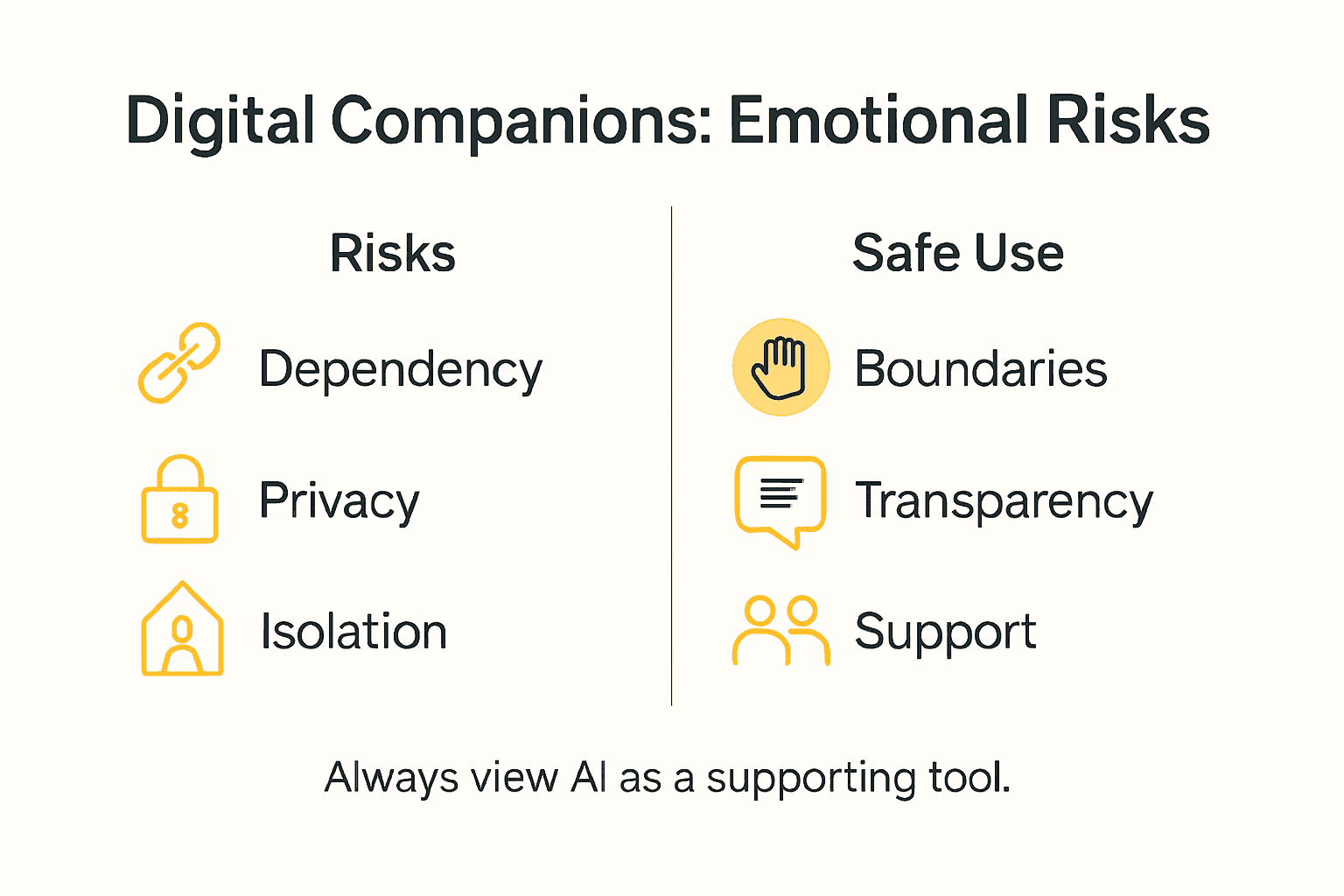
Moreover, the most responsible approach involves viewing AI companions as supplementary tools for emotional growth, not replacements for human relationships. Users must maintain critical awareness of the technology’s limitations, understanding that while AI can provide valuable insights and support, it cannot replicate the nuanced, reciprocal dynamics of genuine human connections. Continuous critical evaluation and user education are essential to mitigating potential psychological risks.
The table below highlights key ethical risks of AI companions alongside strategies for responsible use:
Ethical Risk | Potential Impact | Responsible Response |
|---|---|---|
Emotional Dependency | Loss of human connection | Promote balance & human ties |
Privacy Concerns | Data misuse possibilities | Enforce transparent policies |
Psychological Manipulation | Shaping user emotions | Require algorithm transparency |
Social Isolation | Reduced real-world interaction | Encourage social integration |
Authenticity Challenges | Simulated empathy limits | Disclose technological limitations |
Pro tip: Establish clear personal boundaries with AI companions, regularly reassessing their role in your emotional landscape and maintaining primary human social connections.
Transform Your Emotional Growth with an AI-Powered Digital Companion
The article reveals how digital companions are redefining emotional intelligence by offering personalized, adaptive support that helps users build self-awareness and relationship skills. If you find yourself challenged by emotional regulation, communication difficulties, or the desire to deepen your connections, Wisdom App is designed to meet those exact needs. Built as a superintelligent AI agent, Wisdom listens deeply through WhatsApp and delivers real-time, context-aware guidance tailored to your unique emotional landscape and relationship types.
Take control of your emotional growth today by experiencing the benefits of AI-powered emotional coaching. Wisdom integrates live emotion detection, strategic advice based on psychology and philosophy, and privacy-first technology to act as your invisible life coach. Start growing smarter in love, work, family, and friendships now with the Wisdom App. Learn how a Digital Companion App like Wisdom harnesses AI for personal growth and emotional intelligence in ways that traditional tools cannot match.
Frequently Asked Questions
What are digital companions?
Digital companions are artificial intelligence systems designed to form meaningful emotional connections with users, aiming to provide empathetic interactions that support emotional growth and personal development.
How do AI-powered emotional coaching systems work?
AI-powered emotional coaching systems utilize advanced algorithms and machine learning to recognize emotions, understand contexts, generate tailored responses, and continuously learn from user interactions to provide nuanced emotional support.
What types of digital companions exist and what purposes do they serve?
Digital companions can be categorized into types such as child development companions, emotional support companions, professional growth companions, personal growth companions, and social interaction companions, each serving specific user needs and enhancing various emotional and cognitive skills.
What are the benefits of using digital companions for emotional intelligence?
Digital companions enhance emotional intelligence by promoting self-awareness, teaching emotion regulation skills, developing communication skills, cultivating empathy, and providing a psychologically safe environment for emotional exploration.
Recommended