Dec 30, 2025
Role of Statistics in Emotional Intelligence Coaching
Explore how AI emotional coach apps use statistics to analyze emotions, predict outcomes, and offer data-driven guidance for relationship success.

Role of Statistics in Emotional Intelligence Coaching
Over 80 percent of American Millennials and Gen Z individuals believe data-driven insights can transform their emotional well-being. For tech enthusiasts looking to harness AI for better relationships and personal growth, understanding the role of statistics in emotional intelligence has become essential. Discover how modern analytics turn emotions into actionable knowledge, offering practical ways to boost self-awareness and build authentic connections.
Table of Contents
Defining Statistics In Emotional Intelligence
Types Of Statistical Methods For EI
Real-Time Emotion Detection And Analysis
Predictive Insights For Relationship Outcomes
Risks And Limits Of Data-Driven Emotional Coaching
Key Takeaways
Point | Details |
|---|---|
Importance of Statistics in Emotional Intelligence | Statistics help quantify emotional intelligence, enabling researchers to gain insights into emotions and their effects on behavior and relationships. |
Various Statistical Methods | Techniques like correlation analysis, regression modeling, and cluster analysis provide distinct insights into emotional intelligence patterns and profiles. |
Real-Time Emotion Detection | Technological advancements in emotion detection allow for immediate feedback and tailored coaching, enhancing emotional intelligence development. |
Risks of Data-Driven Coaching | Data-driven approaches must navigate privacy concerns and potential biases, emphasizing the need for a balanced and contextual understanding of emotional intelligence. |
Defining Statistics in Emotional Intelligence
Statistics in emotional intelligence represent a systematic approach to measuring, analyzing, and understanding the complex landscape of human emotions and interpersonal dynamics. By transforming subjective emotional experiences into quantifiable data points, researchers can develop precise insights into how emotions influence behavior, relationships, and personal development. Emotional data analytics provide a scientific framework for understanding the intricate patterns of human emotional responses.
Traditionally, emotional intelligence has been challenging to quantify due to its inherently nuanced nature. However, modern statistical techniques now enable researchers to break down emotional intelligence into measurable components, such as self-awareness, empathy, emotional regulation, and social skills. Psychometric assessments and standardized testing have emerged as powerful tools for capturing these complex emotional attributes, allowing coaches and researchers to develop targeted interventions and personal growth strategies.
The statistical approach to emotional intelligence involves multiple research methodologies, including longitudinal studies, correlation analyses, and predictive modeling. Researchers utilize sophisticated statistical techniques like regression analysis, factor analysis, and structural equation modeling to unpack the intricate relationships between emotional competencies and real-world outcomes. These quantitative methods help validate the significance of emotional intelligence across various domains, from professional performance to personal relationship success.
Pro tip: When exploring emotional intelligence statistics, focus on understanding the underlying patterns rather than getting lost in raw numbers, as context and interpretation are key to meaningful insights.
Types of Statistical Methods for EI
Researchers employ several sophisticated statistical methods to analyze and understand emotional intelligence, each offering unique insights into human emotional dynamics. Comprehensive statistical approaches reveal the complex mechanisms underlying emotional competencies through rigorous quantitative techniques. The primary statistical methods include correlation analysis, regression modeling, structural equation modeling, and cluster analysis, each serving a distinct purpose in decoding emotional intelligence patterns.
Correlation analysis represents a foundational technique, helping researchers identify relationships between different emotional intelligence components and external variables. Regression models go a step further by predicting outcomes based on emotional intelligence scores, allowing coaches and psychologists to understand how specific emotional skills might influence professional performance, relationship success, and personal development. Structural equation modeling provides an advanced approach, enabling researchers to examine complex, multi-dimensional relationships between emotional intelligence constructs and their potential predictors or consequences.

Cluster analysis emerges as another powerful statistical method, helping researchers categorize individuals with similar emotional intelligence profiles. This technique allows for nuanced understanding of emotional patterns across different populations, revealing how emotional intelligence manifests uniquely in various demographic groups, professional settings, and cultural contexts. By breaking down complex emotional data into meaningful clusters, researchers can develop more targeted interventions and personalized coaching strategies that address specific emotional intelligence characteristics.
Pro tip: When interpreting emotional intelligence statistics, always consider the context and methodology behind the numbers, as statistical techniques can reveal different facets of emotional complexity.
Here’s a comparison of key statistical methods used in emotional intelligence research:
Method | Primary Purpose | Typical Application | Strengths |
|---|---|---|---|
Correlation Analysis | Find relationships between EI variables | Linking EI facets and outcomes | Reveals direct associations |
Regression Modeling | Predict outcomes from EI scores | Projecting performance trends | Forecasts impact of EI |
Structural Equation Modeling | Analyze multi-dimensional EI constructs | Unpacking complex EI scenarios | Handles intricate structures |
Cluster Analysis | Categorize EI profiles | Segmenting populations | Detects patterns and groups |
Real-Time Emotion Detection and Analysis
Real-time emotion detection represents a groundbreaking technological frontier in emotional intelligence coaching, enabling unprecedented insights into human emotional experiences. Cutting-edge computational approaches now allow coaches and researchers to capture instantaneous emotional shifts through advanced sensing technologies, transforming how we understand and interact with human emotions.
Multiple technological modalities contribute to real-time emotion analysis, including facial recognition software, physiological tracking, voice tone analysis, and machine learning algorithms. These sophisticated techniques measure subtle emotional indicators such as microexpressions, heart rate variability, vocal pitch changes, and neurological responses. By integrating multiple data streams, emotion detection technologies can create comprehensive emotional profiles that provide nuanced understanding of an individual’s psychological state, enabling more targeted and responsive coaching interventions.
Hybrid methodologies are emerging as particularly powerful in emotion detection, combining traditional psychological assessment with advanced technological tools. Innovative sensing technologies now enable coaches to track emotional trajectories in real time, offering unprecedented opportunities for personalized emotional intelligence development. These approaches allow for immediate feedback, adaptive coaching strategies, and data-driven insights that can help individuals better understand and manage their emotional responses across different personal and professional contexts.
Pro tip: When exploring emotion detection technologies, focus on the holistic interpretation of emotional data rather than relying solely on isolated technical measurements.
Key advantages and potential risks of real-time emotion detection in coaching:
Advantage | Description | Potential Risk | Mitigation Strategy |
|---|---|---|---|
Immediate feedback | Instant insights support adaptation | Privacy concerns | Anonymize sensitive data |
Comprehensive profiling | Combines multiple emotion indicators | Overreliance on technology | Blend tools with human judgment |
Adaptive coaching | Tailors sessions to current emotions | Misinterpretation of signals | Expert review and context |
Predictive Insights for Relationship Outcomes
Predictive statistical modeling has revolutionized our understanding of relationship dynamics, offering unprecedented insights into emotional intelligence and interpersonal connections. Quantitative research methods now enable coaches and researchers to anticipate relationship outcomes with remarkable precision, transforming how we understand human emotional interactions and potential challenges.
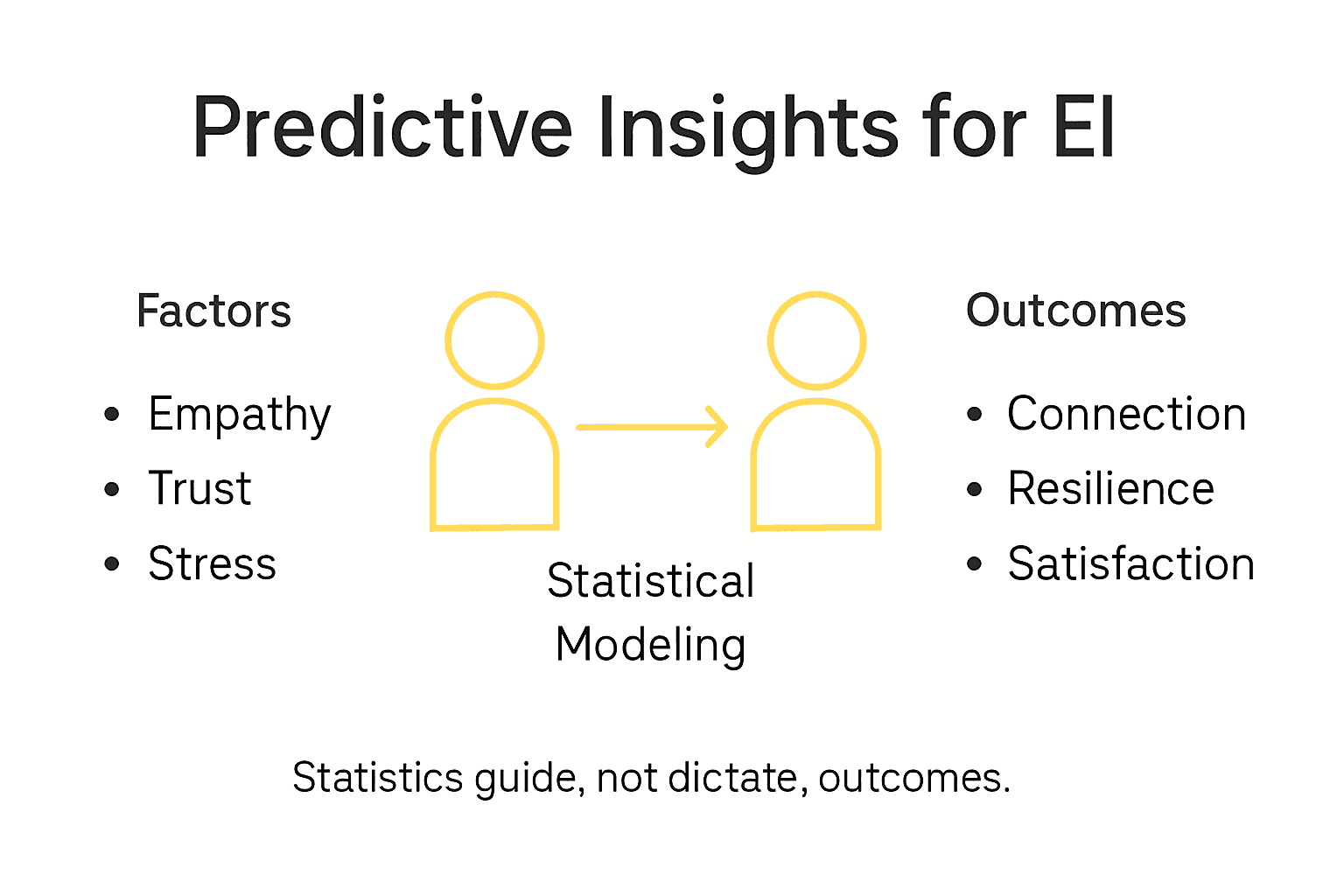
Advanced statistical techniques allow for complex analysis of emotional intelligence factors that significantly influence relationship success. Researchers can now map intricate patterns of communication, emotional regulation, empathy, and conflict resolution, creating predictive models that identify potential relationship strengths and vulnerabilities. These models consider multiple variables such as communication styles, emotional responsiveness, stress management capabilities, and interpersonal adaptability to generate nuanced projections about relationship potential and long-term compatibility.
The power of predictive insights extends beyond simple relationship forecasting. By analyzing large datasets of emotional intelligence metrics, researchers can develop sophisticated algorithms that not only predict potential relationship challenges but also provide targeted interventions and personalized growth strategies. Predictive relationship management approaches enable individuals to proactively address emotional patterns, develop more effective communication strategies, and build more resilient interpersonal connections through data-driven understanding of their unique emotional landscapes.
Pro tip: Approach predictive relationship insights as guidance tools, not absolute determinants, and always combine statistical analysis with personal intuition and individual context.
Risks and Limits of Data-Driven Emotional Coaching
Data-driven emotional coaching introduces powerful analytical capabilities, but also presents significant challenges that demand critical examination. Ethical boundaries in quantitative emotional assessment reveal complex limitations that practitioners must carefully navigate to ensure responsible and effective coaching approaches.
Key risks emerge from potential statistical biases, contextual misinterpretations, and the inherent complexity of human emotional experiences. Quantitative models may oversimplify nuanced emotional dynamics, reducing intricate human interactions to numerical representations that fail to capture the depth and subtlety of individual emotional landscapes. Virtual coaching methodologies demonstrate that while data can provide valuable insights, they cannot fully replace the empathy, intuition, and contextual understanding that human coaches bring to emotional intelligence development.
The most significant challenges in data-driven emotional coaching center on privacy concerns, potential algorithmic discrimination, and the risk of creating overly mechanistic approaches to human emotional growth. Statistical models must be continuously refined to account for diverse cultural contexts, individual variations, and the dynamic nature of emotional intelligence. Responsible practitioners recognize that data should inform coaching strategies, not dictate them entirely, maintaining a balanced approach that respects the complexity of human emotional experiences and individual agency.
Pro tip: Always view statistical insights as supportive guidance, not absolute truth, and maintain a holistic, contextually sensitive approach to emotional intelligence coaching.
Harness the Power of Statistical Insights with Wisdom App for Emotional Intelligence Coaching
Understanding the complex role of statistics in emotional intelligence coaching helps reveal deeper patterns in how we relate and grow. However, turning emotional data into meaningful, actionable steps can be challenging. If you want to move beyond raw numbers and gain real-time, personalized guidance that interprets your emotional dynamics, Wisdom App is designed for exactly that purpose. It uses advanced AI to analyze your emotional responses and relationship patterns instantly — so you get tailored advice rooted in data-driven insights and psychological expertise.

Experience live emotion detection combined with predictive relationship intelligence inside WhatsApp. Don’t just explore correlations or regression models on paper — receive practical coaching powered by a superintelligent AI agent that adapts uniquely to your chats. Join thousands transforming their emotional awareness and relationship success with the first AI-powered emotional coach. Take the next step toward smarter emotional and relationship management by signing up today at Wisdom App and unlock your personalized growth engine.
Frequently Asked Questions
What statistical methods are commonly used in emotional intelligence coaching?
Researchers often use correlation analysis, regression modeling, structural equation modeling, and cluster analysis to analyze emotional intelligence. Each method provides unique insights into emotional dynamics and can help identify relationships between various emotional competencies.
How does real-time emotion detection enhance emotional intelligence coaching?
Real-time emotion detection uses advanced technologies to capture instantaneous emotional shifts, allowing coaches to provide immediate feedback and personalized interventions. This helps individuals better understand and manage their emotions in various contexts.
What are the risks associated with data-driven emotional coaching?
Key risks include potential statistical biases, oversimplification of complex emotional dynamics, privacy concerns, and algorithmic discrimination. It’s crucial for practitioners to balance data insights with human intuition and contextual understanding to ensure responsible coaching.
Can predictive insights from emotional intelligence statistics improve relationship outcomes?
Yes, predictive statistical modeling can identify factors that influence relationship success by mapping emotional competencies. These insights can help individuals develop effective communication strategies and proactively address potential relationship challenges.
Recommended