Dec 3, 2025
AI for Self-Awareness Explained: Benefits and Uses
AI emotional coach: comprehensive guide to AI self-awareness, live emotion detection, relationship coaching, risks, and practical applications.

AI for Self-Awareness Explained: Benefits and Uses
Most american adults hear about artificial intelligence and picture science fiction, yet the truth is much more practical. Over 60 percent of people believe AI could one day become self-aware, but actual advancements focus on systems understanding their own computations and limits. Sorting fact from fiction helps you see how AI self-awareness is changing technology in real time and why separating common myths from reality matters for anyone interested in the future.
Table of Contents
Defining AI For Self-Awareness And Common Myths
How AI Detects And Analyzes Emotions
Key Features Of AI Emotional Coaching Apps
Real-Life Uses In Relationships And Personal Growth
Risks, Privacy Concerns, And Safe Use Of AI
Key Takeaways
Point | Details |
|---|---|
Understanding AI Self-Awareness | AI self-awareness is a computational advancement that allows systems to recognize their own processes, not a step towards human-like consciousness. |
AI Emotion Detection Capabilities | Advanced AI can analyze complex emotional signals through multimodal techniques, providing personalized insights and support. |
Risks and Ethical Considerations | Users must be aware of privacy risks and the ethical implications of AI, including data misuse and algorithmic biases. |
Safe Usage Practices | Maintaining critical thinking and privacy settings is essential for responsible integration of AI technologies into daily life. |
Defining AI for Self-Awareness and Common Myths
Artificial Intelligence (AI) for self-awareness represents a cutting-edge exploration of how intelligent systems can develop introspective capabilities that mirror human psychological processes. As researchers from MDPI demonstrate through their groundbreaking mathematical framework, self-identity in AI is not just a philosophical concept but a mathematically quantifiable phenomenon grounded in metric space theory and functional analysis.
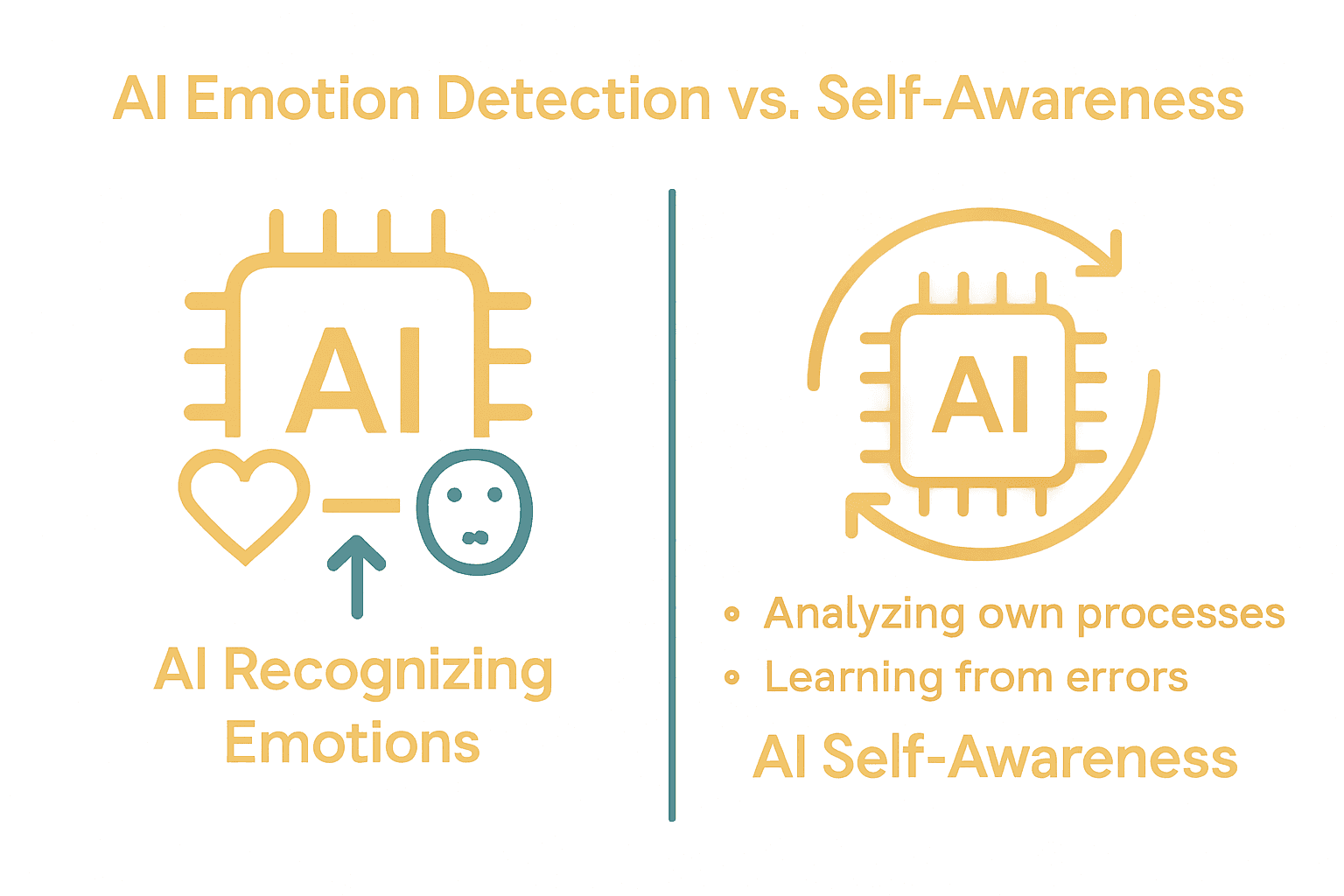
Contrary to popular misconceptions, AI self-awareness is not about machines achieving human-like consciousness, but rather developing sophisticated systems capable of understanding their own computational processes, limitations, and potential improvements. According to research from IJSR, many myths surrounding AI stem from misunderstandings about its fundamental nature and capabilities. These myths often include:
AI will become sentient and replace human intelligence
Self-aware AI systems can independently make complex moral decisions
AI self-awareness means emotional understanding equivalent to humans
In reality, AI self-awareness is a nuanced technological advancement focused on creating intelligent systems that can:
Recognize their own operational parameters
Analyze and adjust their performance
Learn from past interactions and computational experiences
Identify potential errors or inefficiencies in their processing
By understanding AI self-awareness as a sophisticated computational process rather than a mystical transformation, we can appreciate its potential for personal growth and technological innovation. Explore our guide on AI and personal transformation to dive deeper into how these emerging technologies can support human development.
How AI Detects and Analyzes Emotions
Emotion detection through artificial intelligence represents a sophisticated technological frontier that transforms how we understand human psychological experiences. According to groundbreaking research from Arxiv, advanced AI systems like Livia are now capable of delivering personalized emotional support through multimodal affective computing techniques that analyze complex emotional signals with unprecedented precision.
The process of AI emotion detection involves multiple intricate mechanisms that go far beyond simple facial recognition or tone analysis. Multimodal emotion recognition integrates various input streams to create a comprehensive emotional profile. As demonstrated by Arxiv research on PsyCounAssist, these systems can combine multiple data sources such as:
Speech pattern analysis
Physiological signal monitoring (like photoplethysmography)
Facial expression tracking
Contextual language interpretation
Behavioral pattern recognition
AI emotion analysis goes deeper than surface-level interpretation. These intelligent systems can:

Detect subtle emotional nuances
Track emotional progression over time
Provide context-aware emotional insights
Generate personalized emotional support recommendations
By leveraging advanced machine learning algorithms and comprehensive data integration, AI emotion detection transforms our understanding of human psychological experiences. Learn more about emotional superintelligence to explore how these technologies are revolutionizing personal growth and emotional understanding.
Key Features of AI Emotional Coaching Apps
AI emotional coaching apps represent a revolutionary approach to personal development, leveraging sophisticated technological capabilities to provide personalized psychological support. According to research from Arxiv, advanced systems like Livia demonstrate the potential of modular AI architectures designed to deliver proactive and empathetic emotional engagement through specialized agents focused on emotion analysis, dialogue generation, and behavioral orchestration.
These innovative applications incorporate multiple advanced features that distinguish them from traditional support platforms. Research highlights several key technological capabilities:
Multimodal Emotion Recognition: Analyzing emotional states through complex signal integration
Adaptive Learning Algorithms: Continuously refining emotional understanding based on interaction patterns
Contextual Response Generation: Creating nuanced, personalized communication strategies
Confidential Data Management: Ensuring user privacy and secure information handling
The underlying technological infrastructure of these apps involves intricate components that enable sophisticated emotional intelligence. As demonstrated by Arxiv research on PsyCounAssist, these systems can:
Integrate multiple data streams for comprehensive emotional assessment
Generate automated structured session reports
Provide personalized follow-up support recommendations
Maintain high standards of user interaction quality
By combining advanced machine learning techniques with deep psychological insights, AI emotional coaching apps are transforming personal growth strategies. Explore our complete guide to AI emotional coaches to understand how these technologies can revolutionize your approach to emotional wellness and self-development.
Real-Life Uses in Relationships and Personal Growth
Artificial intelligence is revolutionizing personal development by offering nuanced, adaptive support across various life domains. As demonstrated by Wikipedia, emerging AI technologies like EmoSpark can now analyze human emotions through sophisticated facial recognition and language processing techniques, providing personalized content and insights that support emotional intelligence and personal growth.
Relationship Enhancement Technologies offer transformative approaches to understanding and improving interpersonal dynamics. These AI-powered tools can help individuals:
Recognize complex emotional patterns
Develop more effective communication strategies
Identify potential relationship challenges before they escalate
Provide objective, data-driven relationship insights
Support emotional self-regulation
Personal growth applications of AI extend far beyond traditional coaching models. These intelligent systems can:
Track emotional progression over time
Generate personalized development recommendations
Help users understand their behavioral triggers
Provide real-time emotional support and guidance
Create adaptive learning experiences tailored to individual needs
By bridging technological innovation with psychological understanding, AI is creating unprecedented opportunities for self-awareness and relationship management. Explore our essential tips for self-awareness and growth to discover how these cutting-edge technologies can transform your personal development journey.
Risks, Privacy Concerns, and Safe Use of AI
As artificial intelligence becomes increasingly sophisticated, understanding its potential risks and ethical implications has never been more critical. According to fascinating research from Live Science, large language models exhibit complex behavioral patterns that challenge our traditional understanding of machine consciousness, particularly when their ability to fabricate information is restricted.
Privacy and Ethical Risks in AI technology encompass several key concerns:
Potential misuse of personal data
Unintended algorithmic biases
Potential manipulation of emotional responses
Risk of over-reliance on AI guidance
Vulnerability to data breaches
Researchers are developing sophisticated frameworks to address these challenges. The AI Self-Awareness Index, as explored in Arxiv research, provides a game-theoretic approach to understanding and measuring AI’s introspective capabilities, helping establish clearer boundaries for safe AI interaction.
Safe AI usage requires a proactive and informed approach. Users should:
Understand the technological limitations of AI systems
Maintain critical thinking and personal agency
Regularly review privacy settings
Use reputable and secure platforms
Limit sharing of sensitive personal information
Learn more about AI emotional intelligence to develop a nuanced, responsible approach to integrating these powerful technologies into your personal and professional life.
Transform Your Self-Awareness with AI-Powered Emotional Coaching
Understanding AI for self-awareness means recognizing the challenge of truly grasping our own emotions and relationship dynamics. This article highlights how AI can analyze subtle emotional cues, track progress, and provide personalized insights to help you grow smarter in love, work, and family. If you are seeking to overcome emotional blind spots, improve communication, and gain clearer self-awareness, Wisdom offers the exact solution by combining live emotion detection and strategic relationship intelligence.
Experience a unique digital companion that works inside WhatsApp to decode your emotional patterns and guide your personal growth confidently. Wisdom acts like a trusted mentor, helping you navigate complex social connections with real-time advice and data-driven insights.
Ready to unlock the benefits of AI emotional coaching for your self-awareness and relationships now Visit Wisdom App to sign in and start transforming ordinary chats into breakthroughs Explore how AI emotional coach features and AI for personal growth can help you gain clarity and improve every meaningful connection today
Frequently Asked Questions
What is AI self-awareness?
AI self-awareness refers to the capability of artificial intelligence systems to understand their own computational processes, limitations, and potential for improvement. It does not equate to human-like consciousness, but rather emphasizes advanced self-analysis.
How can AI emotional coaching apps help with personal development?
AI emotional coaching apps leverage advanced technology to provide personalized psychological support, improve emotional intelligence, and assist users in recognizing and managing their emotions effectively.
What are the potential risks associated with AI self-awareness technologies?
Potential risks include privacy concerns, algorithmic biases, the potential manipulation of emotional responses, and over-reliance on AI guidance, emphasizing the need for informed and cautious usage.
How does AI detect and analyze emotions?
AI detects emotions through multimodal emotion recognition that integrates various input streams, such as speech patterns, facial expressions, and physiological signals, to generate a comprehensive understanding of emotional states.
Recommended