Dec 26, 2025
Role of AI in Family Communication: Improving Connection
AI emotional coach transforms family communication by enhancing empathy, guiding conflict resolution, and offering privacy-first emotional insights.

Role of AI in Family Communication: Improving Connection
Most American families now encounter technology that can understand not just words but emotions. With more than 60 percent of American households using smart devices daily, the rise of artificial intelligence in family communication is no longer just science fiction. AI-powered tools are changing how families share feelings, resolve conflicts, and stay connected by offering insights that help everyone feel understood and valued.
Table of Contents
AI-Powered Family Communication Explained
Types of AI Tools for Family Conversations
How AI Enhances Emotional Awareness
Real-Life Family Use Cases and Outcomes
Risks, Privacy, and Ethical Considerations
Key Takeaways
Point | Details |
|---|---|
AI Enhances Family Communication | AI tools improve interactions by providing emotional insights and personalized communication strategies for families. |
Variety of AI Tools | Families can use different AI tools tailored to specific communication challenges, from emotional support to collaborative learning. |
Emotional Awareness Development | AI fosters deeper emotional understanding among family members, promoting empathy and enhanced communication skills. |
Privacy and Ethical Considerations | Families must prioritize privacy and ethical practices when integrating AI tools to ensure safe and respectful communication. |
AI-Powered Family Communication Explained
Artificial Intelligence is revolutionizing how families interact, communicate, and understand each other. By integrating advanced technologies like emotion detection and contextual analysis, AI now offers unprecedented insights into family dynamics. Emerging research on AI communication tools demonstrates how these intelligent systems can bridge communication gaps and facilitate more meaningful interactions.
AI-powered communication tools leverage sophisticated algorithms to interpret emotional nuances and provide personalized communication strategies. These systems can detect underlying communication patterns, suggesting constructive approaches to resolving conflicts and improving mutual understanding. For instance, intelligent communication platforms can analyze conversation tone, identify potential misunderstandings, and recommend communication techniques tailored to specific family members’ emotional states.
The technology goes beyond simple translation or messaging. Advanced AI systems now integrate social-emotional learning principles, helping families develop stronger emotional intelligence. By providing real-time feedback and suggestions, these tools can help family members develop more empathetic communication skills, understand each other’s perspectives, and navigate complex emotional landscapes more effectively.
Pro Communication Tip: Start small by introducing AI communication tools gradually, allowing family members to become comfortable with the technology and its insights without feeling overwhelmed by sudden changes in interaction patterns.
Types of AI Tools for Family Conversations
AI tools for family communication are rapidly evolving, offering specialized solutions that address different aspects of family interactions. Families are increasingly exploring multiple specialized AI agents designed to support communication, learning, and household management. These tools range from emotional support platforms to collaborative learning assistants, each targeting specific communication challenges within family dynamics.
Conversational AI Platforms represent the first wave of family communication technologies. These systems use advanced natural language processing to facilitate more meaningful dialogues, helping family members express themselves more effectively and understand each other’s emotional states. Some platforms offer real-time translation, emotion detection, and personalized communication strategy recommendations, breaking down communication barriers across generations and communication styles.
Collaborative learning prototypes demonstrate how AI can enhance family interactions beyond traditional communication tools. These advanced systems can distribute household tasks, visualize individual contributions, and provide personalized support for group learning experiences. Intelligent family assistants can now help mediate conversations, suggest constructive communication approaches, and even provide context-aware emotional guidance that adapts to each family member’s unique communication preferences.
Pro Communication Tip: Choose AI communication tools that prioritize privacy, allow customizable settings, and provide incremental learning experiences to help family members gradually become comfortable with the technology.
Here’s a comparison of common AI tools used for family communication and their unique strengths:
AI Tool Type | Primary Function | Distinct Advantage |
|---|---|---|
Conversational AI Platform | Facilitates dialogue | Adapts to emotion, real-time feedback |
Emotional Support Platform | Provides emotional insight | Detects subtle mood changes |
Collaborative Learning Tool | Assists with group interactions | Visualizes contributions, customizes learning |
Intelligent Family Assistant | Mediates and suggests approaches | Context-aware, adapts to preferences |
How AI Enhances Emotional Awareness
Emotional awareness represents a critical dimension of human communication that artificial intelligence is transforming. Advanced conversational AI platforms are now designed to foster emotionally intelligent interactions, particularly benefiting individuals who struggle with traditional communication methods. These sophisticated systems can detect subtle emotional nuances, helping family members understand and respond to each other’s feelings with unprecedented depth and sensitivity.
AI tools have developed remarkable capabilities in analyzing communication patterns and emotional signals. Sophisticated emotional detection algorithms can now provide detailed feedback that helps individuals recognize their emotional triggers, understand communication blind spots, and develop more empathetic interaction strategies. By breaking down complex emotional interactions into measurable components, these technologies offer families unprecedented insights into their interpersonal dynamics.

The most advanced emotional intelligence AI goes beyond simple pattern recognition. These systems can contextualize emotional responses, considering factors like tone, word choice, historical communication patterns, and non-verbal cues. This multilayered approach allows AI to provide nuanced guidance that adapts to each family member’s unique emotional landscape, helping them develop more sophisticated emotional communication skills and deeper mutual understanding.
Pro Communication Tip: Practice active listening with AI emotional awareness tools by reviewing their insights together as a family, treating the technology as a collaborative learning experience rather than a judgmental system.
Real-Life Family Use Cases and Outcomes
Real families are experiencing transformative communication breakthroughs through artificial intelligence technologies. Innovative AI systems like eaSEL have demonstrated significant improvements in parent-child interactions, showing how technology can create deeper emotional connections and more meaningful engagement. These AI-mediated platforms help families move beyond traditional communication barriers, enabling more nuanced and empathetic conversations.
The practical applications of AI in family communication extend far beyond simple conversation facilitation. Field studies with family learning prototypes have revealed remarkable outcomes, including reduced caregiver stress and enhanced collaborative learning experiences. Families are discovering that AI can serve multiple roles: from emotional mediator to educational assistant, providing personalized support that adapts to each family member’s unique communication style and emotional needs.
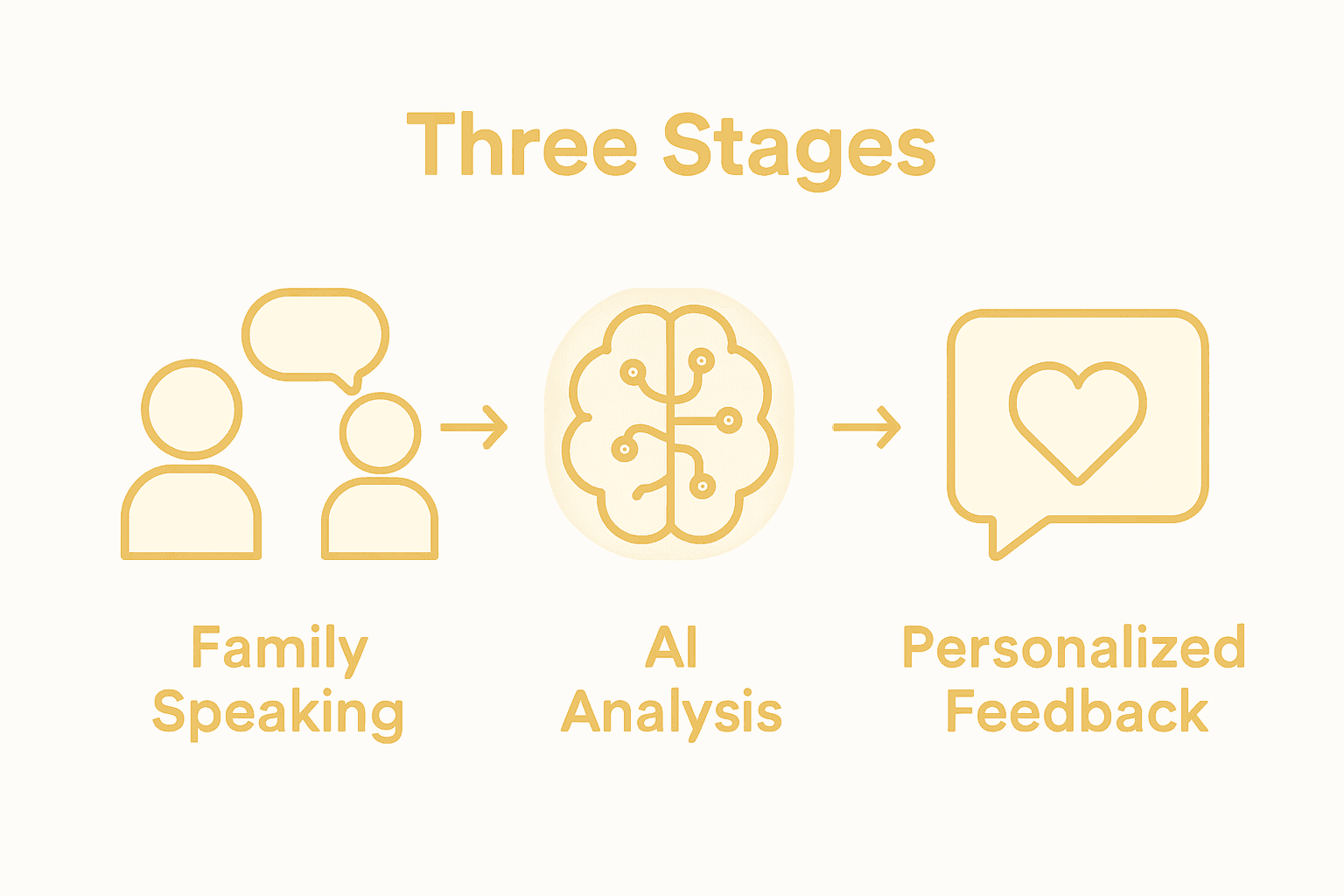
Emotional intelligence technologies are proving particularly powerful in addressing communication challenges across different family dynamics. These systems can help bridge generational communication gaps, provide neutral mediation during conflicts, and offer insights that might otherwise remain unspoken. By analyzing communication patterns, tone, and emotional subtext, AI tools help family members develop more empathetic and understanding relationships, transforming potentially challenging interactions into opportunities for growth and connection.
Pro Communication Tip: Approach AI family communication tools as collaborative learning experiences, encouraging open discussions about the insights generated and treating the technology as a supportive partner in improving family relationships.
Risks, Privacy, and Ethical Considerations
The integration of artificial intelligence into family communication raises critical questions about privacy, safety, and ethical boundaries. Researchers have identified significant concerns surrounding AI tools in family interactions, highlighting the need for careful implementation and robust safeguards. These concerns range from data protection and potential algorithmic biases to the psychological implications of technology-mediated family communication.
Privacy boundaries represent a fundamental challenge in AI-assisted family interactions. Families consistently emphasize the importance of maintaining clear agent-specific privacy protocols, recognizing that technological assistance must never compromise personal autonomy or intimate family dynamics. This means developing AI systems with granular privacy controls, transparent data handling practices, and mechanisms that prioritize individual family members’ consent and emotional safety.
Ethical considerations extend beyond simple data protection. Advanced AI communication tools must be designed with sophisticated understanding of emotional contexts, avoiding potential manipulation or inappropriate intervention in sensitive family dynamics. This requires ongoing development of ethical frameworks that account for the complex emotional landscapes of family relationships, ensuring that AI remains a supportive tool rather than an invasive or controlling mechanism. Responsible AI development demands continuous assessment of potential psychological impacts, algorithmic fairness, and the preservation of human agency within family communication systems.
Pro Privacy Tip: Regularly review and adjust AI communication tool privacy settings as a family, establishing clear agreements about data sharing, usage boundaries, and individual comfort levels with technological assistance.
To better understand privacy and ethical considerations, review this quick-reference table:
Concern | Potential Risk | Recommended Safeguard |
|---|---|---|
Data Privacy | Unauthorized data access | Use granular privacy controls |
Algorithmic Bias | Unfair suggestions or mediation | Continually audit AI recommendations |
Emotional Manipulation | Inappropriate system influence | Maintain human oversight |
Unlock Deeper Family Connections with AI-Powered Emotional Coaching
Navigating family communication challenges like emotional misunderstandings and generational gaps requires more than just good intentions. This article highlights how AI tools can enhance emotional awareness and deliver personalized communication strategies. If you want to transform routine conversations into opportunities for empathy and growth, embracing an advanced AI relationship coach is key.

Experience how the Wisdom App acts as your personal AI emotional coach inside WhatsApp. It detects real-time emotional dynamics and offers context-aware guidance tailored to your unique family relationships. With features like live emotion detection and data-driven insights, Wisdom helps you resolve conflicts, build empathy, and strengthen bonds effortlessly. Start improving your family communication today by signing up at Wisdom App and join thousands already growing smarter in love and family. Visit AI Life Coach App to take the first step toward healthier conversations now.
Frequently Asked Questions
How can AI improve communication within families?
AI enhances family communication by analyzing emotional nuances, providing personalized feedback, and suggesting constructive communication strategies to foster understanding and empathy among family members.
What types of AI tools are available for family communication?
Common AI tools include conversational AI platforms for meaningful dialogues, emotional support platforms for insight into feelings, collaborative learning tools for group interactions, and intelligent family assistants for mediation and guidance.
How does AI enhance emotional awareness in family conversations?
AI improves emotional awareness by detecting subtle emotional signals and providing insights into communication patterns, helping family members understand each other’s emotions and develop empathetic interaction strategies.
What are the privacy concerns associated with AI in family communication?
Privacy concerns include unauthorized data access and algorithmic biases. Families should implement granular privacy controls, continually audit AI recommendations, and maintain human oversight to protect personal autonomy and emotional safety.
Recommended