Dec 26, 2025
Step-by-Step Guide to Emotional Intelligence in Families
Discover a step-by-step guide to emotional intelligence in families, empowering you to build trust, resolve conflicts, and boost connection for lasting harmony.

Step-by-Step Guide to Emotional Intelligence in Families
Nearly half of American families report that open communication at home feels harder than ever. With busy schedules and growing emotional demands, finding ways to connect can be a serious challenge. Building strong emotional intelligence is not just a luxury but a cornerstone for happier relationships and healthier problem solving. This guide empowers you with proven steps to foster trust, active listening, and real empathy at home.
Table of Contents
Step 1: Set Up an Open Communication Space
Step 2: Identify and Express Family Emotions Clearly
Step 3: Establish Empathic Listening Routines
Step 4: Develop Conflict Resolution Strategies
Step 5: Review Progress and Celebrate Growth
Quick Summary
Key Insight | Explanation |
|---|---|
1. Create a Safe Communication Space | Designate a space and time for family dialogue to foster trust and encourage open sharing of thoughts and emotions. |
2. Develop Emotional Awareness Together | Use a shared vocabulary to express emotions clearly, allowing family members to articulate feelings beyond basic terms like ‘happy’ or ‘sad.’ |
3. Practice Empathic Listening | Implement routines that prioritize active listening, ensuring each person feels heard without interruption during conversations. |
4. Establish Conflict Resolution Techniques | Set ground rules for respectful communication during disagreements, focusing on ‘I’ statements to share feelings without blaming others. |
5. Celebrate Family Growth and Progress | Regularly review and celebrate emotional intelligence milestones to reinforce positive communication practices and family connections. |
Step 1: Set Up an Open Communication Space
Creating a welcoming environment for honest family dialogue requires intentional strategy and genuine commitment. Establishing consistent communication rituals allows family members to develop trust and feel safe sharing their thoughts and emotions.
Start by designating a specific time and neutral space where everyone feels comfortable speaking without interruption or judgment. This could be a weekly family meeting in your living room, a weekend breakfast gathering, or a regular evening check-in where phones are put away and full attention is given to each person. The key is creating a predictable, judgment-free zone where vulnerability and honest expression are encouraged.
As you begin implementing this communication space, remember that consistency matters more than perfection. Some family members might initially feel awkward or resistant, but patience and genuine interest will gradually build trust. Listen actively, validate feelings, and model the open communication you want to see.
Pro Tip: Choose a communication time when everyone is typically calm and not rushed, like after dinner or during a relaxed weekend morning, to maximize the likelihood of meaningful interaction.
Step 2: Identify and Express Family Emotions Clearly
Learning to recognize and communicate emotions effectively is a foundational skill for building strong family relationships. By developing emotional awareness, families can create deeper understanding and connection through honest and compassionate dialogue.
Start by creating a shared emotional vocabulary that helps everyone articulate their feelings more precisely. This means moving beyond basic emotions like happy or sad to more nuanced descriptions. Encourage family members to describe their emotional states with specific language like frustrated, overwhelmed, excited, or anxious. Parents can leverage collaborative AI systems to support children’s emotional education, helping them develop more sophisticated emotional communication skills.

Implement a regular practice of emotional check ins where each family member has the opportunity to share their current emotional state without judgment. This might look like a brief round robin during dinner or a dedicated weekly family meeting where everyone takes turns expressing how they are feeling and why. The goal is to normalize emotional sharing and create a safe space where vulnerability is welcomed and supported.
As you practice these communication techniques, remember that emotional intelligence is a skill that develops over time. Some family members might initially feel uncomfortable or struggle to articulate their feelings. Patience, active listening, and consistent practice will help everyone become more emotionally fluent.
Pro Tip: Create an emotion wheel or chart that helps younger family members expand their emotional vocabulary and learn to more accurately describe their internal experiences.
Step 3: Establish Empathic Listening Routines
Empathic listening transforms family communication by creating deeper understanding and emotional connection. This critical skill goes beyond simply hearing words to truly comprehending the feelings and experiences behind them.
Developing a structured communication approach helps families navigate complex emotional landscapes more effectively. Implement a communication hierarchy where each family member gets uninterrupted time to speak while others practice active listening. This means maintaining eye contact, avoiding interruptions, and offering nonverbal cues that show genuine attention and care.
Inspired by teachings on mindful communication, practice listening with full presence. As Thích Nhất Hạnh suggests, true listening requires setting aside personal judgments and preconceptions. When a family member speaks, focus entirely on understanding their emotional experience without immediately preparing your response or offering advice. Validate their feelings by reflecting back what you hear and asking clarifying questions that demonstrate your sincere interest.
Remember that empathic listening is a skill that improves with consistent practice. Some family members might initially find it challenging to stay fully present or resist the urge to interrupt. Approach these moments with patience and gentle guidance, recognizing that building emotional intelligence is a collective journey.
Pro Tip: Establish a family agreement where each person gets 3 5 minutes of uninterrupted speaking time during communication sessions, with listeners practicing active and empathetic engagement.
Step 4: Develop Conflict Resolution Strategies
Successful conflict resolution transforms family dynamics by turning potential arguments into opportunities for deeper understanding and growth. Learning to navigate disagreements constructively is a critical skill that strengthens relationships and builds emotional intelligence.
Implementing a structured communication approach helps families move beyond destructive conflict patterns. Start by establishing ground rules that prioritize respect and mutual understanding. This means creating a safe space where each family member can express their perspective without fear of judgment or retaliation. Use a communication framework that encourages each person to share their feelings using ‘I’ statements that focus on personal experiences rather than blaming or attacking others.
Understand that conflict resolution is about managing meanings and perceptions. According to communication theories, each family member brings their own interpretation and emotional context to a disagreement. Practice active listening techniques that help you understand the underlying emotions and needs behind each person’s position. This might involve paraphrasing what you hear, asking clarifying questions, and showing genuine curiosity about the other person’s experience.
Remember that effective conflict resolution is a skill that improves with practice. Some family members might initially struggle to remain calm or communicate clearly during heated moments. Approach these challenges with patience and a commitment to learning. Recognize that every conflict is an opportunity to build deeper empathy and understanding.
Pro Tip: Create a family conflict resolution toolkit that includes calm down techniques, communication scripts, and a shared agreement to take breaks if emotions become too intense.
Step 5: Review Progress and Celebrate Growth
Tracking and acknowledging emotional intelligence development is crucial for maintaining motivation and reinforcing positive family communication patterns. This final step transforms your family’s emotional growth journey from a theoretical exercise into a meaningful celebration of collective achievement.
Regular feedback helps refine communication strategies and provides valuable insights into your family’s emotional development. Schedule quarterly family reflection sessions where everyone shares their personal growth observations. During these meetings, each member can highlight moments when they successfully applied new emotional intelligence skills like active listening, empathy, or conflict resolution.
Create a visual progress tracker that makes emotional growth tangible and engaging. This might be a shared journal, a digital dashboard, or a large poster where family members can document their communication milestones, emotional breakthroughs, and moments of mutual understanding. Recognize both small victories and significant transformations equally important steps in your collective emotional intelligence journey.
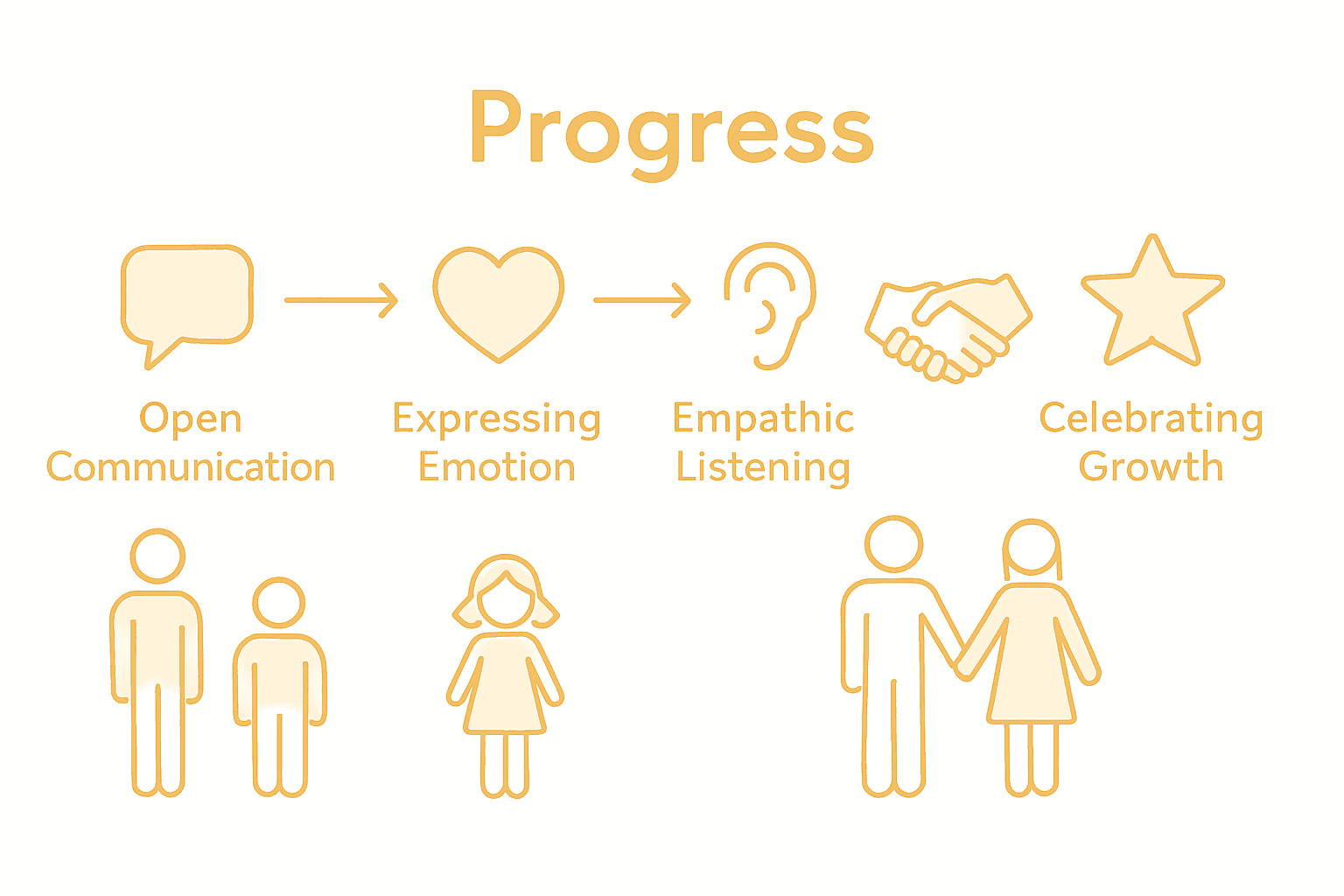
Remember that growth is not linear. Some family members might progress faster than others, and that is perfectly normal. Approach these reviews with compassion, curiosity, and a spirit of mutual support. Celebrate individual and collective achievements without judgment, focusing on the positive changes you are creating together.
Pro Tip: Develop a family reward system that acknowledges emotional intelligence milestones, such as a special outing or a meaningful shared experience when significant communication goals are met.
Consider these common barriers to emotional intelligence and ways to overcome them:
Barrier | Example | Overcoming Strategy |
|---|---|---|
Hesitance to share | Fear of judgment | Foster a judgment-free zone |
Limited vocabulary | Stuck on “sad” or “mad” | Use emotion charts and prompts |
Interruptions | Talking over each other | Set clear speaking times |
Escalating conflict | Arguments intensify quickly | Use calm-down techniques |
Uneven participation | Some voices dominate | Ensure equal speaking turns |
Here’s a summary of key strategies for effective family communication:
Step | Core Purpose | Practical Tool |
|---|---|---|
Set Up Communication Space | Build trust and safety | Regular meetings, phone-free zones |
Express Emotions Clearly | Improve emotional vocabulary | Emotional check-ins, emotion wheels |
Use Empathic Listening | Strengthen understanding | Active listening routines |
Resolve Conflicts Constructively | Transform disagreements | Communication scripts, ground rules |
Celebrate Growth | Reinforce positive change | Progress trackers, reflection sessions |
Enhance Your Family’s Emotional Intelligence with AI-Powered Support
Building emotional intelligence in families requires consistent effort around clear communication, empathic listening, and thoughtful conflict resolution. If you find yourself facing challenges like awkward conversations, hesitance to share feelings, or escalating conflicts as described in the “Step-by-Step Guide to Emotional Intelligence in Families,” you are not alone. These pain points highlight the need for guided, real-time support that fosters understanding and growth in everyday interactions.
Wisdom App offers a groundbreaking solution as the world’s first AI-powered emotional and relationship coach integrated directly into WhatsApp. Acting as your personalized digital companion, Wisdom detects emotional cues live, helps expand emotional vocabulary, encourages empathic listening, and provides strategic advice tailored to your unique family dynamics. By combining psychological insights with intuitive AI intelligence, Wisdom makes it easy to practice the communication rituals and conflict resolution techniques that your family needs to thrive.
Take the next step toward deeper connection today with this smart coaching tool designed for busy families seeking emotional growth.
Try Wisdom App now and transform your family conversations into meaningful opportunities for love and understanding.
Explore how AI emotional coaching supports families

Unlock smarter communication and emotional insight right inside WhatsApp. Start your family’s journey to emotional intelligence with Wisdom App today.
Frequently Asked Questions
How can I create a safe communication space for my family?
Creating a safe communication space involves designating a regular time and neutral location for family discussions. Choose a calm environment, such as after dinner or during a weekend breakfast, where everyone feels comfortable to speak openly.
What is the best way to express emotions clearly within my family?
To express emotions clearly, develop a shared emotional vocabulary and encourage everyone to articulate their feelings using specific terms. Regular emotional check-ins during family meetings can help normalize sharing emotions and foster deeper connections.
How can I practice empathic listening with my family?
To practice empathic listening, establish routines where each family member gets uninterrupted time to speak while others listen actively. Focus on understanding their feelings and experiences, and validate their emotions by reflecting back what you hear and asking clarifying questions.
What strategies can I use for effective conflict resolution in my family?
Effective conflict resolution starts with establishing ground rules that prioritize respect and understanding. Encourage the use of ‘I’ statements to express feelings without blame, and practice active listening to comprehend everyone’s perspective during disagreements.
How can we track and celebrate our family’s emotional growth?
You can track emotional growth by holding quarterly family reflection sessions to discuss personal progress. Create a visual progress tracker to document milestones and celebrate achievements, encouraging a shared commitment to improvement.
Recommended