Dec 18, 2025
AI Emotional Coaching: Transforming Self-Growth in Chat
AI emotional coaching explained: Learn how AI-powered coaching on WhatsApp supports emotional intelligence, self-growth, and relationship success with privacy.

AI Emotional Coaching: Transforming Self-Growth in Chat
Most American adults now encounter artificial intelligence in their daily lives, yet few realize its growing role in emotional coaching. With over 50 million Americans seeking mental health support each year, the need for accessible, responsive guidance is higher than ever. AI emotional coaching steps into this gap, delivering personalized support and deep insights that traditional methods rarely match. This new technology offers practical ways to improve emotional awareness, strengthen relationships, and support long-term growth.
Table of Contents
Defining AI Emotional Coaching and Its Impact
Key Technologies Powering AI Coaching
How AI Detects Emotions in Real Time
Personalized Guidance for Relationships and Growth
Comparing AI Coaching With Human Alternatives
Privacy, Security, and Responsible AI Use
Key Takeaways
Point | Details |
|---|---|
AI Emotional Coaching | Leveraging advanced AI, this approach provides personalized and real-time emotional support, adapting to individual needs. |
Technological Innovations | Key technologies, including machine learning and natural language processing, drive AI’s emotional understanding and guidance capabilities. |
Comparison with Human Coaching | AI coaching offers consistent, accessible support, complementing traditional human coaching without replacing it. |
Privacy Considerations | Responsible AI use requires rigorous data protection measures to safeguard sensitive emotional information from exposure. |
Defining AI Emotional Coaching and Its Impact
AI emotional coaching represents a groundbreaking approach to personal development, leveraging advanced artificial intelligence to provide nuanced, context-aware emotional support. Unlike traditional therapy or self-help methods, this innovative technology offers real-time, personalized guidance that adapts dynamically to individual emotional landscapes. AI platforms like Reflexion are pioneering structured emotional self-reflection, integrating real-time emotion detection with layered reflective techniques that enable deeper psychological insights.
The core premise of AI emotional coaching involves using sophisticated algorithms to analyze emotional patterns, communication styles, and psychological responses. These intelligent systems go beyond simple chatbot interactions, employing advanced emotional intelligence algorithms that can detect subtle emotional nuances, predict potential interpersonal challenges, and provide strategic guidance. Research investigating emotionally enriched AI feedback demonstrates significant potential for reducing negative emotional responses, particularly in high-stress environments like academic and professional settings.
Key characteristics of AI emotional coaching include its unprecedented level of personalization, accessibility, and continuous learning capabilities. Unlike human coaches limited by time and subjective perspectives, AI emotional coaches can process vast amounts of interaction data, identifying complex emotional patterns and providing tailored recommendations. These digital mentors offer several transformative benefits:
Immediate emotional support available 24/7
Non-judgmental analysis of personal communication dynamics
Data-driven insights into relationship and personal growth patterns
Adaptive guidance that evolves with user interactions
Pro Tip for Personal Growth: Start your AI emotional coaching journey by approaching the technology with an open mind and commitment to honest self-reflection, allowing the system to learn and provide increasingly nuanced insights into your emotional landscape.
Key Technologies Powering AI Coaching
Artificial intelligence has revolutionized emotional coaching through sophisticated technological frameworks that enable deep psychological understanding. Innovative emotion-aware platforms like Livia demonstrate how modular AI agents can provide personalized emotional support, combining advanced computational techniques with nuanced psychological insights. These technologies leverage complex algorithms designed to interpret human emotional states with unprecedented accuracy and depth.
The core technological infrastructure of AI emotional coaching relies on several cutting-edge methodologies. Advanced computer vision and deep learning techniques enable precise emotion detection, analyzing subtle facial expressions, vocal intonations, and body language to generate comprehensive emotional profiles. Multimodal affective computing plays a crucial role, integrating data from multiple sensory inputs to create a holistic understanding of an individual’s emotional landscape.
Key technological components driving AI emotional coaching include:
Machine Learning Algorithms: Continuously adapt and refine emotional interpretation
Natural Language Processing: Understand contextual emotional nuances in communication
Predictive Analytics: Anticipate emotional patterns and potential psychological challenges
Data Compression Techniques: Efficiently store and process complex emotional interaction data
These technologies work synergetically to create intelligent emotional coaching systems with the ability to provide real-time, personalized psychological support. By combining computational power with deep psychological understanding, AI emotional coaches can offer unprecedented insights into personal emotional dynamics.
Pro Tip for Tech Understanding: Approach AI emotional coaching technologies with curiosity and openness, recognizing them as sophisticated tools that complement rather than replace human emotional intelligence.
How AI Detects Emotions in Real Time
Emotion detection represents a sophisticated technological frontier where artificial intelligence transforms human emotional understanding. Multimodal emotion detection approaches like Livia demonstrate remarkable capabilities in analyzing complex emotional signals, integrating multiple sensory inputs to create comprehensive emotional profiles with unprecedented accuracy. By combining advanced computational techniques, AI systems can now interpret emotional states with a level of nuance previously achievable only through human interaction.

Computer vision algorithms leverage optical sensors to capture and analyze intricate facial expressions and bodily signals, breaking down emotional communication into measurable data points. These technologies use deep learning models that can identify micro-expressions, vocal tone variations, and physiological changes that humans might unconsciously miss. Emotional mapping occurs through sophisticated neural networks that recognize patterns across thousands of emotional interactions, allowing AI to develop increasingly refined emotional intelligence.
The emotion detection process involves several critical technological components:
Visual Analysis: Tracking facial muscle movements and expressions
Vocal Tone Evaluation: Analyzing pitch, speed, and emotional undertones
Linguistic Pattern Recognition: Interpreting semantic and contextual emotional cues
Physiological Signal Processing: Monitoring subtle bodily responses
Advanced emotional analytics help decode the intricate language of human emotions, transforming complex psychological signals into actionable insights. By processing multiple data streams simultaneously, AI emotional detection systems create a holistic understanding of an individual’s emotional state that goes far beyond traditional communication methods.
Pro Tip for Emotional Awareness: Practice self-observation by paying attention to your own micro-expressions and emotional signals, which can help you better understand how AI might perceive and interpret your emotional states.
Personalized Guidance for Relationships and Growth
Relationship coaching has entered a transformative era with artificial intelligence offering unprecedented personalization and depth. Advanced AI platforms like PACEE demonstrate remarkable potential for collaborative emotional guidance, enabling nuanced support that adapts dynamically to individual psychological landscapes. These intelligent systems go beyond generic advice, creating tailored strategies that resonate with each user’s unique emotional context and relationship dynamics.
Digital mental health platforms showcase how technology can provide targeted emotional support, integrating evidence-based therapeutic techniques with adaptive intelligence. Personalized guidance emerges through sophisticated algorithms that analyze communication patterns, emotional responses, and interpersonal challenges, generating insights that help individuals develop more meaningful connections and self-awareness. By processing complex emotional data, AI coaches can identify subtle relationship patterns that might remain invisible in traditional counseling approaches.
Key elements of personalized relationship and growth guidance include:
Contextual Intelligence: Understanding relationship dynamics across different interaction types
Emotional Pattern Recognition: Detecting recurring behavioral and communication challenges
Adaptive Recommendation Systems: Generating evolving strategies based on individual progress
Predictive Relationship Mapping: Anticipating potential communication barriers
The pathway to personal growth becomes more accessible through intelligent, data-driven coaching approaches, which provide actionable insights tailored to individual psychological profiles. These technologies transform traditional coaching by offering continuous, judgment-free support that evolves alongside personal development journeys.
Pro Tip for Personal Development: Approach AI emotional coaching with curiosity and openness, treating it as a collaborative tool that amplifies your self-understanding rather than a replacement for personal reflection.
Comparing AI Coaching With Human Alternatives
The landscape of emotional support is experiencing a profound transformation with the emergence of artificial intelligence as a complementary coaching modality. Research examining emotional support environments highlights the nuanced interplay between technological and human interaction, revealing that AI and human coaches are not competitors but potential collaborative partners in personal growth. While traditional human coaching offers deep empathetic connections, AI brings unprecedented consistency, accessibility, and data-driven insights.
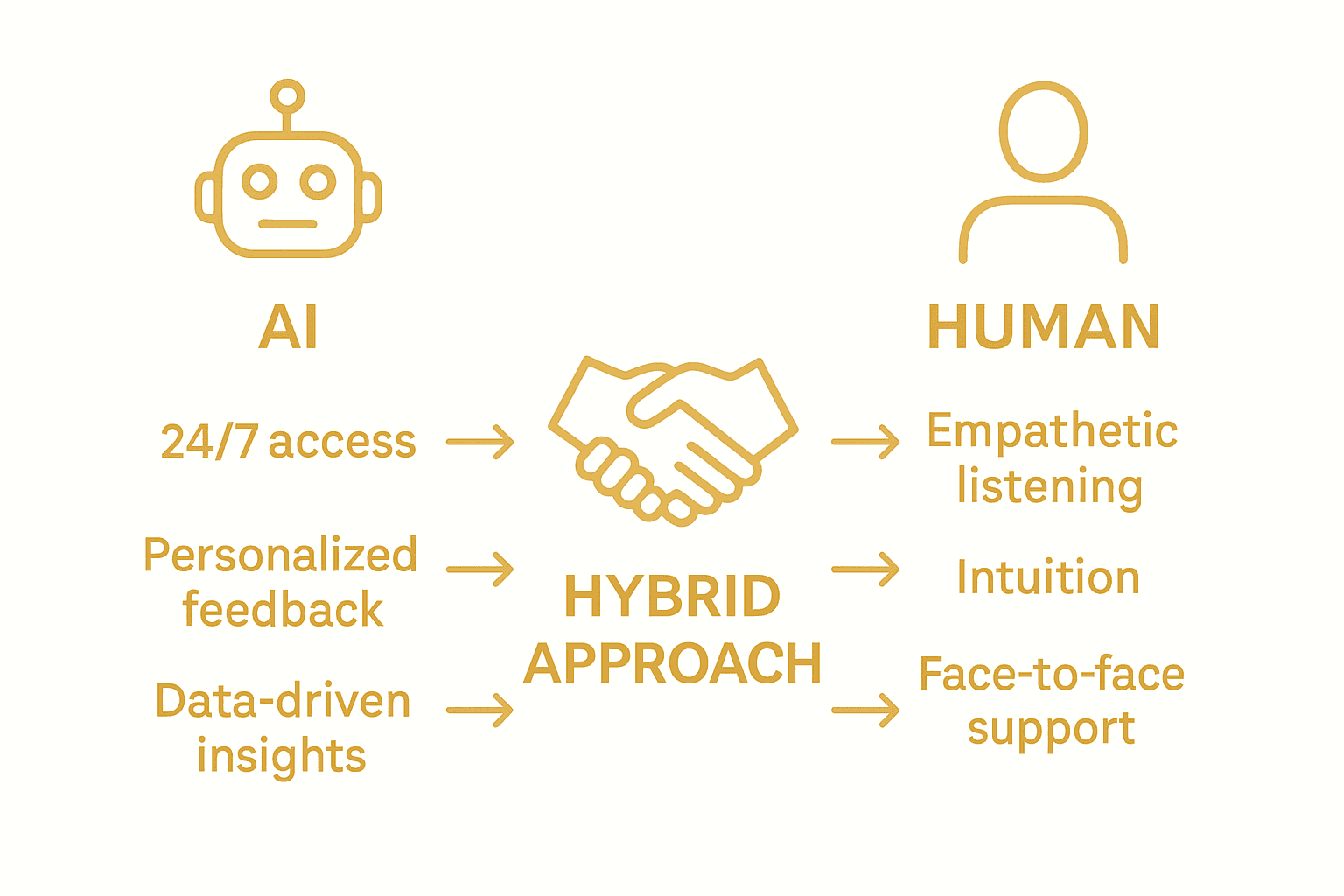
Students and users can develop meaningful emotional connections with AI systems through predictable, non-judgmental, and attentive interactions, challenging conventional assumptions about technological emotional support. Emotional intelligence in AI coaching manifests through sophisticated algorithms that analyze communication patterns, detect emotional nuances, and provide personalized recommendations without the limitations of human bias or emotional fatigue.
Key comparative dimensions between AI and human coaching include:
Accessibility: 24/7 availability versus limited human scheduling
Consistency: Uniform emotional analysis without mood variations
Data Processing: Instantaneous pattern recognition and insights
Cost-Effectiveness: Significantly lower investment compared to traditional coaching
Privacy: Zero personal judgment or external social consequences
Emerging emotional coaching technologies demonstrate remarkable potential for complementing human psychological support, creating a hybrid model where technological precision meets human empathy. The future of emotional coaching lies not in replacement, but in strategic integration of AI-powered insights with human understanding.
Here’s how AI and human coaching differ and complement each other:
Dimension | AI Emotional Coaching | Human Coaching | Hybrid Potential |
|---|---|---|---|
Availability | 24/7 on-demand support | Limited to scheduled sessions | Blended access, extended reach |
Emotional Consistency | Uniform, algorithmic analysis | Subject to mood and fatigue | Calibrated by both strengths |
Insight Generation | Data-driven pattern recognition | Intuitive, empathetic interpretations | Multi-layered understanding |
Economic Costs | Low digital-only expenses | High ongoing professional fees | Cost optimization possible |
Privacy Sensitivity | Governed by digital protocols | Bound by professional ethics | Combined policy improvements |
Pro Tip for Balanced Coaching: Approach AI emotional coaching as a powerful supplementary tool, using its data-driven insights to enhance rather than substitute traditional human emotional support.
Privacy, Security, and Responsible AI Use
The intersection of artificial intelligence and personal emotional coaching introduces complex privacy considerations that demand rigorous ethical frameworks. Emerging technologies like augmented reality platforms raise critical questions about emotional data manipulation and personal boundaries, highlighting the urgent need for comprehensive privacy protections in AI-driven emotional support systems. Responsible AI development must prioritize user autonomy, transparent data handling, and robust security mechanisms that protect individuals’ most sensitive psychological information.
Emotional intelligence research emphasizes the critical importance of creating safe, supportive environments for psychological exploration, a principle that extends directly to AI coaching platforms. Ethical AI design requires multi-layered security approaches that go beyond traditional data protection, incorporating advanced encryption, anonymization techniques, and strict user consent protocols. These strategies ensure that personal emotional insights remain confidential and are used exclusively for the user’s benefit.
Key principles of responsible AI emotional coaching include:
Data Minimization: Collecting only essential emotional and interaction data
User Consent: Transparent opt-in processes with clear information rights
Secure Encryption: Advanced protection for sensitive psychological information
Anonymization: Removing personally identifiable details from processed data
Limited Data Retention: Automatic deletion of outdated interaction records
Privacy considerations in AI coaching platforms require continuous technological and ethical evolution, ensuring that technological capabilities never compromise individual psychological safety. The goal is creating a balanced ecosystem where technological innovation supports personal growth without undermining fundamental privacy rights.
Key concerns and solutions for safeguarding emotional data in AI coaching include:
Privacy Challenge | Risk Example | Ethical Solution |
|---|---|---|
Sensitive Data Exposure | Unintended sharing of emotional logs | Advanced encryption |
User Consent Gaps | Ambiguous data collection practices | Transparent opt-in policies |
Data Retention Length | Accumulation of old interaction data | Auto-deletion mechanisms |
Identity Protection | Linking emotions to user identities | Anonymization techniques |
Pro Tip for Digital Privacy: Regularly review and understand the privacy settings of your AI emotional coaching platform, treating your psychological data with the same care and scrutiny you would apply to your most personal financial or medical information.
Experience Next-Level Self-Growth with AI Emotional Coaching in Your Chat
The article highlights the powerful potential of AI emotional coaching to provide personalized, real-time emotional support and strategic guidance tailored to your unique relationship dynamics and personal growth goals. If you are looking to overcome challenges like emotional inconsistency, limited accessibility to traditional coaching, or impersonal advice, then embracing AI-powered tools designed for your everyday conversations offers a game-changing solution. Wisdom App brings this advanced concept directly to your fingertips by acting as a superintelligent AI agent inside WhatsApp that reads emotional cues, relationship types, and communication patterns instantly.
Start transforming your emotional awareness, relationship success, and personal growth today. Join thousands who trust the Wisdom App as their digital companion for smarter love, work, family, and friendships. Discover how AI emotional coaching can deliver context-aware, privacy-first insights without the wait or cost of traditional human coaching. Sign up now at Wisdom App Sign In and experience how intelligent live emotion detection and data-driven advice shape every conversation into an opportunity for real transformation.
Frequently Asked Questions
What is AI emotional coaching?
AI emotional coaching is a cutting-edge approach to personal development that utilizes advanced artificial intelligence to offer real-time, personalized emotional support tailored to individual emotional patterns and communication styles.
How does AI detect emotions in real time?
AI detects emotions in real time through sophisticated technologies such as computer vision, vocal tone evaluation, linguistic pattern recognition, and physiological signal processing, analyzing various data points to create comprehensive emotional profiles.
What are the benefits of AI emotional coaching compared to traditional coaching?
AI emotional coaching offers benefits such as 24/7 availability, consistent emotional analysis, data-driven insights, lower costs, and a non-judgmental environment for personal exploration, complementing human coaching rather than replacing it.
How can AI emotional coaching help with personal growth?
AI emotional coaching assists with personal growth by providing tailored insights, identifying emotional patterns, and offering adaptive guidance to help individuals navigate their emotional landscapes and improve their personal and relationship dynamics.
Recommended