Dec 10, 2025
AI Emotional Detection: Transforming Personal Growth
AI emotional detection empowers personal growth, improves relationships, and enhances real-time emotional awareness with privacy and actionable insights.

AI Emotional Detection: Transforming Personal Growth
Most advice about AI emotional detection overstates what current technology can actually do. As interest surges among American companies and researchers, many overlook that even the most advanced systems fall short of true emotional understanding. In fact, studies reveal that machine learning models still miss critical emotional cues. This article unpacks what AI emotional detection really offers, separating scientific promise from popular myths, and highlights key realities every American user should know.
Table of Contents
AI Emotional Detection Defined and Debunked
Types of AI Emotional Analysis Methods
How AI Reads Emotions in Conversations
Benefits for Relationships and Self-Improvement
Potential Pitfalls and Privacy Protections
Key Takeaways
Point | Details |
|---|---|
AI Emotional Detection | While promising, AI emotional detection has significant limitations, including difficulty in interpreting nuanced emotions and a lack of cultural awareness. |
Analysis Methods | Major methods include facial expression recognition, speech emotion detection, physiological signal processing, and textual sentiment analysis, each contributing to understanding emotions. |
Benefits for Personal Development | Emotionally aware AI can enhance self-awareness, communication skills, and provide personalized growth recommendations, aiding in relationship improvement. |
Ethical Considerations | Critical challenges include algorithmic bias and privacy risks, necessitating transparent data practices and robust user consent mechanisms to protect personal information. |
AI Emotional Detection Defined and Debunked
Artificial intelligence has sparked significant interest in emotional detection technologies, promising unprecedented insights into human psychological landscapes. However, the reality of AI emotional intelligence is far more nuanced than popular narratives suggest. While cutting-edge systems aim to decode complex emotional signals, researchers have identified critical limitations that challenge the fundamental premise of machine-based emotional comprehension.
At its core, AI emotional detection attempts to interpret human feelings through advanced algorithms analyzing facial expressions, vocal tonalities, physiological signals, and textual communication patterns. These technologies leverage machine learning models trained on extensive datasets of human emotional responses, seeking to classify and predict emotional states with scientific precision. Yet emerging research in emotional intelligence technologies reveals significant hurdles in translating intricate human emotions into binary computational frameworks.
The most profound challenge lies in the inherent complexity of human emotional experiences. Emotions are not simply measurable outputs but dynamic, context-dependent phenomena influenced by cultural backgrounds, individual psychological makeup, and situational nuances. Advanced AI systems like Wisdom recognize this complexity, moving beyond simplistic emotion detection toward a more sophisticated understanding of emotional superintelligence. These intelligent systems aim to provide contextual understanding rather than merely classifying surface-level emotional states.
Critical limitations in current AI emotional detection include:
Difficulty interpreting subtle emotional gradients
Lack of cultural and contextual emotional intelligence
Overreliance on limited training datasets
Inability to capture the full depth of human emotional complexity
While AI continues to advance, true emotional understanding remains a profoundly human capability that machines can supplement but not entirely replicate. The future of emotional AI lies not in replacement, but in creating intelligent tools that enhance our own emotional awareness and interpersonal capabilities.
Types of AI Emotional Analysis Methods
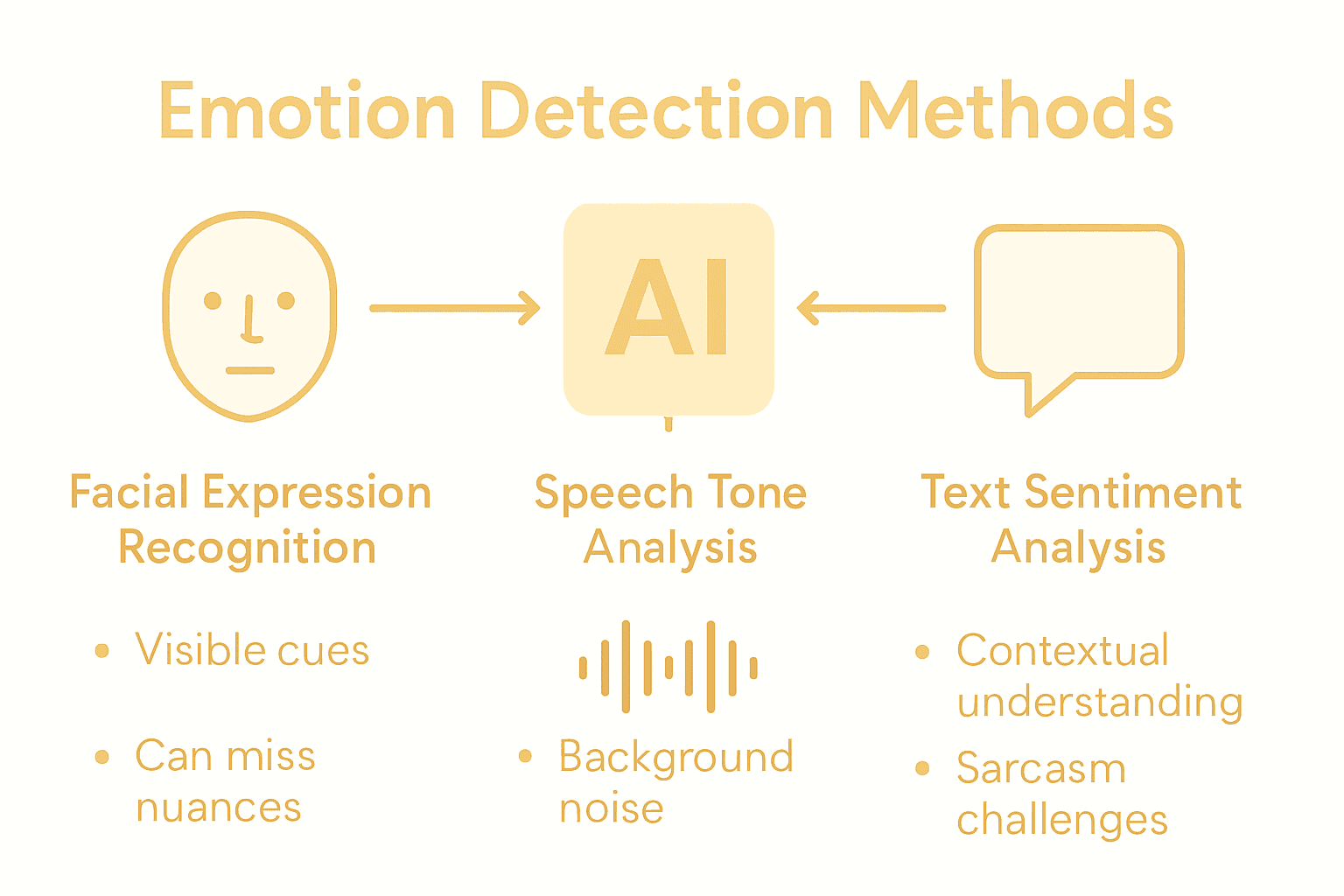
Artificial intelligence has developed sophisticated methods to analyze human emotions through multiple technological approaches. Comprehensive research in emotion recognition reveals four primary modalities of emotional analysis: facial expression recognition, speech emotion detection, physiological signal processing, and textual sentiment analysis. Each method employs unique algorithmic techniques to decode the intricate landscape of human emotional experiences.
Facial expression analysis represents one of the most advanced emotional detection techniques. By utilizing deep learning neural networks, AI systems can now map minute facial muscle movements, tracking microexpressions that often reveal underlying emotional states faster than conscious interpretation. Sophisticated AI techniques enable these systems to recognize emotional nuances across diverse demographic groups, though cultural variations still pose significant challenges in achieving universal accuracy.

Speech and vocal emotion recognition offers another powerful avenue for emotional analysis. These systems analyze vocal characteristics like pitch, tone, rhythm, and speech patterns to infer emotional states. Machine learning algorithms can detect subtle emotional markers that human listeners might miss, providing unprecedented insights into an individual’s psychological landscape. Emotional analytics technologies continue to refine these techniques, pushing the boundaries of computational emotional intelligence.
Key emotional analysis methods include:
Facial Expression Recognition
Deep neural network mapping
Microexpression tracking
Machine learning classification
Speech Emotion Detection
Vocal characteristic analysis
Pitch and tone interpretation
Emotional state inference
Physiological Signal Processing
Heart rate variability monitoring
Galvanic skin response tracking
Neurological pattern recognition
Textual Sentiment Analysis
Natural language processing
Contextual emotion extraction
Semantic emotional mapping
While these technologies represent remarkable advancements, they remain supplementary tools in understanding human emotional complexity. The most effective emotional intelligence approaches integrate multiple analysis methods, recognizing that true emotional understanding transcends any single computational technique.
How AI Reads Emotions in Conversations
Artificial intelligence has developed remarkable capabilities for decoding emotional nuances within conversational contexts, transforming how we understand interpersonal communication. Advanced contextual reasoning networks now enable AI systems to analyze conversations as dynamic, interconnected emotional landscapes, moving beyond simplistic sentiment analysis to capture the intricate emotional rhythms of human dialogue.
The process of emotional detection in conversations involves sophisticated multilayered analysis. AI models meticulously examine linguistic patterns, semantic content, tone variations, and contextual cues to construct a comprehensive emotional profile. Emotionally aware response generation represents a cutting-edge approach where AI not only recognizes emotions but also generates contextually appropriate responses that demonstrate genuine emotional intelligence.
Modern AI conversation analysis incorporates several key techniques to read emotional subtext:
Linguistic sentiment analysis
Contextual emotion mapping
Tone and inflection tracking
Semantic emotional inference
Psychological pattern recognition
Psychological insights into AI communication tools reveal that the most effective systems integrate multiple analysis techniques, recognizing that human emotions are complex, layered experiences that cannot be reduced to simple algorithmic calculations. These intelligent systems aim to provide nuanced, context-aware emotional understanding that respects the profound complexity of human emotional experiences.
Benefits for Relationships and Self-Improvement
Emotionally aware AI technologies are revolutionizing the landscape of personal development and interpersonal relationships by offering unprecedented insights into emotional dynamics. These intelligent systems provide a nuanced understanding of human interactions, helping individuals navigate complex emotional terrain with greater self-awareness and empathy. By analyzing communication patterns, emotional responses, and underlying psychological mechanisms, AI tools create personalized pathways for emotional growth and relationship enhancement.
The transformative potential of AI extends beyond simple emotional detection, creating opportunities for profound personal transformation. Philosophical investigations into emotion recognition technologies reveal that these systems can act as powerful mirrors, reflecting our emotional patterns and helping us understand deeper aspects of our psychological makeup. This self-reflective capacity enables individuals to identify emotional blind spots, recognize recurring relationship challenges, and develop more effective communication strategies.
Key benefits of AI-powered emotional intelligence include:
Enhanced self-awareness
Improved communication skills
Deeper emotional understanding
Personalized growth recommendations
Objective emotional pattern recognition
Personal growth coaching strategies demonstrate that the most effective emotional development occurs when individuals receive targeted, compassionate guidance. AI technologies provide this support by offering real-time insights, adaptive learning experiences, and non-judgmental feedback that traditional coaching methods cannot consistently deliver. The ultimate goal is not to replace human connection but to amplify our capacity for emotional intelligence and meaningful relationships.
Potential Pitfalls and Privacy Protections
Critical challenges in AI emotion detection reveal significant ethical and technical limitations that demand careful consideration. While emotional AI technologies offer transformative potential, they also introduce complex risks related to accuracy, privacy, and potential misuse. These concerns span multiple domains, from personal relationships to professional environments, highlighting the need for robust safeguards and transparent technological frameworks.
The primary pitfalls of emotional AI technologies center on their potential for misinterpretation and bias. Machine learning algorithms, despite sophisticated design, can inadvertently perpetuate cultural stereotypes or misread nuanced emotional signals. Privacy becomes paramount in this context, as these systems process deeply personal psychological information that requires stringent protection. Responsible development demands comprehensive consent mechanisms, transparent data handling protocols, and clear user controls over emotional data collection and analysis.
Key privacy and ethical considerations include:
Comprehensive user consent protocols
Transparent data collection practices
Robust anonymization techniques
Strict access controls
Regular algorithmic bias audits
User rights to data deletion
Understanding privacy dynamics in communication platforms demonstrates that effective emotional AI must balance technological capability with fundamental human dignity. The most ethical systems prioritize user agency, offering granular control over personal emotional data while maintaining the highest standards of confidentiality and respect for individual privacy.
Unlock Deeper Emotional Growth with AI-Powered Coaching
The article reveals the challenges of AI emotional detection and its limits in interpreting complex human feelings. If you want to overcome these pain points like misinterpretation and lack of contextual understanding, Wisdom App offers a powerful solution. As a superintelligent AI agent, Wisdom provides live emotion detection, relationship superintelligence, and context-aware advice that transform ordinary WhatsApp chats into personalized coaching moments for self-awareness and relationship success.

Experience the future of emotional intelligence with the world’s first AI-powered emotional and relationship coach for WhatsApp. Start improving your communication skills, emotional awareness, and personal growth today by signing in at Wisdom App. Discover how a digital companion app can enhance your interactions in love, work, family, and friendships. Don’t just read about AI emotional coaching—try the AI life coach app that turns emotional complexity into actionable insights.
Frequently Asked Questions
What is AI emotional detection?
AI emotional detection refers to the technology that uses advanced algorithms to interpret human feelings through various methods such as facial expressions, vocal tonalities, and textual communication patterns.
How can AI emotional detection improve personal growth?
AI emotional detection can enhance personal growth by providing insights into emotional patterns and communication styles, helping individuals develop greater self-awareness and empathy in relationships.
What are the key methods used in AI emotional analysis?
The primary methods of AI emotional analysis include facial expression recognition, speech emotion detection, physiological signal processing, and textual sentiment analysis. These methods collectively aim to decode complex emotions accurately.
What ethical considerations should be taken into account with emotional AI?
Ethical considerations for emotional AI include ensuring user consent for data collection, maintaining transparency in data handling practices, and conducting regular audits for algorithmic bias to protect personal privacy.
Recommended
How to Coach Emotional Intelligence for Lasting Growth - Wisdom
Master the Emotional Self-Improvement Process with AI Guidance - Wisdom
Emotional Awareness Guide for Transforming Relationships - Wisdom
Understanding How Dogs Show Emotions: Emotional Language Revealed – iPupPee
AI for Customer Engagement: Complete Implementation Guide - BizDev Strategy