Dec 26, 2025
Why Use AI for Relationship Advice: Smarter Connections
AI emotional coach for relationship advice—discover benefits, live emotion detection, privacy, and why AI guidance outshines traditional support.

Why Use AI for Relationship Advice: Smarter Connections
Most American couples now encounter AI-powered relationship advice, with experts estimating that over 50 percent of users have tried at least one digital support tool. As technology reshapes personal connections, people are exploring how artificial intelligence can help navigate emotional challenges and improve communication. This article uncovers how AI-driven guidance compares to traditional counseling, revealing what these modern tools offer for American relationships searching for thoughtful, personalized support.
Table of Contents
AI For Relationship Advice Explained
Types Of AI Coaching And Support
How AI Detects Emotions And Context
Benefits Over Traditional Approaches
Addressing Privacy, Trust, And Misconceptions
Key Takeaways
Point | Details |
|---|---|
AI Enhances Relationship Guidance | AI tools provide personalized, data-driven insights that adapt to emotional contexts in real-time, complementing traditional counseling. |
Objective Support Over Human Bias | AI relationship tools offer unbiased, objective analysis, helping users navigate emotional dynamics without therapist limitations. |
Real-Time Support Accessibility | These systems provide 24/7 support, offering immediate feedback and strategies that traditional counseling cannot match. |
AI as a Complement, Not a Replacement | While valuable, AI tools should be viewed as supportive resources that enhance understanding but cannot replace genuine human emotional connections. |
AI for Relationship Advice Explained
Artificial Intelligence is revolutionizing how we approach relationships, offering unprecedented insights into emotional dynamics and communication strategies. Unlike traditional counseling methods, AI relationship tools provide personalized, data-driven guidance that adapts in real time to individual interactions and emotional contexts.
Research indicates that AI companions are increasingly being used to supplement human connections, with fascinating psychological implications. Emerging studies on AI interactions reveal complex patterns of user engagement, showing that people with smaller social networks are more likely to seek emotional support from chatbots. However, these interactions come with nuanced psychological considerations - while AI can provide immediate emotional support, they cannot fully replace genuine human connections.
The key advantages of AI relationship advice include instantaneous feedback, non-judgmental analysis, and the ability to process communication patterns with remarkable precision. Unlike human counselors constrained by personal biases, AI tools like AI in Dating: Transforming Emotional Connections can offer objective insights into relationship dynamics. These systems leverage advanced natural language processing to detect emotional undertones, communication blockages, and potential areas of interpersonal friction.
Pro Relationship Tech Tip: Treat AI relationship tools as supportive guides, not replacements for human connection. Use their insights to enhance your understanding and communication skills, but always prioritize genuine, in-person emotional interactions.
As AI technology continues evolving, relationship support tools are becoming increasingly sophisticated, offering personalized strategies tailored to individual communication styles and emotional needs. The future of relationship advice lies not in replacing human connection, but in providing intelligent, nuanced support that helps individuals develop deeper, more meaningful interpersonal skills.
Types of AI Coaching and Support
AI relationship coaching has rapidly evolved, offering diverse approaches to emotional support and interpersonal guidance. These innovative tools range from individual emotional support systems to more complex relationship-oriented platforms designed to address various personal and relational challenges.
Advanced research on conversational agents reveals multiple sophisticated modes of AI relationship support. Researchers have identified key interaction types, including individual mode (focusing on personal emotional growth), concurrent mode (supporting partners separately), and conjoint mode (facilitating direct relationship mediation. These approaches demonstrate the nuanced ways AI can provide targeted emotional coaching, addressing individual needs while maintaining relationship context.
Different types of AI coaching tools have emerged to serve specific relationship needs. Some platforms focus on Role of AI in Emotional Growth by offering personalized communication analysis, emotional intelligence training, and strategic conflict resolution guidance. These tools leverage natural language processing to detect emotional patterns, communication barriers, and potential areas of interpersonal improvement. Key variations include:
Individual Emotional Coaching: AI systems providing personal insights and emotional development strategies
Couple’s Communication Tools: Platforms designed to improve partner interactions and understanding
Conflict Resolution Assistants: AI guides helping navigate complex relationship challenges
Compatibility and Growth Analyzers: Systems that assess relationship dynamics and suggest improvement strategies
Pro Communication Tech Tip: Approach AI relationship tools as collaborative partners in personal growth, using their insights to complement - not replace - human emotional intelligence and authentic communication.
As technology continues advancing, AI relationship support is becoming increasingly sophisticated, offering increasingly personalized and context-aware guidance. The future of relationship coaching lies in creating intelligent, empathetic systems that can provide nuanced, supportive insights while respecting the deeply personal nature of human connections.
How AI Detects Emotions and Context
Emotion detection represents one of the most sophisticated frontiers of artificial intelligence, transforming how machines understand and respond to human emotional experiences. Advanced AI systems now leverage complex algorithms and machine learning techniques to interpret subtle emotional nuances across multiple communication channels.

Research on AI emotional recognition reveals the intricate process of detecting emotional cues through language, tone, and even digital communication patterns. These systems analyze multiple dimensions simultaneously, including word choice, sentence structure, punctuation, response time, and contextual markers to create a comprehensive emotional profile. By recognizing frustration, enthusiasm, or uncertainty, AI can dynamically adjust its responses to provide more empathetic and targeted support.
The core technologies enabling emotional detection include natural language processing, sentiment analysis, and machine learning algorithms. These tools work in concert to break down communication into measurable components. Psychology of AI Communication Tools demonstrates how these technologies translate human communication into actionable emotional insights. Key detection mechanisms involve:
Linguistic Pattern Recognition: Analyzing word selection and sentence complexity
Sentiment Scoring: Quantifying emotional intensity and valence
Contextual Inference: Understanding emotional subtext beyond literal language
Micro-expression Analysis: Interpreting subtle emotional indicators in digital communication
Pro Emotional Intelligence Tip: Train yourself to be as clear and specific in digital communication as possible, which helps both human and AI systems better understand your emotional state and needs.
This table summarizes key capabilities of AI in detecting emotions within digital communication:
Detection Capability | How AI Identifies It | Impact on Relationship Support |
|---|---|---|
Word Choice Analysis | Scans for emotional terms | Gauges mood and concerns |
Response Time Monitoring | Tracks reply speeds | Detects emotional urgency |
Sentiment Scoring | Assigns positive/negative | Adjusts tone in recommendations |
Contextual Patterning | Assesses conversation flow | Identifies shifts or discord |
As artificial intelligence continues advancing, emotion detection technologies are becoming increasingly nuanced, offering unprecedented insights into human emotional experiences. The future promises even more sophisticated systems capable of understanding emotional complexity with remarkable depth and sensitivity.
Benefits Over Traditional Approaches
Traditional relationship counseling and advice often rely on limited human perspectives, constrained by individual therapists’ experiences and personal biases. In contrast, AI-powered relationship tools offer a revolutionary approach that combines data-driven insights, objective analysis, and personalized guidance without the limitations of human-only interventions.
Research on relationship satisfaction reveals that AI technologies can significantly enhance communication quality and intimacy between partners. Unlike traditional counseling methods that typically involve scheduled appointments and retrospective discussions, AI tools provide real-time, continuous support that adapts dynamically to evolving relationship contexts. These systems can detect subtle communication patterns, offer immediate strategic guidance, and help couples navigate challenges more effectively.
The key advantages of AI relationship support extend far beyond traditional approaches. Computational relationship analysis demonstrates how advanced algorithms can provide unprecedented insights into compatibility, communication styles, and potential relationship dynamics. Specific benefits include:
Objective Analysis: Removing human therapist biases and personal interpretations
Continuous Availability: 24/7 support without scheduling constraints
Data-Driven Insights: Leveraging statistical models to predict relationship patterns
Personalized Recommendations: Tailoring advice to specific communication styles
Privacy and Confidentiality: Maintaining strict digital confidentiality
Pro Relationship Technology Tip: Treat AI relationship tools as complementary support systems, not complete replacements for human connection and professional counseling when complex issues arise.
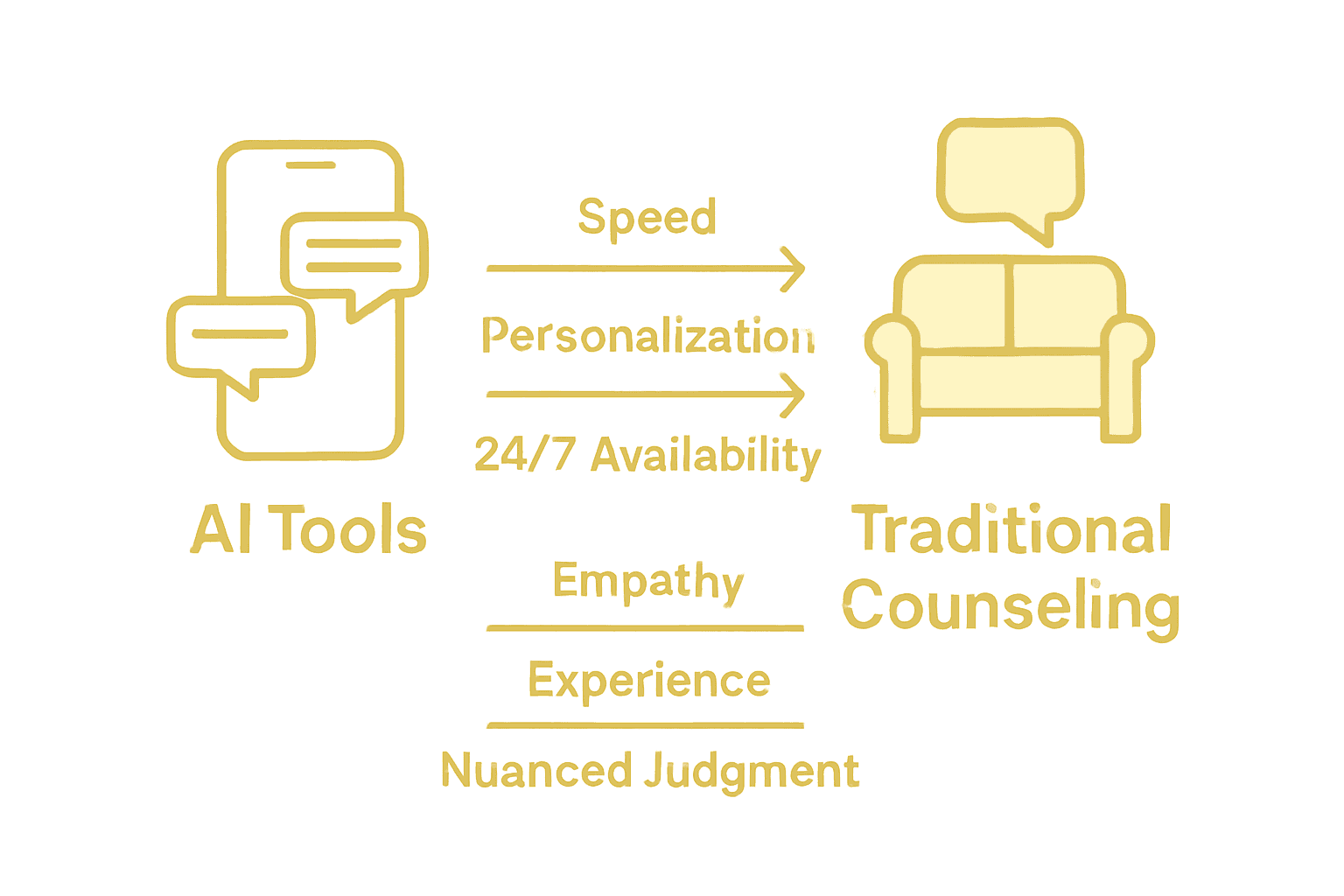
Here’s a comparison of AI vs. traditional relationship support approaches:
Aspect | AI Relationship Tools | Traditional Counseling |
|---|---|---|
Accessibility | 24/7, on-demand availability | Scheduled appointments required |
Personalization | Tailored using data patterns | Based on therapist’s experience |
Objectivity | Algorithm-driven, bias-free | Subject to human bias |
Communication Style | Focus on texts/chats, digital | Conversational, face-to-face |
Privacy Management | Digital confidentiality protocols | Human confidentiality policies |
Adaptability | Real-time feedback and updates | Slower to adapt to new info |
As technology continues evolving, AI relationship support will become increasingly sophisticated, offering more nuanced, empathetic, and contextually aware guidance. The future of relationship coaching lies in creating intelligent systems that understand human emotions with remarkable depth and sensitivity.
Addressing Privacy, Trust, and Misconceptions
AI relationship support technologies are transforming personal growth and emotional intelligence, but they also raise critical questions about privacy, emotional authenticity, and technological limitations. Users must navigate these emerging tools with nuanced understanding and realistic expectations about their capabilities and potential risks.
Research on AI relationship advice limitations reveals several important misconceptions about how these technologies function. While AI systems can provide valuable insights and guidance, they cannot replace genuine human emotional connections. Key concerns include potential bias reinforcement, where AI might inadvertently validate a user’s perspective without offering balanced perspectives, and the risk of emotional dependency on non-human interaction platforms.
Critical analysis of AI wisdom in relationships highlights significant technological constraints. AI algorithms struggle to comprehend the intricate emotional landscapes of human relationships, lacking the depth of empathy, cultural understanding, and nuanced interpretation that human counselors provide. Specific limitations include:
Emotional Complexity: Inability to fully grasp subtle emotional contexts
Cultural Sensitivity: Limited understanding of diverse relationship dynamics
Empathy Simulation: Simulating understanding without genuine emotional experience
Privacy Concerns: Potential data security and confidentiality risks
Pro Privacy Protection Tip: Always review the privacy policy of any AI relationship tool, understand data usage terms, and maintain healthy boundaries between technological support and personal emotional processing.
Understanding the Importance of Privacy in Family Chat Apps emphasizes the critical need for transparent data handling. While AI tools offer remarkable insights, they should be viewed as supplementary resources that complement, not replace, human emotional intelligence and professional counseling when complex relationship challenges emerge.
Elevate Your Relationship Conversations with Smarter AI Guidance
The article highlights common challenges such as emotional complexity, communication barriers, and the need for real-time, personalized support in relationships. If you find yourself seeking objective analysis combined with live emotion detection to better understand your interactions, Wisdom App offers a unique solution designed specifically to transform everyday chats into meaningful growth opportunities. By leveraging relationship superintelligence, strategic advice, and data-driven insights, Wisdom helps you navigate emotional subtleties and communication patterns much like the advanced AI coaching tools described.
Discover how the world’s first AI-powered emotional and relationship coach for WhatsApp can help you master smarter connections today. Start growing your emotional intelligence and relationship skills seamlessly inside your chats by signing in to Wisdom App now. Harness the power of a superintelligent AI agent that understands your unique relationships and responds with compassionate, expert guidance whenever you need it.
Frequently Asked Questions
How can AI improve communication in relationships?
AI can analyze communication patterns and provide personalized insights, helping partners understand each other better and navigate conflicts more effectively.
What types of AI tools are available for relationship support?
There are various AI tools such as individual emotional coaching, couple’s communication platforms, conflict resolution assistants, and compatibility analyzers that cater to different relationship needs.
Are AI relationship tools a substitute for human counseling?
While AI tools offer valuable insights and support, they should not replace human connections. They are best used as supplementary resources alongside traditional counseling when needed.
How does AI detect emotions during conversations?
AI uses natural language processing, sentiment analysis, and machine learning algorithms to interpret emotional cues from language, tone, and communication patterns, adjusting responses accordingly.
Recommended