Dec 10, 2025
Why Use AI for Relationships—Smarter Emotional Growth
AI emotional coach for relationships: Discover real-time guidance, privacy features, predictive insights, and how AI transforms emotional intelligence.

Why Use AI for Relationships—Smarter Emotional Growth
More than 40 percent of American adults say they wish they had better tools to handle emotional challenges in their relationships. With work, family, and digital distractions, developing real communication skills is often put on the back burner. AI emotional coaching introduces a new way to support personal growth by offering tailored, data-driven guidance. Discover how this technology is changing the way Americans build emotional intelligence while still honoring the importance of human connection.
Table of Contents
AI Emotional Coaching—What It Is and Isn’t
Core Features of AI Relationship Assistants
Personalized Guidance in Romantic and Family Ties
Privacy, Security, and Ethical Design in AI Apps
Comparing AI Support vs. Traditional Coaching
Real-World Impact: Success Stories and Limitations
Key Takeaways
Point | Details |
|---|---|
AI Emotional Coaching as a Supplement | AI emotional coaching enhances self-awareness and communication skills but is not a substitute for human interaction or professional mental health services. |
Advanced Emotional Intelligence | AI relationship assistants use sophisticated algorithms to detect emotional cues and provide personalized guidance, improving emotional dynamics in relationships. |
Ethical Considerations | Privacy and user consent are paramount in AI design, ensuring emotional safety and confidentiality during interactions. |
Accessibility and Cost-Effectiveness | AI coaching offers 24/7 access and unbiased feedback, making personalized emotional support more affordable and scalable compared to traditional coaching. |
AI Emotional Coaching—What It Is and Isn’t
AI emotional coaching represents an innovative approach to personal development that leverages artificial intelligence to provide personalized, adaptive emotional support and guidance. Unlike traditional therapy or counseling, AI emotional coaching uses advanced algorithms and machine learning to analyze communication patterns, detect emotional nuances, and offer strategic insights tailored to individual relationship dynamics.
At its core, AI emotional coaching is not a replacement for human connection or professional mental health services. Instead, it functions as a supplemental tool designed to enhance self awareness, improve communication skills, and provide immediate, judgment free feedback. Comprehensive insights into AI’s role in emotional growth reveal that these systems can help users recognize emotional patterns, understand interpersonal challenges, and develop more effective communication strategies.
The key distinction lies in how AI emotional coaches operate. These intelligent systems can process vast amounts of conversational data, identifying subtle emotional cues that humans might miss. They offer real time guidance without the limitations of human bias or scheduling constraints. However, they are not magical solutions that will solve all relationship challenges. Successful emotional growth still requires personal commitment, self reflection, and genuine human effort. AI serves as a powerful tool to accelerate and support this journey, providing data driven insights and personalized strategies for emotional intelligence development.
Effective AI emotional coaching involves several critical components:
Contextual emotion detection
Adaptive communication analysis
Strategic relationship insights
Personalized growth recommendations
Privacy protected interactions
Ultimately, AI emotional coaching represents a cutting edge approach to personal development that combines technological intelligence with deep psychological understanding.
Core Features of AI Relationship Assistants
AI relationship assistants have emerged as sophisticated digital companions designed to provide nuanced, personalized emotional support across various interpersonal contexts. Advanced conversational technologies enable these systems to go beyond simple chatbot interactions, leveraging complex algorithms that understand and respond to intricate emotional landscapes.

Researchers have identified critical design considerations for these intelligent systems, focusing on creating relationship-centered design approaches that prioritize emotional competence and relational specificity. The core technological objective is developing AI assistants that can detect subtle communication patterns, analyze emotional dynamics, and provide context-aware guidance without replacing human connections.
The most advanced AI relationship assistants incorporate multiple sophisticated features that distinguish them from traditional communication tools. Emotional intelligence algorithms enable these systems to process conversational nuances, detect underlying emotional states, and generate responsive, empathetic interactions. Key technological capabilities include:
Real-time emotion detection
Contextual communication analysis
Adaptive response generation
Personalized relationship strategy recommendations
Privacy-protected interaction frameworks
Ultimately, these AI relationship assistants represent a groundbreaking approach to digital emotional support, bridging technological intelligence with deep psychological understanding.
Personalized Guidance in Romantic and Family Ties
AI has revolutionized how we approach emotional guidance in romantic relationships and family dynamics, offering unprecedented levels of personalized support. Advanced relationship-centered design frameworks enable intelligent systems to provide nuanced insights that adapt to the unique emotional landscapes of different interpersonal connections.
In family contexts, AI assistants have demonstrated remarkable potential for enhancing emotional communication. Innovative research has shown how AI-supported parent-child interaction systems can dramatically improve emotional understanding and engagement. These intelligent platforms analyze communication patterns, detect underlying emotional states, and generate contextually appropriate guidance that supports healthier relationship dynamics.
The personalization capabilities of modern AI relationship assistants extend far beyond generic advice. Emotional intelligence algorithms enable these systems to:
Detect subtle communication nuances
Provide relationship-specific strategic recommendations
Offer real-time emotional support tailored to individual relationship contexts
Identify potential communication barriers
Generate adaptive interaction strategies
Ultimately, these AI-powered tools represent a transformative approach to relationship support, bridging technological intelligence with deep psychological understanding and providing individuals with unprecedented insights into their emotional connections.
Privacy, Security, and Ethical Design in AI Apps
Ethical AI design has become paramount in developing relationship support technologies, with a critical focus on protecting user privacy and emotional safety. Innovative research frameworks have established comprehensive guidelines that prioritize user protection while maintaining the integrity of technological interventions.
Advanced AI applications now integrate sophisticated privacy-aware emotional support mechanisms that respect individual boundaries and cultural sensitivities. These systems are designed with multiple layers of protection, ensuring that sensitive emotional interactions remain confidential and secure. Ethical design principles demand that AI relationship tools create safe digital environments where users can explore personal growth without compromising their privacy or emotional wellbeing.
Key ethical considerations in AI app development include:
Transparent data handling protocols
Robust encryption technologies
User consent and control mechanisms
Cultural sensitivity in emotional interpretation
Non-invasive interaction models
Strict confidentiality standards
Adaptive privacy settings
Ultimately, the future of AI relationship support hinges on maintaining a delicate balance between technological innovation and human dignity, ensuring that digital companions serve as trusted, respectful partners in personal emotional development.
Comparing AI Support vs. Traditional Coaching
The landscape of emotional support is transforming dramatically with the emergence of AI-powered coaching technologies. Advanced research on user engagement reveals that AI assistants are creating unique opportunities for emotional disclosure and personalized interaction that traditional coaching models struggle to match.
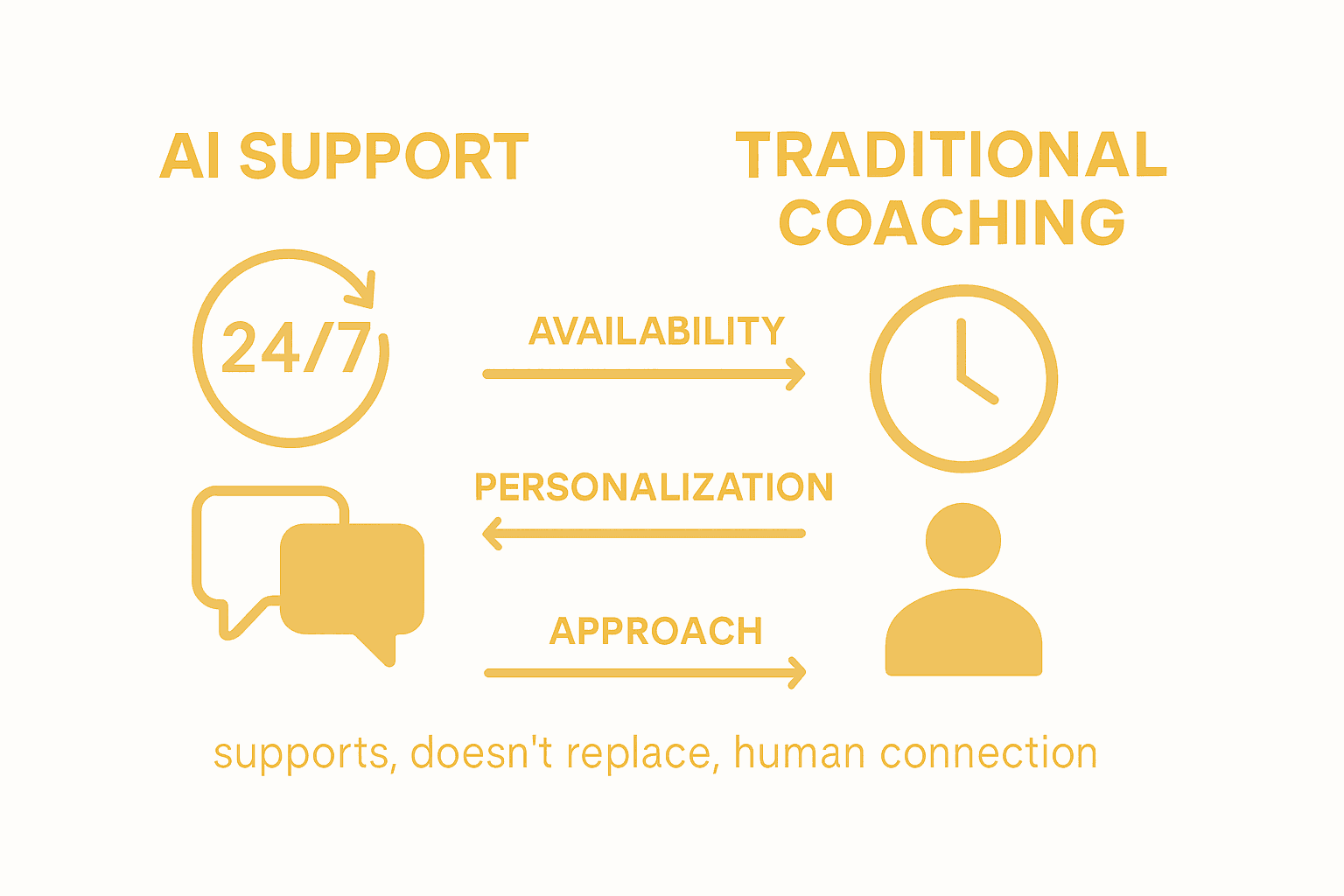
Technological intelligence introduces unprecedented advantages in emotional support delivery. While traditional coaches are limited by human constraints like scheduling, availability, and personal bias, AI systems provide instantaneous, non-judgmental, and consistently adaptive guidance. These digital companions can analyze communication patterns in real time, offering nuanced insights that might take human coaches multiple sessions to uncover.
Key differences between AI and traditional coaching include:
24/7 accessibility
Instant emotional pattern recognition
Data-driven personalization
Consistent, unbiased feedback
Privacy-protected interactions
Scalable support mechanisms
Cost-effective guidance
Ultimately, AI coaching represents not a replacement for human connection, but a powerful complementary tool that enhances personal growth, emotional intelligence, and self-awareness through technological innovation.
Real-World Impact: Success Stories and Limitations
AI emotional support technologies have demonstrated remarkable potential in transforming interpersonal communication and personal growth strategies. Innovative family interaction research reveals significant improvements in emotional engagement, with studies showing how AI systems can enhance communication dynamics across various relationship contexts.
Technological breakthroughs in emotional support have uncovered both profound successes and notable limitations. Privacy-aware psychological support systems demonstrate the nuanced capabilities of AI in providing non-intrusive, contextually intelligent guidance. However, these technologies are not infallible and require ongoing refinement to truly replicate the depth of human emotional intelligence.
Key observations from real-world AI emotional support implementations include:
Enhanced communication pattern recognition
Immediate, judgment-free feedback mechanisms
Personalized emotional growth strategies
Consistent availability and accessibility
Potential privacy and emotional complexity limitations
Supplemental rather than replacement support
Continuous learning and adaptation capabilities
Ultimately, AI emotional support represents a powerful technological frontier that bridges human vulnerability with intelligent, adaptive guidance, offering unprecedented opportunities for personal development while maintaining critical ethical and emotional boundaries.
Unlock Smarter Emotional Growth with AI Relationship Coaching
Navigating the complexities of love, family, and friendships can often feel overwhelming, especially when emotional patterns and communication barriers stand in the way. This article highlights the power of AI emotional coaching to detect subtle cues, provide real-time guidance, and deliver personalized strategies tailored to your unique relationships. If you are seeking to improve self-awareness and relationship management with adaptive, data-driven insights, embracing AI support is the next step toward meaningful, lasting growth.
Experience how the Wisdom App transforms everyday WhatsApp conversations into actionable emotional intelligence. As a superintelligent AI agent, Wisdom offers live emotion detection, context-aware advice, and privacy-first design—guiding you like a true emotional coach without the constraints of traditional methods. Discover why this AI life coach app is the future of relationship support with features such as:
Relationship superintelligence that adapts to each person you chat with
Strategic insights based on psychology and spiritual wisdom
Continuous, judgment-free emotional feedback to build smarter connections
Take control of your emotional wellbeing and relationship success today. Try the Wisdom App AI emotional coach now and join thousands who are growing smarter in love and life.
Start transforming your relationships right inside WhatsApp with the Wisdom App AI relationship coach. Don’t wait to experience the benefits of 24/7 personalized guidance that truly understands your emotional landscape. Visit Wisdomnow.co and begin your journey toward smarter emotional growth today.
Frequently Asked Questions
What is AI emotional coaching?
AI emotional coaching leverages artificial intelligence to provide personalized emotional support and guidance, helping users enhance self-awareness and communication skills through advanced algorithms.
How does AI emotional coaching differ from traditional therapy?
Unlike traditional therapy, AI emotional coaching offers immediate feedback and 24/7 accessibility, utilizing data-driven insights while not replacing human connection or professional mental health services.
What are the benefits of using AI for emotional growth in relationships?
AI provides personalized support tailored to individual relationship dynamics, detects emotional patterns in real time, and offers adaptive strategies for improving communication and emotional intelligence.
Are AI relationship assistants secure and private?
Yes, advanced AI relationship assistants integrate robust privacy and security measures, including transparent data handling and user consent protocols, ensuring interactions remain confidential and secure.
Recommended